QASED Non-government Research Organization
Note: You can download the PDF format of the report from here.
Preface
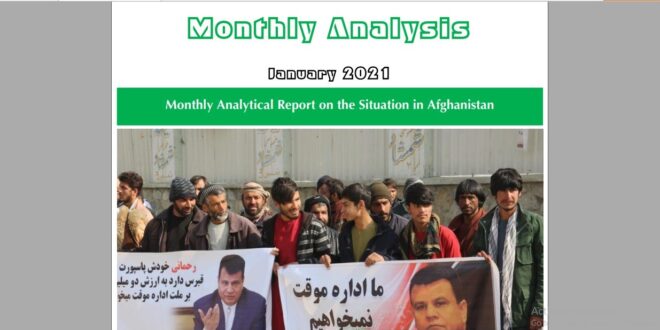
This report looks at the situation in Afghanistan in January 2021. On the political front, Rumors about a provisional government and the reaction of Afghan politicians and the government, and the continuing disagreements between the Wolesi Jirga (House of Representatives) and the government, have attracted a lot of attention this month. Also, the commencement of the second round of intra-Afghan peace talks and stalemate in the negotiations after the start of this round, taking office by Joe Biden in the United States and its impact on Afghan peace, and Taliban representatives’ visits to countries in the region were the key topics of the peace process in this month. On the security front, continued targeted killings, Taliban infiltration attacks and an increase in casualties among Afghan forces and the Taliban have been seen during this month. This report presents the warring parties and civilians’ casualty figures in January, relying mostly on government, Taliban, national and international organizations, and media sources. The details and analysis of these and other vital issues have been discussed in this report.
Political Situation
Rumors of an Interim Government
The idea of a caretaker or provisional government has been discussed by various political parties in recent years, and most peace activists believe that the success of the peace process is impossible without the establishment of an interim or caretaker government. But Afghan government officials, and President Ashraf Ghani in particular, have vehemently opposed the interim government, both during the National Unity Government (NUG) period as well as in the current period.
During January, the interim government discussion became a little hotter than before, and various parties, including President Ghani, have commented on this subject. For the first time in late January, Abbas Stanekzai, a member of a delegation from the Taliban’s political office, told a press conference in Moscow that the Afghan government is the main obstacle to peace. To achieve peace, he said this government must be overthrown and replaced by a government that is acceptable to all. He added that a “new Islamic government” should be established in Afghanistan based on the Doha Agreement. According to him, President Ashraf Ghani and some other government officials are currently obstructing the peace process, and if Ashraf Ghani wants to step down, they are ready to work with the new government.
The Afghan government vehemently denied the Taliban delegation’s statement in Moscow. Speaking at an online meeting of the Aspen Security Forum on January 29, President Ashraf Ghani denied claims by some politicians and Taliban officials that he is an obstacle to peace. He called himself a peace hero and accused the Taliban of having no intention of making peace in the country. President Ghani also rejected establishing an interim government, adding that the interim government leads to bloodshed. He also urged United States President Joe Biden’s new administration to step up pressure on the Taliban and not rush to withdraw more troops from Afghanistan. President Ghani also told CNN on January 9 that he is ready to hand over the power to only an elected government.
Rumors about an interim government surfaced after Khalilzad met with some Afghan politicians, except for President Ghani, during his recent visit to Afghanistan, and is said to have discussed the interim government. But the debate escalated after that the speaker of the Wolesi Jirga Mir Rahman Rahmani supported the establishment of an interim administration, as well as some other Afghan politicians. Rahmani’s remarks also drew sharp reactions. Even Maryam Sama, a member of the Wolesi Jirga, directly accused the speaker of taking orders from foreign countries. There were also protests in some provinces against the Wolesi Jirga speaker, condemning the interim government plan. But some politicians called the protesters government-hired.
Following the interim government’s rumours, a draft of a provisional government was also leaked to the media, the source of which is unknown. First Vice President Amrullah Saleh posted an article on his Facebook page calling the plan “destructive” and saying it was the same plan that the Pakistani military had prepared for Afghanistan in the 1990s. He said the sketch, dubbed the Joint Peace Government, was published from an unknown address. He said: “I have read this so-called sketch, which smells like a terrorist lobby, and is nothing more than a project to weaken and divide Afghanistan.” According to him, the distribution of power in this plan is complex and ambiguous, which divides the country into several parts. According to him, this plan will destroy the centrality of Afghanistan and the president will not be the first and competent person but will be transformed to a benevolent and powerless person. Mr. Saleh also said that under the plan, people would be forced to elect people as their representatives who had been nominated by the Taliban and other parties, and that they had no role in selecting them.
Earlier, in an audio clip attributed to Amin Ahmadi, a member of the Afghan government’s negotiating team, he said that the peace process in Afghanistan was meaningless without the formation of an interim government and that the international community had now concluded that president Ashraf Ghani must be removed from power.
The issue of the formation of an interim government is a contentious topic in the intra-Afghan negotiations, as the Taliban seems to be unwilling to accept the continuation of the current government, and at the same time the current government, the president in particular, is trying to complete his term in office. There are even analyses that the Afghan government is creating obstacles to intra-Afghan talks and prolonging the peace process.
Disagreements between the Wolesi Jirga and the Government
Over the past few months, distrust between the Wolesi Jirga and the government seems to be on the rise. Last December, several incidents led to disputes and mistrust between the Wolesi Jirga (House of Representatives) and the government. The first vice-president accused parliament members of corruption, prompting the Wolesi Jirga to suspend the vote of confidence in ministerial nominees for several days. Later, when the Wolesi Jirga did not give the vote of confidence to some ministerial nominees, especially female nominees, Afghanistan’s first lady, Rula Ghani, reacted by saying that the Wolesi Jirga has become a business ground. According to her, women ministers will remain in the office whether the Wolesi Jirga wants or not. Ms. Ghani’s remarks further fueled controversy between parliament and the government, calling it an insult to the Wolesi Jirga. These and other factors led the Wolesi Jirga to reject the government’s proposed budget for 1400 [solar year], calling it unbalanced.
On January 16, the Wolesi Jirga once again rejected the revised budget sent by the government. Wolesi Jirga Speaker Mir Rahman Rahmani said their proposals for amendments and reforms in the draft budget had not been considered. He specifically noted that their request to balance government employees’ salaries in the budget has not been considered.
In continuation of this mistrust between the Wolesi Jirga and the government, after that Hezb-e-Islami leader Gulbuddin Hekmatyar talked about the transfer of cash and gold abroad in uncrewed aerial vehicles, and later SIGAR in a report Reporting the smuggling of cash from Afghanistan, Wolesi Jirga Speaker Mir Rahman Rahmani also said that if corruption was such rampant, the Bactrian gold treasure could not be preserved. According to him, the gold treasure should be transferred to a reputable country as a safe deposit as soon as possible. Later, the Presidential Palace and the Ministry of Information and Culture said that the Bactrian gold treasure had been kept inside the country for a long time and there is no need to send it to other countries for safety.
The speaker’s remarks on the interim government have widened the gap between the Wolesi Jirga and the government. The Wolesi Jirga has also set up a 21-member committee to play a more active role in peace affairs, led by Wolesi Jirga Speaker Mir Rahman Rahmani. Mr. Rahmani said in the first meeting of the committee that the Wolesi Jirga should be involved in the peace process and that it should know which side is creating obstacles to the process.
Peace Process
The Second Round of Intra-Afghan talks
The second round of intra-Afghan talks resumed on January 6, and the two sides began initial discussions on setting the agenda for the negotiations. But after several initial meetings, the process was once again faced obstacles and delays, mainly due to taking office by Joe Biden as President of the United States on January 20.
The Afghan government’s negotiation team said in a tweet on January 6: “The second round of intra-Afghan talks began today with a preliminary meeting. It was decided that the teams designated by both sides would begin their work on Saturday to discuss the issues on the agenda.” Three days later, a meeting was held between the two negotiation teams to develop the negotiations’ agenda, but no clear progress was made, and it was only agreed that the meetings would continue. On January 17, the two negotiation teams’ heads met and discussed the negotiations’ agenda, but the discussions did not yield any apparent results.
Finally, on January 26, Nader Naderi, a member of the Afghan government’s negotiation team, announced in a tweet that the intra-Afghan negotiations are stalled. He said: “Peace and ending the violence are our people and government top priority. To achieve this noble goal, the Peace Negotiation Team of IRoA is committed and present in Doha. Since nine days, formal meetings are not held, and the other side is not willing to engage in talks to end the conflict and save lives.”
Following the disruption of peace talks between the Afghan government and the Taliban, the government’s negotiation team in Qatar met with various figures and parties to put pressure on the Taliban, including the leadership of the International Union of Muslim Scholars. The government’s negotiation team also held an online press conference in late January, outlining the negotiations’ status in Doha and urging the Taliban to come to the negotiation table.
Thus, although the second round of talks began in January, not only there was no visible progress in the negotiations, but the process once again stalled, the main reason of which is the US new government intention to review the US-Taliban agreement after taking office by Joe Biden in the US. Therefore, it seems that the continuation of the intra-Afghan talks is obviously dependent on the new US administration’s decision and if the Biden administration does not remain committed to the agreement reached with the Taliban, the intra-Afghan talks may also be cancelled.
Joe Biden Coming to Power in the US and Its Impact on Afghan Peace
Democratic candidate Joe Biden won the US presidential election of November 3, 2020. But rival candidate Donald Trump did not accept the election results and accused the election of widespread fraud. There were fears that Trump’s opposition could lead to a disputed election result and that power would not be transferred to the new president on January 20. On January 6, Trump supporters attacked the US Congress, causing casualties, which increased pressures on Trump, and the attack was widely condemned. Twitter suspended Trump’s account permanently, which had more than 80 million followers, and other social media networks also blocked his other social media accounts. That’s why Trump condemned his supporters’ attack on Congress on January 8, and for the first time acknowledged that there would be a regular transfer of power on January 20.
The US presidential election and the subsequent transfer of power to Biden on January 20 have had a direct impact on the Afghan peace process. The analysis is that the length and delay of the intra-Afghan talks are mostly because both sides were waiting for the new US administration’s decisions. The Taliban hopes that Biden’s administration will remain committed to the agreement reached with the Taliban, but the Afghan government expects Biden to rescind its agreement with the Taliban and reverse its decision to withdraw its troops from Afghanistan.
On January 17, US Special Representative for Afghan Peace Zalmai Khalilzad and General Scott Miller, commander of NATO forces in Afghanistan, met with the Taliban’s political deputy in Qatar and the head of the Qatar office of Taliban. Releasing the remaining prisoners of the Taliban and removing their leaders’ names from blacklist were among the issues discussed and stressed at the meeting. Khalilzad and Miller’s visit to Qatar just days before Biden’s taking office in the US showed that the US-Taliban agreement might remain in place with the transfer of power in the United States.
However, Biden has extended the mandate of US Special Representative for Afghan Peace Zalmai Khalilzad for now, which mostly demonstrates the Biden administration’s commitment to the US-Taliban agreement. But in late January, some issues raised doubts about the US-Taliban agreement’s fate.
The Biden administration said on January 23 that it is reviewing the US agreement with the Taliban. The Afghan government welcomed the US intention to review the agreement; however, the Taliban became concerned about the new US administration’s stance and, therefore, this might have contributed to their disengagement in the intra-Afghan peace negotiations.
The Taliban on January 27 vehemently denied a report by the US Treasury Department that there are still members of al-Qaeda in Afghanistan. The Taliban said in a statement that there are no foreign fighters in Afghanistan at the moment and that such reports are based on those who saw their interests in the war. The Taliban reiterated that they are fully committed to the Doha Agreement and will not allow anyone to use Afghan soil against others.
Two days later, on January 29, the Taliban again denied a report by the US Department of Defense that the Taliban had not complied with the Doha Agreement. The Taliban said in a statement that they are strongly committed to all the provisions of the Doha Agreement and called on the United States to abide by it.
However, before January 20, the US-Taliban agreement was being implemented. On January 15, the Pentagon confirmed that the number of US troops in Afghanistan had been reduced to 2500, the lowest number of US troops in Afghanistan since 2001. But if the US-Taliban agreement is rescinded by the new US administration or becomes in somewhat ambiguous status, it seems that intra-Afghan talks will also be cancelled and the Taliban will once again push for war.
Taliban Visits to Regional Countries
The second round of intra-Afghan talks began two weeks before taking office by the United States’ new president. There has been no progress in the negotiations over these two weeks, and when the new US administration called for a review of the agreement with the Taliban, the Taliban stopped the negotiations and started trips to regional countries to put pressure on the United States.
On January 27, a delegation from the Taliban’s political office, led by Mullah Baradar, travelled to Iran, where they met with Ali Shamkhani, secretary of the Supreme National Security Council (SNSC), and other senior Iranian officials. On January 31, Mullah Baradar met with Iranian Foreign Minister Jawad Zarif. The meetings focused on intra-Afghan talks and security and stability in Afghanistan and the region.
One day after the Taliban delegation’s visit to Iran, another Taliban delegation arrived in Moscow on January 28, where they met with Russia’s special envoy to Afghanistan, Zamir Kabulov, and other officials at the Russian Foreign Ministry. They also discussed intra-Afghan negotiations and the implementation of the Doha Agreement.
Besides that, On January 21, Mullah Baradar also met with Chinese Ambassador to Doha Zhou Jian in Doha to discuss the full implementation of the US-Taliban agreement and intra-Afghan talks. Also, following the Taliban delegation’s visits to Moscow and Iran, a Taliban delegation led by Mullah Baradar travelled to Turkmenistan to discuss various issues, including the Afghan peace process, with Turkmen officials.
Most of the analyses are that one of the main reasons for the US readiness to negotiate with the Taliban in 2018 was the Taliban’s expanding relations with countries in the region, especially with US rivals such as Russia, Iran and China. The United States feared that Afghanistan’s war would be further complicated by these countries ties and cooperation with the Taliban. It now appears that the Taliban are worried about the fate of the Doha Agreement and are trying to persuade the United States that if the agreement is rescinded, the Taliban also have other options.
On the other hand, the Afghan government is trying to gain regional and global support. The Afghan government is currently working hard to persuade the new US administration to stop withdrawing its troops from Afghanistan and continue to support the Afghan government.
Security Situation
The first month of 2021 started again with bloody wars and casualties in the country. According to a report by the Afghan Independent Human Rights Commission (AIHRC), at least 8500 civilians were killed or injured in the conflict in 2020. Based on the report, an average of eight civilians are killed every day as a result of the ongoing war. However, according to the report, there was a 21 percent reduction in civilian casualties compared to 2019.
Although there were no major attacks or major explosions in big cities by the Taliban during January, the death toll was slightly higher than it was in December. The persistence of violence in the country still had reactions nationally and internationally. In late January, the US Embassy in Kabul, the European Union, the diplomatic missions of Australia, Canada, the Czech Republic, Denmark, Finland, France, Germany and Italy, and some other foreign organizations issued a joint statement. They condemned the ongoing violence in Afghanistan and called on the Taliban to renounce violence and show their commitment to peace. The statement said that the Taliban are continuing to unreasonable fight, killing civilians and destroying public places. However, the Taliban issued a statement in response, calling the allegations baseless and calling themselves the perpetrators of Afghanistan’s ongoing tragedy.
Targeted Killings
During January, as in the previous month, a series of targeted killings took place across the country, in which civilians, civil society activists, religious scholars, tribal elders and journalists were targeted and killed.
The number of targeted killings has increased during the month, but only the deaths of celebrities have been reported in the media. On January 1, a local radio station manager in Ghor province was killed in an attack by gunmen, but no one claimed responsibility.
On January 7, a military pilot was killed in an attack by unknown gunmen in the 5th District of Kabul city. On January 17, two female judges were killed in an attack by unknown gunmen in the Qala-e-Fathullah area of Kabul city. There have also been such targeted killings during the month, with the perpetrators of such attacks on civilians, in particular, are unknown. The Afghan government blames the attacks on the Taliban. However, the Taliban has denied targeting civilians, blaming the Afghan government and saying that government-linked groups are carrying out such attacks for the Taliban’s bad reputation.
Given these attacks’ ambiguous and complex nature, many celebrities, who do not have enough resources to protect themselves, have become concerned about their security. Therefore, many political figures, journalists and civil society activists have left the country in January, but many are reluctant to share information with the media.
Taliban’s Infiltration Attacks
Several incidents of infiltration by the Taliban were also recorded during January. The Taliban’s infiltration attacks have been high in the past year, but there have been no such attacks in recent months. These attacks have also resulted in heavy casualties for Afghan forces this month.
On January 4, nine policemen of the special police unit were killed in an attack of a Taliban infiltrator in Arghandab district of Kandahar province. One day later, on January 5, seven Afghan soldiers were killed in an attack by a Taliban infiltrator in Ghazni. On January 8, in Balkh province, five Afghan soldiers were killed after being poisoned by a Taliban infiltrator. Also, on January 15, a Taliban infiltrator killed 13 local police officers at a police outpost in the Ghorian district of Herat province.
Major Security Incidents
There were no major security incidents in January, especially in the big cities. But some Afghan government airstrikes have resulted in heavy civilian casualties. There were also high casualties among Afghan forces in some Taliban attacks.
On January 6, five civilians were killed and five others were wounded in a bombardment by Afghan forces in Lashkar Gah, Helmand province. A few days later, on January 9, Afghan forces bombed civilian homes in the Khashrod district of Nimroz province, killing at least 18 civilians, including 11 children and three women, and injuring several others. However, as usual, the Afghan government appointed a delegation to investigate the incident, but the results have not been announced yet as usual. After the incident, the Nimroz governor said that the bombing had killed 12 Taliban fighters, which angered the victims’ families, who brought their relatives’ bodies to Zaranj, the capital of Nimroz province, in a protest to see who have been killed in the bombardment.
On the other hand, Taliban attacks in Baghlan and Kunduz provinces were bloody and in Kunduz province alone, 50 Afghan soldiers were killed in a few incidents during this month. On January 14, nine Afghan soldiers were killed in a Taliban attack in Pul-e-Khumri, Baghlan province’s capital. Four days later again, on January 18, at least nine Afghan soldiers were killed and several others wounded in a Taliban attack in Pul-e-Khumri.
At least 14 Afghan soldiers were killed and several others wounded in a Taliban attack on an outpost in the northern city of Kunduz on January 7. Ten Afghan soldiers were also killed in a Taliban attack on an Afghan security outpost in the Imam Sahib district of Kunduz province on January 15. Similarly, 17 Afghan soldiers were killed and three others wounded in a Taliban attack on an Afghan military base in the Dasht-e-Archi district of Kunduz province on January 19. On the same day, eight Afghan soldiers were killed in a Taliban attack on a security outpost in Kunduz city.
On the other hand, the Taliban also have suffered heavy casualties in air and ground attacks by Afghan forces. But the Taliban’s casualty figures, which provide exaggerated figures, have not been confirmed by any third party. On January 6, at least 33 Taliban fighters were killed and several others were wounded during an operation by Afghan forces in the Arghandab district of Kandahar. Four days later, on January 10, the Afghan Ministry of Defense said in a statement that it had killed 23 other Taliban fighters in an operation in the same district. According to another Defense Ministry statement, 17 Taliban fighters, including a commander, were killed and several others wounded in airstrikes in Helmand province on the same day. The Afghan Ministry of Defense released reports of similar incidents and heavy casualties to the Taliban in January, but the Taliban usually do not confirm their casualties.
Casualties
According to the casualty figures compiled by Qased Strategic Research Center, 1017 people were killed or injured during the first month of 2021, including 645 dead and 372 others wounded. According to the report figures, the Taliban, government forces and civilians, were witnessed more casualties respectively. (Table 1).
The death toll from war in January shows that the casualty rate is slightly higher than the previous month (December). In December, 837 people have been killed or injured (503 of them were killed and 334 others were injured), but the figures in January show the death toll has risen again. The number of civilian casualties is lower than last month, but the number of Afghan forces and Taliban casualties has increased again.
QASED Strategic Research Center, as a war casualties’ monitoring organization in the country, calls on both sides of the conflict to immediately pave the way for a permanent ceasefire and stop the ongoing bloodshed in the country.
Table-1: Total Casualties of War and Security Incidents (January 2021)
| Name | Killed | Name | Wounded |
| Afghan Forces | 253 | Afghan Forces | 119 |
| Anti-government Militants | 306 | Anti-government Militants | 156 |
| Civilians | 86 | Civilians | 97 |
| Foreign Forces | – | Foreign Forces | – |
| Total | 645 | Total | 372 |
| Total Casualties 1017 | |||
The end