QASED Non-government Research Organization
Note: You can download the PDF format of the report from here.
Preface
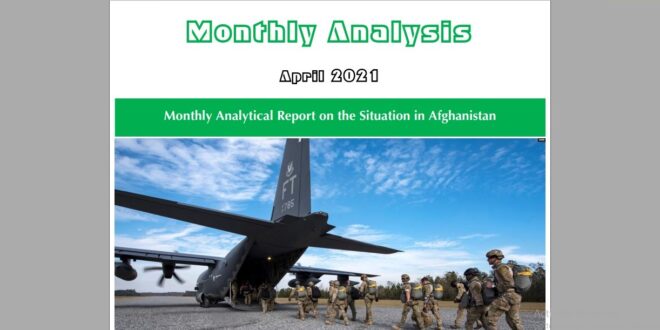
This report provides an analysis and evaluation of the country’s political and security situation during April 2021. The most important political development of this month was the announcement of the U.S. withdrawal from Afghanistan after 20-year presence in the country, which is set to be completed by September 2021. On the eve of the withdrawal of foreign troops from Afghanistan, peace efforts have also intensified but so far have not yielded clear results. The intra-Afghan talks in Doha have been stalled since January, and the Afghan leaders were engaged with discussions about the new peace plans and the planned conference in Istanbul. The Istanbul conference was scheduled to take place in April but was postponed due to the Taliban’s opposition to attending, and no date has been set yet for the meeting. This month, meanwhile, was bloodier for Afghans than previous months, and the casualty figures of the warring parties and civilians show a sharp increase this month. In this analytical report, you would read the details and analysis of these and other important issues.
Political Situation
U.S. Complete Withdrawal from Afghanistan
In mid-April, the Biden’s administration decided to withdraw its troops from Afghanistan by September 2021, contrary to some expectations inside Afghanistan, especially on the Afghan government side. After January 2021, it was assumed that the new U.S. president might extend his country’s military presence in Afghanistan, as he had ordered a review of the U.S. peace agreement with the Taliban. The U.S. decision for review of the agreement was faced with different reactions, especially from the Afghan government, which also resulted in stalling the intra-Afghan talks in Doha. But on the other hand, the Taliban, besides numerous trips to countries in the region, especially to U.S. rivals, published an open letter to the American people, calling on the new U.S. administration to abide by the agreement between the U.S. and the Taliban.
In March, Biden’s administration’s decision on the U.S. long war in Afghanistan became clear to a large extent, especially after that the U.S. Secretary of State sent a letter to Afghan leaders. Finally, on April 14, U.S. President Joe Biden announced that the withdrawal of U.S. troops from Afghanistan would begin on May 1 and will be completed before 9/11. Two weeks after the announcement, he told the U.S. Congress, referring to the war in Afghanistan, that U.S. forces had achieved their goal by killing Osama bin Laden.
The U.S. decision also faced various reactions on the international level. In its statement on the announcement of U.S. withdrawal from Afghanistan, the Russian Federation called the NATO mission in Afghanistan a failure. However, the Afghan government called it an opportunity for peace because, according to Afghan government officials, the Taliban would not have any excuse to continue the war under the name of “jihad”, but the decision raised concerns about the future situation of the country. The Taliban called it a violation of the Doha agreement. The Taliban said in a statement that the months-long delay in the withdrawal of foreign troops from Afghanistan is a clear violation of the Doha agreement and called on countries and organizations present at the signing of the agreement to put pressures on the United States to withdraw all troops from Afghanistan by May 1. The Taliban said, violating the agreement would have consequences for the United States. However, Mr. Biden warned the Taliban when announcing the withdrawal of their forces by September: “The Taliban must know that if they attack us when we leave, we will defend ourselves and our partners with all the means at our disposal.” This statement meant that the delay in withdrawal is a violation of the agreement and that the risk of attacks on foreigners had increased. With the U.S. decision, the North Atlantic Treaty Organization (NATO) also said in a joint statement that their forces would withdraw from Afghanistan with U.S. forces, saying that since there is no military solution to the Afghan issue, international troops would withdraw from Afghanistan within a few months. They further said in the statement that they would complete their withdrawal in few months, but if the Taliban attacked international forces during this period, they would face a strong response.
Before announcing the complete withdrawal from Afghanistan, the United States sought to conclude the intra-Afghan talks through a conference in Turkey before the agreed withdrawal date (May 1), but after the Taliban opposed attendance at the conference, the U.S. announced its complete withdrawal from Afghanistan by September. Hours after the complete withdrawal’s announcement, the Taliban said they would not participate in any conference discussing the country’s future until the complete withdrawal of international troops from Afghanistan.
It seems that this unconditional withdrawal from Afghanistan has also changed the position of the Taliban. The Taliban used to try to force the Afghan government to hand over power to an interim administration, but now there are reports that the Taliban are thinking of seizing power militarily, raising concerns at the national and international levels. In their statement, the Taliban stressed the need to establish a “pure Islamic system”, and until this goal is achieved, they will not give up the fight. Abdul Hakim Haqqani, a member of the Taliban’s negotiating team, leading the group’s delegation in Moscow conference last month, also said at the conference that they would fight against any other regime other than an Islamic one.
A day after the announcement, U.S. Secretary of State Antony Blinken arrived in Kabul on an unannounced visit and met with the President of Afghanistan and the Chairman of the High Council for National Reconciliation (HCNR) to reaffirm the United States’ continued cooperation and commitment to the Government of Afghanistan. The Afghan government is also focusing all its efforts on continuing U.S. financial support for Afghan forces.
However, with the announcement of the full unconditional withdrawal of foreign troops from Afghanistan, there are concerns of escalating violence and civil war after the withdrawal. Therefore, some analysts do not consider this withdrawal a “responsible withdrawal” from the country because the intra-Afghan talks have not concluded so far, and there are serious concerns about civil war. The international community is also skeptical about the security situation in Afghanistan. The U.S. State Department issued a statement on April 27 urging non-essential staff at its embassy in Kabul to leave Afghanistan due to the growing security threats. This statement was a warning of the deteriorating security situation in Afghanistan after May 1.
The ongoing US-led NATO war in Afghanistan began in 2001, following the 9/11 attacks. During these 20 years, according to official figures, more than 2300 US troops were killed and more than 20000 others were wounded in Afghanistan. But the war has taken heavy casualties on the Afghan side. However, there are no exact statistics on the casualties of civilians, Afghan forces, and the Taliban in this war, but the statistics of some periods and years published by local and international agencies show that tens of thousands of Afghans have been killed or wounded in this war every year. According to President Ghani, 45000 Afghan soldiers were killed only during the National Unity Government (NUG). In addition, the current war has had devastating effects on other sectors.
Peace Process
The Intra-Afghan peace negotiations, which have been underway in Qatar for several months, have seen no progress so far. The process came to a complete halt with the announcement of the Istanbul conference and the U.S. decision to withdraw its troops from Afghanistan. During April, peace discussions mainly focused on peace plans and the formation of an interim government at the Istanbul conference, and the fate of the Doha peace negotiation process was unclear.
Peace Plans
Discussions on peace plans took place after the United States presented a new plan for reconciliation between the Afghan government and the Taliban, as well as the formation of an interim government. Although it was supposed that after the U.S. plan for peace in Afghanistan, the Afghan parties would present a comprehensive and acceptable plan for all sides, but most of these efforts also focused on the U.S. plan.
The High Council for National Reconciliation (HCNR) announced earlier this month that it had received about 30 draft peace plans and after their unification, the council would prepare a single and comprehensive plan which would reflect the demands of all Afghans. But the plan, released by the HCNR on April 11, is essentially the same as the U.S. plan, with few changes. These changes, mostly based on President Ghani’s plan and some other views, have led to a contradictory document.
President Ghani also officially announced his plan for peace in the country on April 7 and explained it in a meeting at the presidential palace. President Ghani’s plan emphasizes preserving the Constitution and transferring power through elections. In the meeting convened for this purpose at the presidential palace, he said that maintaining the republic system is a priority for him, but he is ready to step down. The plan has three main parts: early elections, the peace government and the Loya Jirga, which, according to President Ghani, he is willing not to run in the early elections.
For this reason, there were criticisms of the lack of a unified position on the part of the Afghan government. During a visit to Kabul on April 10, the U.S. Special Representative for Afghanistan Reconciliation Zalmay Khalilzad said that the world expects the Afghan government to participate in the Istanbul conference with a single and unified peace plan. On the other hand, Sarwar Danesh, the second vice president, criticized the draft peace plans prepared by the HCNR, saying that the plan presented by this council has serious deficiencies and President Ghani’s plan has also been treated improperly.
Meanwhile, considering the demands of presenting their plan for peace and the future system of Afghanistan, the Taliban only published a paper on their website discussing their desired Islamic system for the country. The article emphasizes that the Taliban do not want a system and democracy in which the president’s job is to protect Washington’s interests and foreign officials enter the country without prior notice. According to this article, the Taliban want a system in which a murderer is retaliated against, an adulterer is punished, a thief and bribe-taker are punished, and the suffered people are freed from injustice. Overall, this article is a general discussion about the Islamic system desired by the Taliban and does not specify the details and characteristics of such a system.
Istanbul Conference
The intra-Afghan meeting planned to be held in Istanbul, Turkey, is a part of the U.S. proposed plan for peace in Afghanistan. As the time approached for Washington to withdraw its forces from Afghanistan, Washington proposed the peace plan and the formation of an interim administration with the Afghan parties and invited them to discuss the plan at the Istanbul conference to urgently address the country’s future system and reach a conclusion. The choice of Turkey for this meeting was also a precise and appropriate choice because Turkey, on the one hand, has close relations with both sides (the government and the Taliban) and, on the other hand, has a good position in the Islamic world.
The meeting was initially scheduled for April 16, but the Taliban did not express their position about the meeting and waited for the United States to announce the withdrawal or non-withdrawal of troops under the Doha agreement. For this reason, after the Taliban refused to attend the meeting two days before the conference date, the U.S. President announced a timely withdrawal of his troops from Afghanistan. With this announcement, the Taliban reacted relatively sharply than before. A few hours after President Biden’s speech, they issued a statement saying that they would not participate in any conference discussing Afghanistan’s future until the complete withdrawal of foreign troops from the country.
Despite the opposition of the Taliban, April 24 was announced as the date for the conference by the Turkish government for the second time, but due to the decision of the Taliban not to participate in the meeting, the meeting was postponed until after Eid-ul-Fitr. However, the meeting does not seem to take place before the decision of the Taliban for participation. According to some sources, the Taliban have set conditions for attending the meeting. The removal of Taliban leaders from the U.N. Security Council’s blacklist and the release of 7000 of the group’s prisoners under the Doha agreement is the Taliban’s condition for participation in the meeting. However, some analysts believe that the Taliban may not agree to participate in the meeting until they are sure of its outcome.
Security Situation
Although efforts for peace between the Taliban and the Afghan government intensified in April, this month was bloodier than previous months for both Afghan sides and civilians. Overall, civilians suffer the most casualties from the ongoing war in the country. UNAMA said in a report on April 14 that in the first three months of this year, about 1790 civilians were killed due to the ongoing war in Afghanistan, of which 573 were killed and 1210 were injured, showing a 29 percent increase compared to the first three months of last year. According to a recent study by the Afghan Independent Human Rights Commission (AIHRC) published on April 17, more than 31000 civilians have been killed and 62000 others injured since the beginning of 2009. With the deadline for the complete withdrawal of foreign troops from Afghanistan under the Doha Agreement, the security situation in the country has become bloodier and deteriorating. That is why different countries have asked their citizens to leave Afghanistan. For example, on April 22, Britain warned all British citizens to leave Afghanistan. The British government has said in a statement to its citizens that they should not travel to places other than safe areas and Hamid Karzai International Airport.
Targeted Killings
As the past few months, targeted killings also continued in April, killing most civilians, including media and civil society activists, but neither side claimed responsibility for the killings. Meanwhile, Human Rights Watch (HRW) said the Taliban are deliberately targeting journalists and media workers, including women. A report released by HRW on April 12 states that attacks on journalists across Afghanistan have risen sharply since the start of the “Afghan-Afghan” peace talks in Doha, raising concerns about freedom of expression and freedom of media in the peace process. Reporters Without Borders (RSF) reported on April 20 that Afghanistan ranks 122nd out of 180 countries in the 2021 World Press Freedom Index and remains the deadliest country for journalists.
Bloody Security Incidents
April also saw bloody security incidents that increased the death toll of Afghan forces, Taliban and civilians compared to previous months. Dozens of Afghan soldiers have been reported killed in most incidents this month. On the other hand, Taliban casualties have also been reported dozens in each incident.
On the other hand, this month we also witnessed bloody incidents of civilian casualties of a mysterious nature. For example, on April 18, at least eight members of a family were shot dead by gunmen in Jalalabad in Nangarhar province.
On the last day of April, a heavy explosion in Logar province killed at least 30 people and injured about 100 others. No group has claimed responsibility for the attack, but Afghan government officials have blamed the Taliban.
Casualties
According to the casualty figures compiled by QASED Strategic Research Center, 1493 people were killed or wounded during April 2021, including 942 dead and 551 others injured. According to the report figures, the Taliban fighters, government forces, and civilians have suffered more casualties, respectively. (Table 1).
The death toll of war casualties in April shows that the number of casualties this month has increased significantly compared to the previous month (March). In March, a total of 1371 people were killed or wounded (848 were killed and 523 others were wounded).
QASED Strategic Research Center, as a war casualties’ monitoring organization in the country, emphasizes that the escalation of war would only result in an increase in Afghan casualties. Therefore, while the foreign forces are leaving the country, the warring parties should take responsibility for the available opportunity for peace in the country and end the bloody war through dialogue.
Table-1: Total Casualties of War and Security Incidents
| Name | Killed | Name | Wounded |
| Afghan Forces | 332 | Afghan Forces | 239 |
| Anti-government Militants | 512 | Anti-government Militants | 198 |
| Civilians | 98 | Civilians | 114 |
| Foreign Forces | – | Foreign Forces | – |
| Total | 942 | Total | 551 |
| Total Casualties 1493 | |||
The end