QASED Non-government Research Organization
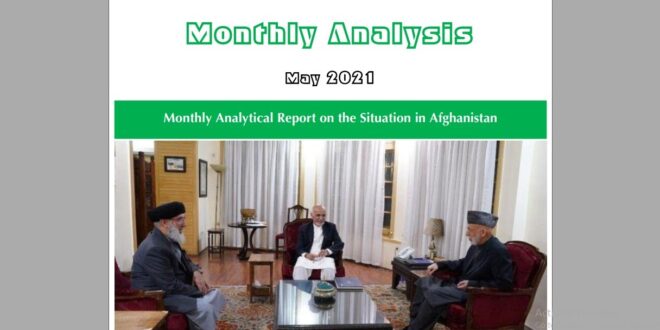
Note: You can download the PDF format of the report from here.
Preface
This report presents an analysis and an overview of the country’s political and security situation during May 2021. The most important political happenings in this month were the beginning of the complete withdrawal of foreign forces from the country and the consequent widespread concerns over the deteriorating political and security situation in the country, political disagreements within the government, and efforts to build national consensus for major national issues. On the other hand, this month, unfortunately, not only has there been no apparent progress in the peace process, but the pessimism about peace has increased nationally and internationally. On the security front, although there was a three-day ceasefire by the warring parties during the three days of Eid al-Fitr, overall it was a bloody month for the parties involved and civilians, with a high casualty rate compared to the past nearly one year, and many districts have fallen to the Taliban. Besides reviewing the country’s political situation and peace efforts, this report presents casualty figures of the warring parties and civilians occurred during this month, mainly relying on government, Taliban, national and international organizations and media sources. The details and analysis of these and other important issues are discussed in the report.
Political Situation
There have been several important developments in the country’s political landscape in May (2021). The complete withdrawal of foreign forces from Afghanistan began on the first day of this month. At the same time, national and international concerns about the situation in Afghanistan have increased, as the security situation in the country has deteriorated remarkably. On the other hand, one year has passed since the signing of the political agreement among government leaders, but there are still internal political differences, and there have been a number of incidents this month that show deep internal disagreements. Besides that, the Afghan government has been working harder than ever to build a political consensus for future decisions about the country’s major issues, but has yet to reach a conclusion by the end of this month. Here we take a quick look at the political situation in the country in May.
The Beginning of Foreign Forces’ Complete withdrawal
With the beginning of May, the complete withdrawal of foreign troops from Afghanistan also began, and in the first step, US forces officially handed over a military base in Helmand province to Afghan forces on May 2. In the first step, supposedly all foreign forces will move from small bases to large bases like Bagram and then move from large bases to their home countries. In late May, logistics for the handover of Bagram Air Base to Afghan forces also began. On May 31, some sources told the media that the Bagram military base would be officially handed over to Afghan forces within two weeks. Bagram has been the center of foreign forces’ command and air operations for the past two decades, as the US presidents have always stayed at the base during their visits to Afghanistan in the past two decades. There is also the famous Bagram prison at the same air and military base, which has already been handed over to the Afghan government.
The withdrawal of all foreign troops from Afghanistan began with the decision by US President Joe Biden, which is set to be completed by 9/11 this year. The date is four months after the date specified in Doha agreement between the United States and the Taliban. That is why the Taliban said in a statement that the “violation” of the date specified in Doha Agreement for the withdrawal of foreign troops from Afghanistan, paved the way for their “every appropriate action” against foreign forces. The Taliban statement said the Taliban fighters are awaiting the decision from their leaders on possible action against foreign forces. Although there has been a possibility of Taliban attacks on foreign forces after May 1, there have been no incidents of attacks on foreign forces during this month.
With this, the country’s security situation mostly deteriorated during May, raising concerns about the situation in Afghanistan at the national and international levels. “Although the Afghan army is well-trained, the future of Afghanistan is not predictable,” US Army Chief of Staff General Mark Milley said in an interview on May 3. Former Secretary of State Hillary Clinton also expressed concern over the situation in Afghanistan, saying Mr. Biden’s plan to withdraw US troops could have “dire consequences”. According to her, the decision has increased the risk of the Afghan government falling into the hands of the Taliban.
At the same time, the international community is committed to continuing to support the Afghan government. US Secretary of State Antony Blinken said in early May that withdrawing troops did not mean leaving Afghanistan and that they are ready for any scenario. NATO Secretary-General Anders Fogh Rasmussen has also said that NATO will continue to provide financial assistance to Afghan security forces, including advice, training and security at Kabul International Airport.
Overall, the beginning of the complete withdrawal of foreign troops has raised concerns about the future political and security situation in the country, and there are fears of a worsening situation and bloody civil war and even the fall of the government. However, there are still hopes that the peace talks will succeed and that the parties involved will soften their stance against each other. But if the peace process does not succeed, the chance of political and security instability is very high.
Political Disagreements
While the complete withdrawal of foreign troops began on May 1, the security situation in the country deteriorated and the internal political disagreements intensified once again.
The internal political differences coincide with the passage of one year since the signing of the political agreement to form the current government on May 17, 2020. The political agreement put an end to the political turmoil over the results of the 2019 presidential election, and it was expected that it would end the political disagreements within the government. But the past year has proved that the government is still facing serious internal political disagreements.
One of the biggest political dispute in the past year was over the appointment and dismissal of government officials. Last month, when President Ghani fired Interior Minister Masoud Andarabi and replaced him with Hayatullah Hayat, as acting minister for the ministry, Dr. Abdullah Abdullah, chairman of the High Council for National Reconciliation (HCNR), reacted sharply to the president’s move, called it an action without consultation and against the political agreement.
In the latest case, the president fired the governor of Faryab and replaced him with a new governor. However, the president’s move drew a backlash from supporters of Marshal Dostum in Faryab province. Armed protesters in the province closed the doors of government offices in the province, including Faryab governor’s office and other government agencies, forcing the new governor of Faryab to take over as governor on May 17 in a military battalion. But opposition to the new governor dragged on, and the government was eventually forced to recall the new governor of Faryab, who was later appointed as governor of Ghazni.
The controversy over the Faryab governor’s appointment has further complicated the political situation in the country, with various politicians commenting on it and the government’s political partners accusing even the president of dictatorship. Generally, the internal political differences have had a profound effect on the overall situation in the country, and as a result, the peace process has not yet reached a positive conclusion. In addition to peace and war, governance, and especially the fight against corruption, is also affected by these political differences.
Efforts for Strengthening National Consensus
The lack of consensus among politicians and political parties within the country has largely led to the growing political and security instability in the country, on the one hand, and the lack of significant progress in the peace process, on the other hand. The country’s political leaders are not only in agreement on major political issues, but also the disagreements between them have cast a negative shadow over various other sectors.
In May, there were reports that the government is working to set up a “High State Council” soon to build national consensus on major political issues. However, the government has not officially commented, but according to some sources, the council will have 15 to 25 members, four of whom are women. Discussions on the council did not yield positive results until the end of May, and there were reports of internal disagreements over the composition of the council. Hafiz Mansoor, a member of the government negotiating team, said at a meeting that the president wants to introduce his colleagues as members of the council under the guise of influential figures in the country.
The need for consultation with influential political figures on major national issues is greater than ever. Until now, all parties have had relied on the decisions of the international community, especially the United States, regarding peace and the future of Afghanistan, but after the announcement of foreign forces’ complete withdrawal, President Ashraf Ghani himself has repeatedly said that his government will no longer need foreign advice on key issues.
Despite these efforts, internal disagreements among the country’s politicians seem to be deep and even agreement on a structure, which aims at resolving these differences and building national consensus on major national issues may not be easy.
Peace Process
Over the past few months, the Afghan peace process has seen rapid changes. Before the announcement of the complete withdrawal of foreign forces from Afghanistan, it was believed that some parties were obstructing the peace talks and trying to delay the process in order to pave the way for an extension of the presence of foreign forces in Afghanistan. But with the US President’s announcement of the complete withdrawal of troops in April, concerns have been raised that the current opportunity for peace is being lost and that the government’s armed opposition might be relying on military pressure instead of peace talks. There have also been signs of a lack of willingness on both sides to move the peace process forward during May.
Intra-Afghan Negotiations and the Proposed Istanbul Conference
Given that the intra-Afghan talks in Doha, which have been underway for the past nine months, have not yielded any positive results, hopes have been raised for the outcome of a decisive meeting of the intra-Afghan talks in Istanbul last April. But those hopes were dashed when the Taliban refused to participate.
It was supposed that the parties involved in the Afghan issue would come to a certain conclusion on the future of Afghanistan at the Istanbul Conference. This was the United States’ plan to conclude the intra-Afghan talks before the agreed date for the withdrawal of its forces, and for them to declare a responsible end to the Afghan war.
In addition to the Taliban’s opposition to the Istanbul Conference plan, there was also some opposition on the part of the Afghan government and a lack of consensus on a peace plan for the conference. These were the key reasons why the conference has not been held despite specific dates announced for holding the conference.
In late May, some Taliban sources told the media that the Taliban are ready to attend the Istanbul Conference conditionally. According to the source, Taliban representatives will attend the meeting in Istanbul if the meeting does not last longer than three days; the agenda does not include decision-making on key issues; and also, the Taliban presence would be at low level.
However, the Taliban’s conditions for participating in the Istanbul Conference show that they do not want to be forced to make important decisions about the country’s future under foreign interference. But at the same time, it has raised concerns on the Afghan side that the Taliban are considering overthrowing the government and a military solution after the complete withdrawal of foreign forces.
Taliban Leader’s Eid Message
The Taliban also accused the United States and the Afghan government of challenging the peace process, saying the United States had violated the Doha Agreement. The message cited delays in the release of prisoners, the removal of the group’s leaders from the UN sanction list, and the postponement of the withdrawal deadline as examples of such violations. But both the United States and the Afghan government have repeatedly accused the Taliban of escalating violence and failing to honor the agreement.
However, there is still a hint of softness in the Taliban leader’s eid message. In his message, the Taliban leader reiterated his call for a negotiated settlement for the Afghan conflict and called on his opponents to stop fighting. The message said that after the complete withdrawal of foreign troops, an inclusive Islamic system would be formed in which all segments would see themselves. But the Afghan government has reiterated that the Taliban are reluctant to negotiate peace and instead seek to gain power through war.
Both sides blame each other for the failure of peace efforts and thus hostile language is still being used between the two sides. A few days ago, Amir Khan Muttaqi, a Taliban leader, also accused the government in an audio statement that the government is looking for excuses to delay peace talks. The Taliban also said in a statement on May 5 that a major obstacle to peace in the country is that some of their leaders are still on “sanctions” and “reward” lists.” The statement added that in the presence of such lists, it is difficult to build trust between the parties involved in the Afghan issue. Therefore, a climate of trust is urgently needed for peace efforts to succeed, but neither side has taken significant steps.
Eid Ceasefire
The only trust-building measure taken by the two sides in recent years is a three-day ceasefire during the Eid holidays. For the first time in 2018, both sides declared a three-day ceasefire in Eid-al-Fitr, which was widely welcomed across the country, with fighters from both sides moving into each other’s controlled areas. Although a three-day ceasefire was observed during Eid in later years, the Taliban did not allow their fighters to enter areas under the control of the government after the first ceasefire, as there have been limited incidents of violence as well. The ceasefire in Eid days played a vital role in building trust.
This year, the Taliban again announced a three-day ceasefire during Eid-al-Fitr on May 10. But the Afghan government’s response was colder than in the past. “We are aware of the Taliban ceasefire, but the Afghan people’s emphasis is on a real and permanent ceasefire,” the president’s office said in response to the Taliban ceasefire.
The Taliban were called nationally and internationally to extend the ceasefire, but the Taliban denied the allegations, saying they had no plans to extend the ceasefire. According to them, the ceasefire announced for Eid is only for the general public. A Taliban spokesman told the media: “We are still at war, we do not want war, but the government is not sincerely participating in the peace talks, the talks have not progressed.” However, there were hopes that the Eid ceasefire would be effective in strengthening trust. But this year’s Eid ceasefire did not have much of an effect on building trust than in previous years.
Security Situation
During the month of May, however, there was a ceasefire between the parties involved during Eid days, but at the same time, this month was also full of bloody security incidents and violence as the death toll for both sides and civilians was higher compared to the past several months. Unlike the past 14 months, the Taliban targeted provincial capitals and several districts have fell to them. One of the main reasons for the deteriorating security situation was the May 1st deadline for the complete withdrawal of foreign troops from Afghanistan under the US-Taliban agreement, while they have not yet fully withdrawn from the country, and therefore, violence was likely to escalate.
Due to this situation, Australia closed its embassy in Kabul. The Australian government said in a statement on May 25 that it had made the decision because of the ‘increasingly uncertain security environment’ in Kabul. The Australian embassy in Kabul also issued a statement announcing its closure, but said it hoped the decision to close the embassy in Kabul would be short-lived and that they would resume permanent work once the situation improved. The Australian embassy is in one of the safest areas in the capital, Kabul, and the Taliban have also assured all foreign diplomats, journalists and staff of humanitarian services and organizations that their safety is secure.
Widespread Attacks and Fall of the Districts
There were reports of bloody and widespread attacks in several provinces during May. Earlier this month, the Taliban carried out large-scale raids in Baghlan, Helmand and Kandahar provinces, and even there were reports of a possible fall of Helmand province to the Taliban. Also, in Laghman province, armed clashes reached the outskirts of the provincial capital. “The militants entered Mehtarlam city. The last belt of the city towards Alingar was also broken and now there is fighting around the prison,” the provincial council chief told the media on May 23.
However, no province fell to the Taliban in this wave of violence during the month of May, but many districts have fallen to the Taliban. The fall of Dawlat Shah district of Laghman, Narkh and Jalrez districts of Maidan Wardak and Burka district of Baghlan province has been confirmed. Besides that, there were conflicting reports about the fall of some other districts, with the government either talking of a tactical retreat or a temporary transfer of the district to other areas. These districts include Charkh district in Logar, Arghistan district in Kandahar, Farsi district in Herat and some other districts.
Bloody Incidents
While widespread reactions and condemnation of the deadly attack in Logar in the last days of April continued, another deadly attack took place in Kabul on May 8, killing dozens of children and injuring dozens more, which also raised national and international reactions. The attack took place in front of Sayed al-Shuhada school in the western part of Kabul city as students were leaving the school. According to some reports, about 85 people were killed and 147 others were injured in the attack. But according to the New York Times, about 90 people were killed and more than 240 others were injured in the attack. However, the president’s office said in a statement that the Taliban were responsible for the attack, but the Taliban issued a statement condemning the incident and denying any involvement. President Ghani also declared a day of general mourning for the attacks in Logar and Kabul.
Besides that, there have been a number of incidents in which dozens of people have been killed in each incident. For example, on May 14, a bomb exploded at a mosque during Friday prayers in the Shakardara district of Kabul province, killing at least 12 people, including the Mullah Imam of the mosque, and injuring more than 15 others. ISIS claimed responsibility for the attack, but the Taliban issued a statement accusing the government of being involved in such attacks. Also, on May 10, a bomb blast in the Shahr-e-Safa district of Zabul killed 11 people and injured 25 others.
Afghan forces also suffered heavy casualties in such bloody incidents. For example, on May 3, at least 20 Afghan soldiers were killed in a Taliban attack in the Bala Buluk district of Farah province. On the same day, in Lashkar Gah city of Helmand province, the Taliban took control of 18 outposts of the Afghan forces, killing and wounding 18 Afghan soldiers. On May 8, a car bomb attack on a military base in the Sayed Abad district of Wardak province killed 12 Afghan soldiers and wounded several others. A day earlier, on May 7, at least 11 soldiers were killed in a Taliban attack on a military base in the provincial capital of Ghazni.
In addition to civilians and Afghan forces, the Taliban have also suffered heavy casualties in a number of attacks, with the highest number of casualties being in airstrikes. Overall, these were bloody incidents that led to a sharp rise in the number of Taliban, Afghan forces and civilian casualties this month.
An important piece of news in this widespread wave of violence was that on May 12, Mullah Abdul Manan Niazi, the deputy leader of a splinter group of the Taliban, was first wounded in a clash with the Taliban, and was taken to Herat Regional Hospital but later reportedly died at a hospital in Kabul.
Targeted Killings
However, the number of targeted killings was also higher in May as it was in previous months, but as violence escalated this month, the incidents did not attract much attention. In Kandahar, for instance, on May 6, a former TOLOnews journalist and current media affairs director of the Ministry of Finance was killed in a targeted attack, in which the Taliban denied involvement. A Taliban spokesman said in a statement that the Finance Ministry officials are being targeted in Kandahar because of corruption in customs and those trying to prevent it are being killed.
The media and journalists were also threatened this month by the Taliban and Afghanistan’s National Directorate of Security (NDS). The head of the NDS said in a secret session of the Wolesi Jirga (house of representative) that the actions of some journalists and analysts in favor of the Taliban are intolerable. At the same time, the Taliban has warned that journalists should be held accountable for spreading false information and for lack of impartiality. Due to the targeted killings of journalists, which coincide with World Press Freedom Day on May 3, the United States, the United Nations and the European Union announced their support for the Afghan media on the occasion of World Press Freedom Day. They called for an end to the ongoing violence against journalists.
Casualties
According to the casualty figures compiled by QASED Strategic Research Center, 2282 people were killed or wounded during May 2021, including 1179 dead and 1103 others injured. According to the report figures, the Taliban fighters, government forces, and civilians have suffered more casualties, respectively. (Table 1).
The death toll of both sides and civilians in May shows that the number of casualties this month was higher compared to the past several months. In April, a total of 1493 people were killed or wounded (942 were killed and 551 others were wounded). But the figures in May show a sharp rise in casualties on both sides of the conflict as well as civilians.
QASED Strategic Research Center, as a war casualties’ monitoring organization in the country, once again urges all parties to the conflict to end the ongoing violence and prioritize peace and reconciliation rather than focusing on the battlefield.
Table-1: Total Casualties of War and Security Incidents
| Name | Killed | Name | Wounded |
| Afghan Forces | 411 | Afghan Forces | 294 |
| Anti-government Militants | 502 | Anti-government Militants | 288 |
| Civilians | 266 | Civilians | 521 |
| Foreign Forces | – | Foreign Forces | – |
| Total | 1179 | Total | 1103 |
|
Total Casualties 2282 |
|||
The end