QASED Non-government Research Organization
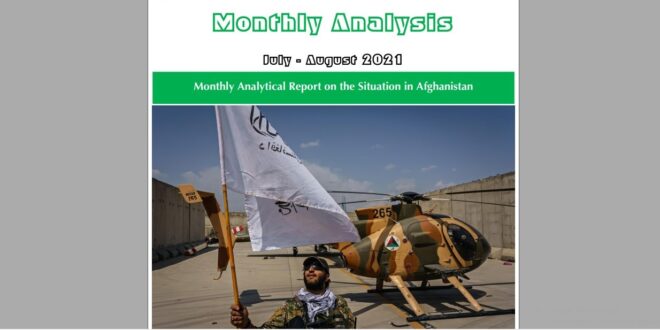
Note: You can download the PDF format of the report from here.
Introduction
This report provides an overview of the overall political and security situation during July and August 2021 in Afghanistan. We witnessed great and historic changes during these two months in terms of all the political, security, economic and social situations in the country. The Afghan peace process also ended with the completion of the withdrawal of foreign troops, the overthrow of the government and the military victory of the Taliban. The Taliban captured most of the country’s districts in July, and all provinces except Panjshir in a ten-day period from August 6 to 15. On August 15, most of the former government officials, including President Ghani, fled the country, disbanding the Afghan government despite the presence of about 300,000 security forces before the full withdrawal of foreign troops. With the arrival of the Taliban in Kabul, the Kabul airport remained under the control of US forces until the end of August, and the US-led operation to evacuate foreigners and Afghans from the airport was underway till August 31. The report looks at the overall situation in the country as well as the casualty figures of the warring parties and civilians occurred during July and August. The details and analysis of these and other important issues are discussed in the report.
Political Situation
July and August were the most crucial and decisive months for Afghanistan in the political arena. Since the beginning of July, the process of the complete withdrawal of foreign troops from Afghanistan has been mostly completed, particularly, they have evacuated their largest military and air base (Bagram). The Taliban also stepped up their attacks on the government, but during this month they focused only on capturing districts. Since the beginning of August, they have been trying to take over major cities from Afghan forces, and Nimroz was the first province to be completely taken over by the Taliban on August 6. Since then, there have been daily reports of the fall of the provinces by the Taliban, and finally they entered Kabul on August 15 without facing any resistance, and the Afghan government was completely dissolved.
July Developments
The political situation in the country in July was still affected by the complete withdrawal of foreign troops from the country and many political developments revolved around this issue. The withdrawal of foreign troops from Afghanistan in the first days of this month was almost complete. On July 2, US forces completely withdrew from Bagram, their major military and air base in Afghanistan, handing over the base to the Afghan government. The Afghan Ministry of Defense acknowledged on July 2 that US forces had completely withdrawn from the base. Bagram Air Base has been used by foreign forces for the past 20 years as a central command base, and the withdrawal from the airbase meant that US forces’ presence in areas other than the US Embassy in Afghanistan has ended. The withdrawal process of other countries’ forces was also completed earlier this month. On July 1, for instance, all Italian troops withdrew from Herat province. However, the formal withdrawal of foreign troops from Afghanistan was not officially announced until the end of this month, and according to the earlier US announcement, the withdrawal of foreign troops was scheduled to be completed by 9/11.
With the withdrawal of foreign troops approaching, this month has been a difficult one for the Afghan government. Following the withdrawal of foreign troops, the Taliban stepped up their attacks, taking control of about 200 districts by the end of this month, and launching attacks on provincial capitals. By the end of this month, bloody battles were raging between the two sides in various provinces, particularly in Herat, Helmand and Kandahar. With the deteriorating security situation in Afghanistan, there has been an international outcry over the withdrawal of Americans. But US President Joe Biden on July 9 defended the decision to withdraw his troops from Afghanistan, saying he is not ready to send another generation of Americans to fight there. “We did not go to Afghanistan for nation building. It’s just the right and responsibility of Afghans to decide their own future.”
Despite the rapid change in the general situation in the country, the Afghan government stood firm in its fight against the Taliban and insisted that it had no plans to surrender to the Taliban. President Ghani told a gathering in Kabul on July 29 that he would not bow to plans made abroad and turn Afghanistan into a battlefield. President Ghani did not elaborate on the details of the plan, but the Taliban had previously said they had shared a plan for Afghan peace with Afghan officials a few months ago.
The Taliban’s widespread offensive this month was also led to national consensus among Afghan politicians, and besides the president and the chairman of the High Council for National Reconciliation (HCNR), other prominent Afghan political figures have also seen in some consultative meetings. The United States and the international community have also sought to boost the Afghan government’s morale. That is why in late July, US forces launched several airstrikes on the Taliban in Kandahar and Helmand, and a Taliban spokesman acknowledged that their fighters had been killed or wounded in these attacks. Gen. Kenneth McKenzie, commander of the US Central Command or CENTCOM, said in the wake of the attacks on July 26 that they would continue airstrikes in support of Afghan forces. In addition, with the escalation of Taliban attacks, the international community has repeatedly stated that it will not recognize a government that has come to power by force in Afghanistan.
August Developments
The month of August witnessed very sudden and unexpected changes in the country. This transition was so rapid and was unexpected by the international community as well as Afghans, including the Taliban and the Afghan government. This month, the government led by President Ghani was overthrown in all its splendor in a matter of days, and the Taliban took control of all of Afghanistan.
The Afghan government made a concerted effort in early August to incite the general population against the Taliban and defeat them through public uprisings. In a speech to a joint session of parliament on August 2, President Ghani reiterated the need for war and called on MPs to take part in mobilizing the people against the Taliban. He said, “We will not let the Akora Khattak madrassa determine the future of Afghanistan”. He added that the security situation in the country would change in six months. There were also protests on August 4 in several cities across the country, chanting “Allah Akbar”, mostly organized by the government.
The Afghan government’s efforts on the battlefield, and in particular the public uprisings policy, were finally failed, and the Taliban captured the provincial capital of Nimroz from Afghan forces on August 6, and Afghan forces were unable to retake the city from the Taliban. Thus, Nimroz became the first province to come under the complete control of the Taliban. On the same day, Sheberghan, the capital of Jawzjan province in the north of the country, also fell to the Taliban and they entered General Dostum’s palace in the city. Pictures surfaced on social media of a Taliban fighter wearing the military uniform of Marshal Dostum. This was the biggest defeat for the public uprising against the Taliban, as the uprisings in the north relied heavily on Dostum and his supporters, but Dostum’s militias could not save even his own house from the Taliban.
On August 8, the capital of the strategic province of Kunduz in the north, as well as the provincial capital of Sar-e-Pul, fell to the Taliban. Just hours later, the provincial capital of Takhar fell to the Taliban and government forces fled. Following the fall of these provinces, the Taliban issued a statement urging government officials and Afghan forces in all provinces to stop fighting. However, resistance to the Taliban continued in other provinces.
From August 9 to 12, one or two provinces fell to the Taliban every day. On August 9, the Taliban captured Aibak city, the capital of Samangan province. On August 10, the capital of Farah province and Pul-e-Khumri, the capital of Baghlan province, fell to the Taliban. On August 11, Badakhshan province fell to the Taliban without casualties and government forces fled the provincial capital. On August 12, Ghazni province fell to the Taliban after a light battle. The governor was arrested on his way to Kabul by the National Directorate of Security (NDS) Forces in Maidan Wardak on charges of dealing with the Taliban, and later the Afghan Air Force bombed Ghazni city, causing extensive casualties. Late on the same day, the most important and strategic province in the western part of the country (Herat) was also captured by the Taliban and the jihadi commander there, Mohammad Ismail Khan, surrendered to the Taliban. Also, Qala-e-Naw city, the capital of Badghis province, fell to the Taliban that night.
On August 13, the fall of provincial capitals accelerated, and in just one day, six more provinces fell to the Taliban. Kandahar and Helmand provinces, which had witnessed bloody clashes compared to other provinces, were captured by the Taliban on August 13. The Taliban also captured Pul-e-Alam city, the capital of Logar province, Ferozkoh, the capital of Ghor province, Tirinkot, the capital of Uruzgan province, and Qalat city, the capital of Zabul province, during the day. With this, in just one week, 18 provinces fell to the Taliban.
On August 14, six more provinces fell to the Taliban. Sharana, the capital of Paktika province, Gardez, the capital of Paktia province, Asadabad, the capital of Kunar province, Mehtarlam, the capital of Laghman province, Maimana, the capital of Faryab province, and Mazar-e-Sharif, the capital of Balkh province were the provinces that fell out of the control of the government during the day.
On August 15, the day of the total collapse of the Afghan government, the Taliban captured eight provinces. Nilli city, the capital of Daykundi Province, Maidan Wardak, the capital of Maidan Wardak Province, Mahmood Raqi, the Capital of Kapisa Province, Charikar, the Capital of Parwan Province, Khost City, the Capital of Khost Province, Bamyan City, the Capital of Bamyan Province, and two provinces in the east of the country; Jalalabad, the capital of Nangarhar Province, and Paroon, the capital of Nuristan province were the provinces fell to the Taliban during this day. The Taliban also seized Bagram airbase, the biggest military base in the past 20 years.
The fighting came to a halt at the gates of Kabul, and the Taliban issued a statement on the afternoon of August 15, saying they had ordered their forces to refrain from entering Kabul city because Kabul is a densely populated city and they do not intend to enter Kabul through war. In the afternoon of the same day, however, the Taliban issued another statement saying that government forces had evacuated all districts of Kabul city, and therefore, they ordered their forces to enter Kabul to prevent burglary. Thus, the whole country except Panjshir province came under the control of the Taliban and with the fall of the provincial capitals, the remaining districts of all provinces also fell to the Taliban one after the other.
On the afternoon of August 15, the news of President Ashraf Ghani’s departure from the country was also circulated in the media. The chairman of the High Council for National Reconciliation (HCNR), Dr. Abdullah, used the “former president” title for Ashraf Ghani in a video message and confirmed his departure from the country. Ashraf Ghani also said in a message through his Facebook page from an undisclosed location late on August 15 that he had left the country to prevent the destruction of Kabul city. He conceded defeat to the Taliban but challenged the Taliban to gain legitimacy. With Ashraf Ghani’s departure, he was also accused of embezzling 169 million in cash. But he denied the allegations in a video message from the United Arab Emirates on August 18, saying he was consulting on returning to the country.
On August 17, Taliban spokesman Zabihullah Mujahid appeared at his first press conference at the government’s media center, declaring an end to the war in the country. Contrary to existing concerns, the Taliban refrained from retaliating against government military and civilian officials and announced a general amnesty for all Afghans fighting them, and this has largely allayed public concerns, but since Western countries, particularly the United States, Britain and Canada, have announced the evacuation of Afghans without official documents, thousands of Afghans have been stranded at airports to reach out to western countries. Kabul airport remained with US forces until the end of August, and the irregular process of evacuating foreigners and Afghans from the country caused the situation at the airport to spiral out of control and thousands of Afghans flocked to the airport gates. This situation at the airport also enabled ISIS to carry out two deadly bombings on August 26 that killed 13 US soldiers and more than 170 civilians. But some media outlets later reported that many civilians had been shot dead by foreign forces after the blast.
On August 31, the last US soldier, Chris Donahue, flew out of Afghanistan on the last flight, ending the 20-year US-led war in Afghanistan. In two weeks, about 123,000 Afghans and foreigners have been evacuated to the western countries in this evacuation operation. The Taliban fighters fired shots of joy in the air at the airport in the middle of the night, celebrating the country’s complete independence from the Americans, as they celebrated the country’s complete independence at a gathering in Kabul on the afternoon of August 31.
Panjshir province, on the other hand, did not come under Taliban control by the end of this month. The Taliban have said they do not want to seize Panjshir through war, but if the issue is not resolved peacefully, they will seize the province by force. Therefore, by the end of August, efforts were being made to find a peaceful solution to the Panjshir issue and talks were underway between the two sides. But given the demands of both sides, the prevailing analysis is that Panjshir will inevitably witness bloody battles and will fall to the Taliban with heavy casualties. The main reason for erupting war in Panjshir would be the former vice president Amrullah Saleh, who may not be willing to join or surrender to the Taliban under any title or deal.
Peace Process
Peace efforts to end Afghanistan’s 20-year long war have also ended with the complete withdrawal of US troops and the Taliban’s military victory. This process, which has been going on for almost a decade, has entered a critical phase in the last two years. The Taliban first negotiated with the US and after a year and a half of negotiations signed the Doha Agreement, which resulted in the complete withdrawal of foreign troops from the country. Inter-Afghan talks then began, but during the inter-Afghan talks, all opportunities for reconciliation were largely wasted by the government side, and eventually the Afghan peace process ended with the dissolution of the government and the Taliban’s entry into Kabul.
July Developments
The first high-level face-to-face meeting between the Afghan government officials and the Taliban took place in July. However, the intra-Afghan negotiation process did not make much progress, rather both sides were focusing on the battlefield.
A high-level Afghan government delegation led by Dr. Abdullah Abdullah, Chairman of the High Council for National Reconciliation, traveled to Doha on July 16, where they met with Taliban representatives, including Mullah Abdul Ghani Baradar, the Taliban’s political deputy and head of the Qatar office. It was hoped that at this meeting the two sides would make progress in the talks and at least agree on a ceasefire on the eve of Eid al-Adha. But things did not go as planned. During the meeting, the two sides stressed on flexibility and reaching a political agreement. But after the meeting, both sides returned to their war literature, and President Ashraf Ghani, in particular, told a cabinet meeting at the Presidential Palace that according to his plan the situation would improve in the next six months. He further said, “We want peace, but the Taleban want surrender.”
That is why in July, not only there was no visible progress in the peace talks, but the propaganda war between the two sides intensified. Government agencies have begun efforts to prevent news broadcasts in favor of the Taliban, and in one case, four journalists were arrested in Kandahar. The NDS later said in a statement that the journalists were spreading propaganda in favor of the Taliban and they would not allow such journalistic activities. The reporters had gone to Kandahar after the Taliban captured Spin Boldak and interviewed Taliban leaders.
On the other hand, members of the Taliban’s Qatar office traveled to three countries in the region, one of which was to meet with representatives of the Afghan government. In the first week of July, a delegation from the group traveled to Tehran, where they met with an Afghan government delegation in the presence of Iranian officials. The Afghan government delegation was led by former Vice President Yunus Qanooni and the Taliban delegation was led by Abbas Stanekzai. After the meeting, the said in a joint statement, “War is not the solution and the focus should be on political reconciliation.” At the meeting, both sides presented their views on the future system, details of which were not shared with the media, but Dr Abdullah told the BBC in an interview before leaving for Doha that the meeting in Tehran made clear many things about the Taliban’s thinking on elections and leadership, and their position on the roadmap between the present and the future.
In the run-up to the intra-Afghan meeting in Tehran, another high-ranking Taliban delegation traveled to Moscow, where they held a press conference on July 10 after discussions with Russian officials about the peace process and the situation in the country. In his remarks, Mawlawi Shahabuddin Delawar, a member of the Taliban’s Qatar office, said: “If the Taliban want, they can bring the whole of Afghanistan under their control in two weeks.”
Also on July 28, a nine-member delegation from the Taliban’s political office in Qatar paid a two-day visit to China, where they met with the country’s foreign minister and other officials. The Chinese Foreign Ministry said in a statement that Mr Wang had told the Taliban during the meeting that they hoped the group would play a “significant role” in “ending the ongoing war” and “rebuilding” Afghanistan.
The situation following the withdrawal of foreign troops in July and the Taliban’s advances on the battlefield were expected to lead the government to reconcile with the Taliban instead of focusing on the war, but contrary to expectations, they did not and thus the last chance for peace was also wasted.
August Developments
The developments in August showed that all parties involved in the Afghan peace process had failed and that a military takeover had finally led to the overthrow of the government. Ashraf Ghani also acknowledged in a video message after fleeing the country that the failure of the peace process was a political leadership failure of the government, the Taliban and the international community. After the fall of Kabul, US President Joe Biden said that he had told President Ghani to make peace with the Taliban, but he had told him that the Taliban would be defeated through war. According to him, President Ghani lied to him.
Various evidences before and after the fall of the government showed that there was no political will to make the peace process a success, but that the process was just a waste of time. Therefore, the analysis now is that if the Taliban had not taken control of the entire country by force, the peace process between the government and the Taliban might not have come to an end and the war would have continued.
Following the Taliban’s military victory, many members of the Taliban’s Qatar political office, where they were negotiating with the Afghan government, including the head of the office Mullah Abdul Ghani Baradar, the Taliban’s political deputy, flew from Doha to Kandahar on August 17. With this, the peace process between the government and the Taliban finally came to an end.
Security Situation
July and August have been bloody months for Afghans. In July, the Taliban stepped up their attacks and toppled dozens of districts, but did not attempt to seize provincial capitals until the end of the month. August was the last month of fighting between the government and the Taliban, and in the middle of the month, the Afghan government suffered a crushing defeat to the Taliban. That’s why the number of Taliban and Afghan forces killed and wounded in August was lower than in July, when the Afghan government fell in the middle of the month and the Taliban captured most of the cities without fighting or after little resistance. But civilian casualties were even higher in August, partly due to a deadly ISIS bombing at Kabul airport on August 26. August was also the first month in nearly two years that US troops have been killed or wounded. But by the end of the month, the main cause of the Afghan war (the presence of foreign troops) had disappeared.
Fall of Districts and Provinces
Every moment in July and August witnessed a change in the battlefield. Most of the districts were reported to have been captured by the Taliban in July, and several provincial capitals were attacked by the Taliban later in the month. These provinces were Badghis, Helmand, Herat and Kandahar, but the Taliban were unable to enter those cities at the time. But in August, a series of provincial collapses began, with several provinces falling each day. This situation was shocking to Afghans and the international community, which resulted in the fall of the whole of Afghanistan to the Taliban in 10 days and the disbanding of the Afghan government with hundreds of thousands of troops.
Intense Process of Warfare
Since the beginning of July, the fighting has intensified across the country, and even on the day of Eid al-Adha (July 22), rockets were fired at the Presidential Palace during Eid prayers. During July, government forces claimed to have recaptured some districts, but these claims were largely untrue and the government focused on retaining provincial capitals. On July 22, US Army Chief of Staff General Mark A. Milley also said that the Taliban are controlling about 200 district centers and now trying to separate populated areas from each other.
Tens of thousands of people from across the country have fled to Kabul since the fall of the provinces in August, and the public perception was that other provinces might fall to the Taliban, but that Kabul could not easily fall to them.
The International Committee of the Red Cross (ICRC) said on July 21 that the escalation of violence in Afghanistan over the past few months has had a devastating effect on civilians. ICRC said in a statement that it had helped nearly 50,000 people injured in the first six months of this year. They had cited Mirwais Hospital in Kandahar as an example, where 2366 injured people were registered in the first half of this year.
The United Nations Assistance Mission in Afghanistan (UNAMA) also said on July 26 that civilian casualties had risen to an all-time high in the first six months of 2021, especially with the withdrawal of foreign troops and an increase in Taliban attacks. UNAMA said in its report that 5183 civilians had been killed or wounded (1659 killed, 3254 wounded) in 2021 so far in the conflict which presents an increase of 47 percent over the same period last year. But the Afghan Independent Human Rights Commission (AIHRC) said in a report on August 1 that civilian casualties had risen by 80 percent.
On August 4, the Taliban also carried out a bloody attack on the guest house of the acting defense minister in Kabul, killing at least 10 people and wounding more than 20 others, but the defense minister and his family were not harmed. On August 6, the Taliban assassinated Dawakhan Minapal, a former presidential spokesman and head of the government’s media center, in an attack in Kabul.
Casualties
According to the casualty figures compiled by QASED Strategic Research Center, 1912 civilians were killed or wounded during July 2021, including 1018 dead and 894 others injured. According to the report figures, the Taliban fighters, government forces, and civilians have suffered more casualties, respectively. (Table 1).
In August, as the fighting lasted until mid-August and the Afghan government collapsed on August 15, the death toll showed a slight decline. A total of 1654 people were killed or wounded this month, including 931 killed and 723 others injured. For the first time this month, the number of Taliban casualties was low, but the number of Afghan forces and civilians was high again, due to fighting for control of cities and deadly bombings at Kabul airport. On 3 August alone, 20 civilians were killed and 189 others were wounded in a bombardment by Afghan forces in Lashkar Gah, the capital of Helmand province. (Table 2).
Table-1: Total Casualties of War and Security Incidents (July 2021)
| Name | Killed | Name | Wounded |
| Afghan Forces | 355 | Afghan Forces | 225 |
| Anti-government Militants | 453 | Anti-government Militants | 193 |
| Civilians | 210 | Civilians | 476 |
| Foreign Forces | – | Foreign Forces | – |
| Total | 1018 | 894 | 1103 |
| Total Casualties 1912 | |||
Table-2: Total Casualties of War and Security Incidents (August 2021)
| Name | Killed | Name | Wounded |
| Afghan Forces | 320 | Afghan Forces | 115 |
| Anti-government Militants | 288 | Anti-government Militants | 98 |
| Civilians | 310 | Civilians | 490 |
| Foreign Forces | 13 | Foreign Forces | 20 |
| Total | 931 | 894 | 723 |
| Total Casualties 1654 | |||
The end