QASED Non-government Research Organization
Note: You can download the PDF format of the report from here.
Introduction
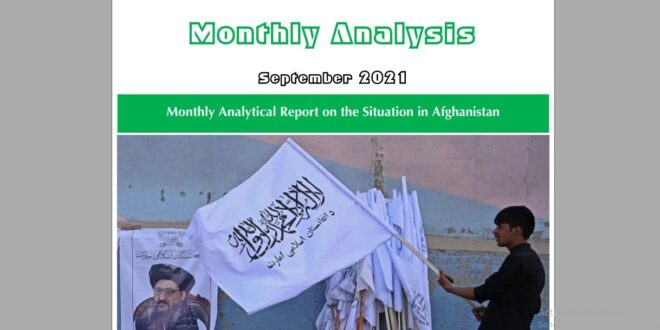
This report presents an overview of the political, economic, and security situation in Afghanistan during September 2021. During this month, the country witnessed a completely different situation compared to the last 20 years. Politically, this month a caretaker government was announced by those who had been at war for the past 20 years and could not live freely. On the other hand, the war between the remnants of the former government and the Taliban was completely over with the capture of Panjshir by the Taliban as the former government officials and politicians who were stationed there under the name of second resistance against the Taliban also left the country. But with these major developments, the wave of economic challenges and problems in the country has been a main concern for Afghans and the international community. Almost a month after the announcement of the new caretaker government, beside the internal problems, the issue of international recognition of the new government was another concern that Afghans have had about the future. In this report, beside these topics, you would read a detailed analysis of the important events of this month.
Political Situation
The month of September became the first month for Afghanistan that, after the 20-year US-led NATO war, there was no foreign military presence in the country. After two decades of war, although security situation has improved in Afghanistan, and particularly with the Taliban’s capture of Panjshir in early September, the Taliban have officially declared an end to the war in the country, but security problems have not been completely eliminated. Moreover, Afghanistan is once again facing the threat of international isolation, as it was 20 years ago. The Taliban announced a caretaker government this month, however, it was criticized by both Afghans and countries in the region and the world, and the new caretaker government was not considered inclusive. That is why, by the end of September, no country had recognized the Taliban government.
A Look at America’s 20-Year Presence
Twenty years have passed since the 9/11 attacks in the United States. These were the events that led to the US invasion of Afghanistan and the overthrow of the Taliban regime. Twenty years later, Americans are commemorating 9/11 as US and NATO forces are out of Afghanistan and the Taliban return to power.
The war in Afghanistan was the longest foreign war of the United States, in which at least 2460 US soldiers killed and more than 20,000 others wounded, according to official figures. At least 1144 other NATO soldiers and more than 4000 American contractors were also killed and thousands others wounded in this war. On the other hand, the exact number of Afghan casualties is not clear, but the main victims of this war were Afghans. According to some recorded figures, about 70,000 Afghan forces, 51,000 anti-government fighters and at least 47,000 civilians have been killed and hundreds of thousands more wounded. These are the only numbers that have been recorded. For example, UNAMA has been recording civilian casualty figures since 2009, and no figures have been recorded before that year. Former President Ashraf Ghani also confirmed in 2019 that at least 45,000 Afghan soldiers had been killed in the four-year rule of the national unity government alone. Therefore, it is assumed that the actual death toll among Afghans is much higher. According to some estimates, at least 241,000 Afghans have been killed in the conflict.
Besides the human casualties, the United States has spent 2.26 trillion dollar in Afghanistan, most of which was spent on the war and the US military, as well as the Afghan army. According to Brown University figures, 933 billion of that money was for US forces alone. In addition, part of the money has been spent on reconstruction activities in Afghanistan, but there have also been reports of widespread corruption and waste of the money.
Despite these human losses and economic costs, Afghanistan has made some progress over the past 20 years, as well as a wide range of challenges. The biggest problem was the worst security situation, which has plagued Afghans for the past two decades, and the presence of foreigners has led to a bloody war. In addition, widespread corruption and high spending on the war did not keep Afghanistan’s economy afloat, and Afghanistan has always relied on foreign aid. There were many other problems and challenges, for which the scope of this report is too narrow to discuss.
Panjshir Resistance
The Islamic Republic of Afghanistan was completely overthrown when the Taliban entered Kabul on August 15, and a number of officials, including former President Ashraf Ghani, fled the country. Also, on August 31, all US troops withdrew from the country, officially ending the 20-year US-led NATO war in Afghanistan. On the other hand, some former government officials and other politicians gathered in Panjshir and raised the banner of resistance against the Taliban, calling themselves the “Second Resistance”. The resistance was led by Ahmad Massoud, son of former commander Ahmad Shah Massoud, and former vice president Amrullah Saleh.
The Taliban did not attack Panjshir until the end of August and efforts were underway to resolve the Panjshir issue peacefully. It was assumed that the Taliban would not take Panjshir easily, as it was a province that had not surrendered during the Russian invasion of Afghanistan, and even during the Taliban’s first rule, the Taliban were unable to take over the province completely. But the Taliban have repeatedly stated on the Panjshir issue that they are not in favor of fighting and bloodshed in Panjshir, but if fighting is needed, they will be able to bring the province under their control in just a few days.
Peace efforts to resolve the Panjshir issue have ultimately failed, as the demands of resistance leaders in Panjshir have been similar to those made by the Afghan government to the Taliban in the past. For example, the transfer of power through elections, the non-entry of the Taliban into Panjshir, and so on; But the Taliban demanded that Panjshir must be surrendered and that weapons and other government supplies be handed over to the central government. The head of the Taliban’s Da’wah and Guidance Commission and the current acting foreign minister Amir Khan Muttaqi has issued a final voice message urging the Panjshir resistance to surrender and stop the bloodshed there. But former Vice President Amrullah Saleh, who declared himself acting president in Panjshir, said on September 1: “Our resistance is to defend the rights of all Afghans, not just Panjshir.”
That is why, the Taliban finally launched an offensive in Panjshir and, according to some reports, the fighting was intensified between the two sides on September 3. On the same day, there were reports that Amrullah Saleh had been wounded in the fighting or had fled Panjshir. But he denied the allegations in a video released on September 3, insisting he would continue his resistance. But finally, on September 6, Panjshir province came under Taliban control and the local politicians and resistance leaders fled to Tajikistan. On the same day, Ahmad Massoud, the leader of the Resistance Front, issued a voice message urging all Afghans to join the national uprising against the Taliban. For this reason, anti-Taliban protests took place in some provinces, including Kabul, on September 7, 8 and 9, but these protests were suppressed by the Taliban under the guise of riots and on September 8, a statement was issued by the Taliban banning the protests by imposing strict conditions on them. Despite the ban, anti-Taliban protests continued in Kabul and some other provinces. But there were reports that Taliban forces fired in the air to disperse them and beat some journalists. Among them, pictures of two journalists being tortured were circulated on social media. However, the protests gradually subsided and no significant protests were seen after September 10.
The Caretaker Government
The Taliban announced their caretaker government on September 7, a day after the complete capture of Panjshir province. In the first stage, they announced the acting ministers for 19 ministries and a number of key departments and independent directorates, such as the General Directorate of National Security and Da Afghanistan Bank. The Islamic Emirate said in a statement: “Our country has gained complete independence from the occupation and all elements of the war have been eliminated and, for the first time, the groundwork has been laid for the establishment of a countrywide security and a stable Islamic system. Now our country is in dire need of performance and service delivery in various sectors. In order to ensure the legal, economic and social rights of the people are addressed in a timely manner, the Islamic Emirate has decided to appoint and announce a caretaker cabinet to carry out the necessary governmental affairs.” The statement added that the remaining ministers and caretakers for ministries and other agencies will also be gradually introduced.
In the caretaker cabinet of the Islamic Emirate, Mullah Mohammad Hassan Akhund was announced as the acting Prime Minister and Mullah Abdul Ghani Baradar and Mawlawi Abdul Salam Hanafi as the deputy prime ministers. A few weeks later, Mawlawi Abdul Kabir was also announced as the third deputy prime minister. Most of the cabinet members are members of the Taliban’s leadership council. Also for three other important ministries, Mawlawi Mohammad Yaqub Mujahid, son of Mullah Mohammad Omar Akhund, Mullah Sirajuddin Haqqani, and Mawlawi Amir Khan Muttaqi, were appointed as acting ministers of Interior Affairs, National Defense, and Foreign Affairs respectively. Other acting ministers are also members of either Taliban’s political office in Qatar or members of the Taliban’s leadership council. In the caretaker cabinet, the Ministry of Women’s Affairs has been abolished and replaced by the Ministry of Da’wah, Guidance, Commanding the Good and Forbidding the Evil/ Amr bil Maroof & Nahi Anil Munkar.
Simultaneously with the announcement of the cabinet, a statement was issued under the name of Emir of the Islamic Emirate Sheikh Hibatullah Akhundzada. The statement said that the future affairs of the government will be governed by the laws of Islamic law and the Islamic Emirate will treat all its neighbors and other countries on the basis of mutual respect and the government will abide by all international laws which is not in conflict with the national values of the country and Islamic Sharia. The statement ensures the protection of the human rights of all citizens.
The announcement of the caretaker cabinet was generally welcomed nationally and internationally, as a power vacuum had been created in the country since August 15. But at the same time, the composition of the cabinet has been criticized for not being inclusive.
The first country in the region to welcome the new cabinet was Uzbekistan. “We hope that this will be the beginning of a broader national unity that will lead to lasting peace and stability in this country,” the Uzbek foreign ministry said in a statement. Moreover, the Pakistani foreign ministry said in a statement: “We hope that the new political structure will coordinate efforts for peace, security and stability in Afghanistan and work to meet the needs of the Afghan people”. In addition, China and some other countries have cautiously welcomed the caretaker cabinet.
But some countries have criticized the composition of the cabinet. Among these countries are the United States, the European Union, Turkey, Iran, Tajikistan and some other countries. Turkish Foreign Minister Mevlut Cavusoglu said in an interview that the Afghan government should represent all Afghans and that if only the Taliban were involved, problems would arise. Ali Shamakhani, secretary general of Iran’s National Security Council, also said in a Twitter message that Afghan officials should make peace and stability a top priority. He said the concern of Afghans is that the need for an inclusive government had been ignored. The US State Department said in a statement that it was “concerned” about some members of the Taliban’s cabinet. The announcement was made in reference to some caretaker ministers who are still on the US and UN blacklists. The European Union (EU) has said that the Taliban government is neither inclusive nor representative.
There were also positive and negative reactions at the national level. Hezb-e-Islami leader Eng. Gulbuddin Hekmatyar resolutely backed the caretaker cabinet, saying it is the best in nearly 50 years. However, some other politicians did not consider the cabinet to be inclusive and criticized the composition of the cabinet. For this reason, the announcement of the new appointments on September 21 also mentioned the original provinces of residence of some of the new acting deputies and a caretaker minister, apparently as an attempt to respond to criticism regarding the composition and inclusion of the caretaker cabinet. Acting Minister of Commerce Nooruddin Azizi, a resident of Panjshir province, and Mohammad Bashir and Mohammad Azim Sultanzada, first and second deputy ministers of the same ministry, were mentioned that they are from Baghlan and Sar-e-Pul provinces, respectively. But once again on September 23, when a young man was appointed as acting chancellor of Kabul University, there was widespread criticism and condemnation of the appointment.
International Recognition of the New Government
The Taliban said in a statement that the Afghan government would be the Islamic Emirate and the Amir al-Mu’minin would be in place. The international community has repeatedly stated at international forums over the past year that it does not support the return of the Islamic Emirate to Afghanistan and that if the Taliban came to power by force, the international community would not recognize their government. That is why, almost a month after the Taliban announced a caretaker government, no country has recognized the new government in Afghanistan. But on the other hand, various countries in the region and around the world have started interacting with the new government and their positions toward the Taliban seem soft.
Immediately after the caretaker government’s announcement, the Taliban’s domestic opponents called on the international community not to recognize the Taliban government. The main criticism was that the cabinet was made up entirely of Taliban leaders, did not include women, did not take into account the role of the tribes, and did not consider professional and educational qualifications. Atta Mohammad Noor and Salahuddin Rabbani, leaders of both factions of the Jamiat-e-Islami party, reacted sharply to the Taliban’s announcement of the caretaker government, calling it a monopoly on power. The Panjshir Resistance Front also condemned the caretaker cabinet in a statement and called on the international community not to recognize it.
Earlier on September 3, British Foreign Secretary Dominic Robb, who was on a visit to Pakistan, told a news conference that Britain did not recognize the Taliban government in Afghanistan, but they would not close the door to talk to them. A day later, on September 4, NATO Secretary-General Jens Stoltenberg said it is too early for the alliance to take a stand on the Taliban or to talk about the new government in Afghanistan. He said the world should judge the Taliban not on the basis of the group’s rhetoric but on their actions.
On the other hand, the United Nations has extended its mission in Afghanistan, signaling that the international community will gradually begin to engage with the Taliban. On September 16, UNAMA said in a statement that its head, Deborah Lyons, had met in Kabul with Acting Taliban Interior Minister Sirajuddin Haqqani and other officials.
In addition, a number of countries did not close their embassies in Kabul and the continued operation of these embassies was a positive sign of future engagement with the Taliban. The embassies of Russia, China, Iran and Pakistan remained fully operational, and some other countries did not close their embassies completely, but reduced their diplomats or temporarily suspended their activities. Overall, many countries said they are considering interacting with the new government in Afghanistan and are closely monitoring the situation.
Thus, with the exception of Tajikistan and the United States, interactions of other countries appear to be soft with the Islamic Emirate, but Tajikistan is the only country where some Afghan politicians and Taliban opponents are based, and its officials have made some harsh remarks about new government in Afghanistan. The Deputy Prime Minister of the Islamic Emirate, Mawlawi Abdul Salam Hanafi, also accused the country of interfering in Afghanistan’s internal affairs in an interview with Al Jazeera TV on September 27. Some US officials have also spoken out against the Taliban. “The Taliban was and is a terrorist group, and it still has ties to al Qaeda,” US Army Chief of Staff General Mark Milley told a special session of the Senate on September 29.
The Islamic Emirate has repeatedly called on other countries that since the new government meet all the conditions for recognition under international law and now have full control over the entire country’s territory, so it must be recognized by other countries. On September 30, the Ministry of Foreign Affairs of the Islamic Emirate invited the ambassadors and diplomats of the active embassies and other political representatives in Kabul and called on them to recognize the new government. At the party, which was also attended by Deborah Lyons, Head of the United Nations Assistance Mission in Afghanistan (UNAMA), the Foreign Minister of the Islamic Emirate thanked the active embassies in Kabul and said that his government seeks friendly relations with all countries of the world.
Despite the Taliban’s demands, most countries have asked other countries not to hurry in recognizing the Islamic Emirate of Afghanistan, citing the establishment of an inclusive government in Afghanistan, women’s work and education issue and so on.
On September 14, US Secretary of State Antony Blinken called on Pakistan not to recognize the Taliban government unless the Taliban agreed to international demands. “All countries, including Pakistan, must insist on the demands they have made of the Taliban in return for recognition,” Mr. Blinken told the Foreign Affairs Committee of US Congress. Therefore, there seems to be some debate going on between the Taliban and the international community behind the scenes, and it is believed that their government has not yet been recognized in order to agree to certain conditions, and in case of showing flexibility in accepting these conditions, some countries may recognize the new government of Afghanistan.
Economic Situation
With the Taliban taking control of the country and the announcement of the new government, the security situation in the country has improved compared to the last 20 years. But at the same time, the situation created by this change has led to the deterioration of the country’s economic situation. However, the economic situation in the country, and in particular the living conditions of ordinary Afghans, has deteriorated over the past 20 years due to widespread corruption and war. But with the recent changes, the situation has worsened due to deferent problems and challenges. Even before the advent of the Islamic Emirate, about 90 percent of the country’s population lived below the poverty line and the unemployment rate was 72 percent. But at an international conference on Afghanistan convened in Geneva on September 13, the UN secretary-general said that about 14 million Afghans were now facing famine.
Frozen Assets of Da Afghanistan Bank
During and after the complete withdrawal of US troops from Afghanistan, they sought to economically crush and challenge the Taliban, which unfortunately had a direct negative impact on the economic situation of the Afghan nation. During the withdrawal process, the Americans tried to destroy all their facilities and not hand them over to the Afghans. For instance, they completely destroyed all the systems at Kabul airport and some of the planes there, causing flights to be suspended for several weeks, but with the help of technical teams from Qatar and Turkey, the airport was restored, and humanitarian aid from some countries reached Kabul. With the Islamic Emirate in power, the US government immediately announced that it would freeze the central bank of Afghanistan’s reserves in the country so that the money would not fall into the hands of the Taliban. The value of these funds and assets amounts to approximately 9.4 billion dollar. The freezing of these reserves has generally had a negative impact on the country’s economic situation.
Suspension of International Aid to Afghanistan
The international community’s assistance to Afghanistan has also been completely cut off. The international community’s conference on Afghanistan in Geneva in November 2020 alone pledged 12 billion dollars in aid to Afghanistan over the next four years (2021-2025), including 1.2 billion euro (approximately 1.4 billion dollar) was aid pledged by the European Union alone. Although the international community once again pledged 1.2 billion in humanitarian aid to Afghanistan at a meeting hosted by the United Nations in Geneva, Switzerland on September 13, 2021, but since no decisive decision has been made on its interaction with the Islamic Emirate, there are concerns about the effectiveness of this assistance. The Taliban has also repeatedly called for free humanitarian assistance from the international community.
The Problem of Liquidity of Banks
Another issue was the impact of the recent changes on the banking system. With the collapse of the previous government, all state-owned and private banks and money changers were initially shut down for fear of theft and robbery, but remained closed with the relative normalization of the situation, mainly due to lack of cash with the central bank. Although the banks reopened about two weeks later, they began paying people out of their own accounts, subject to a limit set by the central bank (20,000 Afghanis or 200 dollar a week). Due to the closure of banks and the lack of money in the market, money exchange markets, especially Sarai Shahzada, the country’s largest money exchange center, remained closed for up to three weeks. Due to this situation, on the one hand, the prices of goods in the markets have increased and on the other hand, people became increasingly distrustful.
In addition, the biggest impact of recent developments on the financial situation has been the devaluation of the Afghani, according to which ordinary Afghans assess the country’s economic situation. Overall, with the collapse of the previous government, the value of the Afghani against the dollar has risen from an average of 80 Afghanis to 90 Afghanis.
Salaries of Government Employees
The above factors and the overall situation have had a profound effect on the economic situation of the people. Foreign organizations here, for instance, have often been closed or reduced their activities and staffs, leading to a large number of Afghans losing their jobs. Besides that, with the collapse of the previous government, the salaries of hundreds of thousands of Afghans who were working for the government were delayed. Most of the daily needs of government employees were met through these salaries. However, the Islamic Emirate has promised to pay the salaries of all government employees after some evaluation and reviews. But so far not much progress has been made in this process.
Overall, this situation has led to an economic crisis in the country, and in order to change this situation, various countries have called for lifting of sanctions on the Taliban. China, for instance, said on September 23 that economic sanctions imposed on Afghanistan after the Taliban came to power must be lifted immediately. The Norwegian Refugee Council also warned on September 27 that the closure of the World Bank and other international donors’ financial resources could put civilians in Afghanistan at risk. The NRC chairman, Jan Egeland, has called on international donors to reconsider their actions. However, the US Treasury Department issued two licenses on September 24, allowing the United States and some international organizations to deal with the Taliban, which facilitates the distribution of humanitarian aid in Taliban-controlled Afghanistan. The move was welcomed by the Taliban, but Afghanistan’s assets are still frozen and it is uncertain when and how the ongoing economic crisis in Afghanistan will be brought under control.
Security Situation
In September, however, the war between the former government and the Taliban ended and it was the first month that US and NATO forces were not present in the country. Yet the country has witnessed various security incidents and developments.
As mentioned earlier in the analysis of the political situation, the security situation in Panjshir this month and the fighting between the Taliban and the Resistance Front were almost the only factors contributing to the security situation and casualties this month. The fighting in Panjshir began in early September, and although it was previously thought that it would be prolonged, the Taliban took control of Panjshir in a matter of days. Heavy casualties were also predicted in the Panjshir war. But the death toll in Panjshir did not appear to be as high as expected. However, no official reports of casualties in the Panjshir war were released, as the media did not have access to the battlefield.
Some Resistance Front officials were also killed in the fighting in Panjshir. Its spokesman, Fahim Dashti, was killed on September 5. But the Taliban claimed that he had been killed as a result of an altercation between local rebellious commanders. Fahim Dashti was a well-known journalist and a nephew of Dr. Abdullah Abdullah, Chairman of the High Council for National Reconciliation (HCNR). Also on September 11, the brother of former vice president Amrullah Saleh was killed. In this regard, a video of Amrullah Saleh was also released, which shows he is watching his brother’s funeral online and appears to be crying.
In addition to the fighting in Panjshir, another concern was the activities of the Islamic State, or ISIS, group, which has been active in the eastern part of the country this month. Concerns about ISIS’s activities are also being taken seriously, as intelligence groups are believed to be behind the group. In late August, US forces also claimed to have targeted a car full of ISIS fighters in Kabul. But on September 11, the deadly US airstrike was challenged in the American media. The New York Times and the Washington Post reported that the drone strike, which Americans say targeted an ISIS car, was carried out on a charity organization workers. These reports have also denied the allegations of the U.S. military about the explosion of the targeted car and the presence of explosives in the car. The U.S. military finally acknowledged on September 18 that it had killed innocent civilians, including children, and apologized shortly afterwards. The incident has also raised concerns that the United States is not taking a real approach to defeating ISIS.
Attacks took place in Jalalabad on September 18 and 19, in which 4 Taliban soldiers were reported killed and several civilians wounded. The ISIS-linked Aamaq news agency said on September 20 that its Khurasan branch had killed 35 Taliban soldiers in the bombings. On the other hand, there are reports that some killings have been carried out due to personal enmity in some areas and in some cases these killings have been carried out under the guise of ISIS fighters. Despite the insecurity and incidents, the number of war casualties in the country this month was lower compared to the past, but it was not possible to determine the exact number of casualties.
Given this situation, there are now concerns that ISIS attacks against the Islamic Emirate may gradually increase and they would carry out more attacks on populated civilian areas. The main concern in this regard is that the security and intelligence agencies of the Islamic Emirate are not strong enough to repel such threats. There are also concerns that the Taliban’s political opponents may resume efforts to resist the new government. Hezb-e-Wahdat leader Karim Khalili, for example, said on September 23 that if the Taliban did not renounce tyranny, Hazaras would start armed resistance.
In addition to the war situation, crimes in the past has been a case that has made the lives of Afghans miserable and there were records of high death toll in criminal incidents. But with the rule of the Islamic Emirate, the level of crime and murder decreased. Although there are no exact statistics in this regard, the perpetrators of such incidents are being treated harshly by the Taliban, which has caused widespread fear and the general opinion is that the Taliban’s harsh treatment and fear has also led to a drop in crimes. For instance, in an incident on September 24, the Taliban killed four kidnappers in Herat and the incident was widely reported on social media.
The end