QASED Non-government Research Organization
Note: You can download the PDF format of the report from here.
Introduction
This report provides an overview of the political, economic and security situation in Afghanistan in the first month of 2022. Despite the cessation of the 20-year long US led NATO war in Afghanistan, this year began with political, economic and security challenges facing Afghanistan that threaten the country’s future. In the political arena, until the end of this month none of the countries in the region and the world recognized the Taliban government, but for the first time, the Taliban held talks with representatives of Western countries in Norway, as well as the Resistance Front in Iran. In the economic arena, during January, as in previous months, there were serious concerns about the plight of Afghans and the humanitarian crises in the country at the international level, particularly due to the economic sanctions on the caretaker government of the Taliban. In the security arena, several security incidents were seen during the month, but overall, the security situation has improved compared to previous months. This report presents brief details and analysis of these and other important events of this month.
Political Situation
The first month of 2022 witnessed some events that show the international community’s growing interaction with the Taliban. This month, although the Taliban continued their efforts to be recognized by the world, none of the countries in the region and the world has yet recognized the Islamic Emirate.
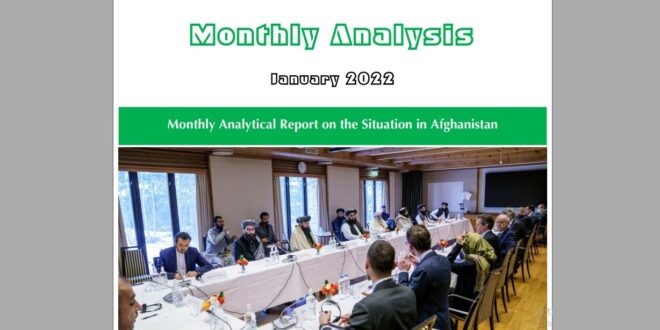
One of the most important events in the political arena this month was the Oslo talks in Norway on January 23 and 24, in which a high-ranking Taliban delegation led by Acting Foreign Minister Amir Khan Mottaqi participated. This was the first visit by high-ranking Taliban members to Europe since the formation of the Taliban caretaker government in Afghanistan. During the meeting, Taliban representatives discussed with members of Afghan civil society and representatives of Western countries on various issues, including the humanitarian crisis in Afghanistan. EU Special Representatives, including France, Germany, Italy, Norway, the United Kingdom and the United States, attended the meeting. This meeting demonstrates the international community’s softness in dealing with the Taliban and even a step towards the de facto recognition of the Taliban. Although the Norwegian foreign minister stressed that the meetings “did not mean legitimacy or recognition of the Taliban”, the invitation of Taliban officials to Europe also provoked protests from a number of Afghans living in Europe.
Despite this softness in dealing with the Taliban, various countries still propound the establishment of an inclusive government in Afghanistan as a precondition for recognizing the Taliban. Following the Oslo meeting, the leaders of India and five Central Asian countries (Tajikistan, Uzbekistan, Turkmenistan, Kazakhstan and Kyrgyzstan) called for a truly inclusive government in Afghanistan. The meeting was held virtually on January 27 and was hosted by Indian Prime Minister Narendra Modi. Iranian Foreign Ministry officials also reiterated at a press conference earlier this month the need for a comprehensive government in Afghanistan, saying that this is the demand of Tehran and all of Afghanistan’s neighbors. Earlier, Bahador Aminian, Iran’s ambassador to Kabul, told local media in Kabul that the new government in Afghanistan is not inclusive and Tehran could not recognize it. Reacting to the remarks, Inamullah Samangani, the Taliban deputy government spokesman, said: “Is the Iranian government or cabinet an inclusive government or cabinet according to their definition of inclusive? Each country defines inclusive government based on their national interests.”
On the other hand, the issue of women’s rights and the arrest of several women’s rights activists became one of the main topics of political meetings and discussions this month. Earlier this month, women’s rights activists took to the streets several times despite the Taliban’s crackdown on female protesters in recent months. The women chanted “Work, education and freedom.” After that, arrests of several women’s rights activists and organizers of the protests were reported. Following the release of these reports, the UN Assistance Mission in Afghanistan (UNAMA), Amnesty International and even the UN Secretary-General repeatedly expressed their concerns and called on the Taliban to ensure the release of these women rights activists. The UN Secretary-General’s Special Representative for Afghanistan, Deborah Lyons, met with Sirajuddin Haqqani, Acting Interior Minister of the Islamic Emirate in Kabul, on January 24 to discuss the issue and ensure the release of the women activists. Faizullah Jalal, a professor at Kabul University, was also arrested by the Taliban, following which some women protested in Kabul on January 9. He was released after four days in detention, but no government agency has acknowledged the arrest of women protesters which in part indicate Taliban’s fear of international community’s pressures to secure women’s rights.
Another important issue in this month was the first meeting of Islamic Emirate officials with members of the Resistance Front in Iran. In recent months, there has been a growing demand for talks with the armed political opposition in order to eliminate the causes of war and conflict in the future. Amir Khan Mottaqi, the Taliban’s acting foreign minister, confirmed on January 10 after returning from Iran that he had met with Ahmad Massoud and Mohammad Ismail Khan, a former jihadi commander in Tehran. However, the talks apparently did not yield results, and the Resistance Front on January 11th issued a statement confirming the Front’s delegation’s meeting with the Taliban delegation in Tehran, saying that the Taliban “proved once again that they are in no way willing to accept principles and values of citizenship, the equitable distribution of power among all races and segments of society, and the formation of an inclusive government based on the votes and will of the Afghan people”. Overall, this negotiation is considered a good step towards ensuring long-term stability in Afghanistan, as it is believed that political stability in the country is only possible through dialogue and negotiation.
Economic Situation
In the economic sphere, continuing concerns about the dire economic situation in Afghanistan, humanitarian aid and repeated calls for humanitarian assistance to Afghans at the national and international levels and the release of Afghanistan’s foreign exchange reserves, as well as relative control over the value of the Afghani currency against the dollar after falling sharply last month were the major economic issues in January.
The plight of Afghans remains a global concern. The International Rescue Committee (IRC) has expressed concern about the growing number of malnourished children in Afghanistan, saying in a January 11 statement that the number of malnourished children has risen by about 30 percent in the past month. The International Labor Organization on the other hand said in a report on January 19 that the crisis had crippled Afghanistan’s economy and severely put pressure on the labor market. The report adds that after the Taliban took control in mid-August 2021, more than half a million people lost their jobs in Afghanistan, and according to the report, by June 2022, between 700000 and 900000 people will lose their jobs in Afghanistan.
Due to the humanitarian crisis in Afghanistan, UN agencies have requested 4.4 billion dollars in humanitarian aid for the needy people of Afghanistan in 2022. This request by UN agencies, which accounts for nearly 25 percent of Afghanistan’s gross domestic product (GDP), is the largest request for financial assistance for a country.
The demands come as humanitarian aid has been raised to prevent the economic and social collapse of Afghanistan over the past few months, but there have been complaints about its unfair distribution. A UN spokesman said that according to estimates by the UN Office for the Coordination of Humanitarian Affairs, they have so far raised 1.5 billion dollars to address the ongoing humanitarian crisis in Afghanistan. It should be noted that a small amount of this aid has reached Afghanistan so far due to problems and limitations in dealing with the Taliban.
Another issue that has been hotly debated for months is the release of Afghanistan’s foreign exchange reserves in the United States and some international institutions. The freezing of Afghanistan’s foreign exchange reserves has had dire consequences for the Afghan economy, as the country is facing a shortage of cash on the one hand and cash withdrawals from banks on the other; a situation that has caused problems not only for individuals, but also for companies. There were also demands in January for the release of these assets. UN Secretary-General António Guterres has called for the suspension of laws that prevent money from being used to save Afghans and the Afghan economy. He told reporters in New York on January 13 that Afghans’ assets must be released in order to save their lives.
Given the economic situation in Afghanistan, it is believed that humanitarian aid and even the release of foreign exchange reserves of the Central Bank of Afghanistan alone cannot be a long-term solution to the humanitarian crisis in Afghanistan. Deborah Lyons, UN Secretary-General’s Special Representative for Afghanistan, said at the “Afghanistan Economic Conference” in Kabul on January 19 that humanitarian aid could not be a long-term solution and stressed that the country’s economic crisis must be fundamentally resolved.
One of the negative economic effects is the devaluation of the Afghani currency against the dollar. Last month, the dollar rose sharply against the Afghani for several days, raising commodity prices in Afghan markets. Some urgent steps by the government to control the value of the Afghani brought the dollar against the Afghani relatively under control in January. During January, one dollar was exchanged for 100 to 105 Afghanis, but commodity prices in the country’s markets remained high and had devastating effects on the economic situation of Afghans.
Security Situation
Although the security situation in the country was better in January than in previous months, threats and some security incidents were also recorded this month. Following an explosion near the Passport Office on December 23, 2021, the Department stopped distributing passports to the Taliban members on Thursdays and to other people in other days of the week due to security threats.
Although it is said that some security incidents are not reported, several incidents were reported in different parts of the country during this month. For example, on January 16, an explosion took place near Shamshad Street in Kabul’s Bagrami district, targeting a Taliban vehicle, killing one child and reportedly injuring four Taliban members. Three days before the incident, a Taliban “Ranger” car was hit by a roadside mine in Parwan-e-Se area, a suburb of Kabul’s fourth security district, injuring a number of Taliban members. Also on January 22, local Taliban officials in Herat province reported an explosion in the city of Herat, saying that seven people, including four women, were killed and nine others were injured. The explosion occurred in a civilian vehicle in a predominantly Shiite area of Herat, and a day later, the Khorasan branch of the Islamic State group claimed responsibility for the deadly attack.
Despite these incidents, there have been no massive and bloody attacks by ISIS throughout the month, partly due to the cold weather in most parts of the country and partly due to the suppression of Islamic State elements by Taliban forces in recent months. But there are growing concerns about the onset of insecurity with the passing of winter.
In addition, some internal Taliban disputes in Faryab province had attracted attention this month. After the arrest of Makhdoom Alam, a Taliban commander in Faryab, a number of residents of the province protested and demanded his release. Makhdoom Alam, a senior Taliban Uzbek commander, was arrested in early January in Mazar-e-Sharif, the capital of Balkh province. According to news reports, several people were killed and wounded by security forces in attacking protesters in the province after the arrest of the commander.
In addition to security incidents, natural disasters killed dozens of Afghans this month. Ministry of Natural Disaster Management officials said that 38 people were killed and 54 others were injured in several natural disasters earlier this month. Mohammad Nasim Haqqani, the ministry’s director of information and public relations, told reporters on January 22 that these people had been killed and injured in heavy snowfall, heavy rains and an earthquake. It is said that as a result of these natural disasters, at least 8000 residential houses have also been destroyed.
At a glance, there was relative calm in terms of security in the country in January, and we did not see deadly incidents that resulted in heavy casualties. But there are serious concerns that if the political situation continues as it is, we might see an increase in security incidents in the coming months.
The end