QASED Non-government Research Organization
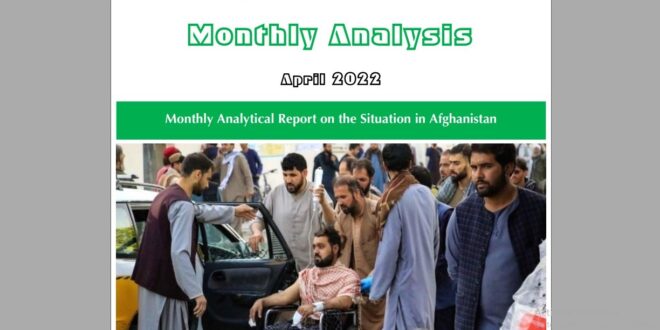
Note: You can download the PDF format of the report from here.
Introduction
This report provides an overview of the country’s political, economic and security situation in April 2022. On the political front, concerns about the political isolation of Afghanistan, particularly the Islamic Emirate, intensified this month, and the Islamic Emirate’s hopes that it was expecting to be recognized by some countries are slowly fading. This frustration is largely due to the recent actions of the Taliban. On the economic front, no significant changes in the economic field have been seen during this month, and as in previous months, there have been international concerns about Afghanistan’s economic situation and the humanitarian crisis, as well as international efforts to raise funds for Afghanistan. In terms of security, April was the deadliest month for civilians compared to the recent months. There have been several heavy and bloody attacks and bombings at religious sites this month, and more minor security incidents than in previous months. In this report, beside these topics, you would read details and analysis of the important events of this month.
Political Situation
The month of April saw no significant political developments, and for the most part this month, the political isolation of the Taliban-ruled Afghanistan was a hot topic of discussion on the national and international stages. But the deadly bombings this month have had a profound effect on the political situation as well.
The gradual increase in international engagement with the Taliban over the past few months has raised hopes that some countries may recognize the Islamic Emirate. But despite the increase in this interaction and engagement, the existing hopes for recognition of the Islamic Emirate have waned. It now appears that some countries are pursuing their political and economic needs through informal interactions with the Taliban or accepting Taliban ambassadors to their countries. One reason for this is the recent hardline actions of the Taliban, which have greatly reduced the likelihood that some countries will recognize the Taliban as opposed to a coordinated move by the international community. In addition to their latest actions, the Taliban have remained silent on political participation and the type of future system, which has added to the frustration about the system’s inclusiveness and the reconciliation of political opponents.
Although the Taliban has continued their efforts for their government to be recognized by the international community, they have so far shown little leniency to international demands. The Taliban leader Mawlawi Hibatullah Akhundzada, in his Eid message on the occasion of Eid al-Fitr, once again called on the international community to recognize their government. His message was that they want good and positive relations with neighboring countries, the region and the world, and that no country would be threatened from Afghan soil.
The Taliban recently banned poppy cultivation in Afghanistan, in an attempt to win the minds and hearts of some countries. The Taliban leader issued a decree on April 3 stating that no one is allowed to grow poppy in Afghanistan. The Taliban’s move drew a positive response from the international community. For instance, the charge d’affaires of the US embassy said in a message that “Outlawing the production of narcotics in Afghanistan is a positive first step but enforcement will be key”.
Despite these efforts, the international community still considers the recognition of the Taliban as the government of Afghanistan to be dependent on the acceptance of international demands by the Taliban. Rina Amiri, the U.S. Special Envoy for Afghan Women, Girls, and Human Rights, said on April 5 that the Taliban would not be recognized as a government if they did not comply with international demands. According to her, it is very disappointing and shocking that the Taliban have decided to close girls’ schools despite their promises.
The issue of girls’ schools has also been a hot topic of discussion about the human rights situation in Afghanistan, with the Taliban failing to resolve their internal differences regarding this issue. Some Taliban leaders appear to be opposed to girls’ education above 6th grade. That is why Human Rights Watch (HRW) expressed frustration on April 25, saying that there were no signs of reopening Afghan girls’ schools above 6th grade and that there were fears that it might be a permanent decision of the Taliban.
Restrictions on freedom of expression is another issue that has raised international concern in recent months. As many as 80 journalists and media workers have been arrested and tortured since the Taliban took power, according to journalists’ support groups in Afghanistan. According to them, more than 6000 Afghan journalists have lost their jobs and hundreds of media outlets have been shut down during this period. However, the Taliban have always denied allegations of ill-treatment of journalists.
Economic Situation
However, there was no any major change in the economic field this month, but there were reports of an increase in mining revenues. Prices of commodities in the market continued to rise, as in previous months, and there were still international concerns about Afghanistan’s poor economic situation and efforts to raise aid for Afghanistan.
This month, however, the Afghani currency maintained its value against the dollar, as it did last month, and the monthly rate average for US Dollar to Afghani was 88 during the month of April, which to some extent also had a positive effect on the stability of commodity prices, however, the slight upward trajectory of prices was due to other factors.
The World Bank, on the other hand, which had suspended some of its projects worth $600 million in Afghanistan due to the extension of the ban on girls’ education on March 30, reversed its decision on April 20, saying that it resumes projects valued at around $450 million in Afghanistan. The Taliban government and the World Bank reaching an agreement about the resume of preparations for three non-education projects at a time that the bank had suspended aid to Afghanistan, along with some other international agencies, ten days after the Taliban came to power in August 2021. The World Bank had said it is concerned about the Taliban’s influence on Afghanistan’s development, particularly on women’s rights.
Nonetheless, the deteriorating economic situation has been a major topic of international debate, as more and more Afghans continue to flee the country due to the deteriorating economic situation. That is why there are ongoing international efforts to raise funds for Afghanistan. Also this month, an international aid conference for Afghanistan was held in Geneva on April 1, with a pledge of 2.4 billion dollar. In this conference, hosted by the United Nations, Britain, Germany and Qatar, the United Nations called to urgently raise nearly 4.4 billion dollar. The conference was attended by representatives of 41 countries and international agencies. On the other hand, more than 50 members of the French parliament wrote an open letter to President Emmanuel Macron on April 12, urging him to impose sanctions on the Taliban for human rights and women’s rights abuses.
On the one hand, there are constant warnings of a severe famine and widespread humanitarian crisis in Afghanistan, but on the other hand, the Ministry of Mines and Petroleum of the caretaker government of the Taliban is talking about increasing their revenue from Afghanistan’s mines. The ministry has stated it hopes that the revenue will increase even more in the coming months after the award of some new contracts. In addition to continuing small and medium scale mining, the Taliban government is currently in talks with the international, particularly with Chinese companies, over large-scale mining, gas and oil. The China National Petroleum Corporation, which won the Sar-e-Pul oil exploration contract in northern Afghanistan during the previous government, and the MCC, which has a contract for the Mes Aynak mine, are in talks with the Taliban. They have shown a willingness to resume their work in meetings with the Taliban. Other major Chinese companies have also offered to invest in Afghanistan’s mining sector.
The Ministry of Mines says it has collected eight billion Afghanis in revenue over the past eight months, and that its revenue is not comparable to that of the previous government. According to them, 111 million Afghanis was collected in the first five-six months of last year, but the current government has been able to collect that amount in one day, ever there were days when up to 180 million Afghanis has been collected. The elimination of corruption in this sector seems to have led to an increase in revenue. However, mining experts say the increase in tariffs, the previous government’s debt collection from companies and the expansion of control over the mining areas, which were formerly Taliban strongholds rather than the government, are among the main reasons for the increase in revenue.
Security Situation
April has been the bloodiest month compared to the last nine months since the Taliban came to power and the caretaker government of the Islamic Emirate was formed. There have been several bloody attacks on civilian targets this month that have resulted in heavy casualties. This month’s attacks and security incidents, on the other hand, were of a slightly different quality than in the past, indicating the complexity of the situation and therefore raising concerns among ordinary Afghans.
At least nine people were killed and more than 50 others were injured in twin explosions in the Dasht-e-Barchi area of Kabul’s 18th district on April 19. The blast took place near to a school called “Abdul Rahim Shaheed School”. A grenade was also hurled at an educational center near the school. The area is mostly Shiite, which has witnessed deadly bombings in the past, with ISIS claiming responsibility.
Two days later, an explosion at a mosque in Mazar-e-Sharif, Balkh province, killed at least 40 worshipers and injured about 90 others. On the same day, an explosion took place in the northern city of Kunduz, killing at least four people and injuring 18 others. The ISIS group claimed responsibility for the attack on a mosque in Mazar-e-Sharif and the explosion in Kunduz city.
At the same time, an explosion took place near the Ministry of Commerce and Industry on Darulaman Road in Kabul city. According to officials, the explosives were placed in a vase, killing one civilian and injuring another.
One day later, on April 22, another bloody attack took place in Kunduz province, resulting in widespread casualties. The blast took place at a Sufi mosque in Imam Sahib District, and the victims were mostly worshipers who had gathered for Dhikr after prayers. The blast killed 33 people, including children, and injured 43 others, according to Bilal Karimi, deputy spokesman for the Islamic Emirate. Some sources put the death toll at more than 60.
Although the Taliban claimed to have captured the mastermind of the Mazar-e-Sharif attack, dozens of people took to the streets in Kabul to protest against the killing of Hazaras. They called on the government to take steps to ensure the safety and security of the Hazara community.
The United Nations Children’s Fund (UNICEF) said on April 25 that more than 50 children had died in Afghanistan in the past week following the bombings.
On the 29th of this month, Kabul once again witnessed a bloody explosion. The blast also occurred after Friday prayers at a Sufi mosque in the Darulaman area, killing at least 50 worshipers, according to some sources. The Taliban officials, however, downplayed the number and said that 10 people were killed and 30 others were injured in the incident. But Reuters news agency quoted health officials as saying that 66 dead and 78 wounded had been taken to hospitals. The attack is said to have been carried out by a suicide bomber.
In April, in addition to these large-scale attacks and explosions, there were other small explosions and security incidents such as targeted and retaliatory attacks and other mysterious killings. On April 1, an explosion in the 12th District of Herat City killed 5 people and injured 22 others. The area where the incident took place is predominantly Shiite.
Two days later, on April 2, a grenade was also detonated at Sarai-e-Shahzada, the large money exchange market in Kabul, killing one person and injuring dozens more. Officials at the Kabul Emergency Hospital told the media that more than 50 people had been injured in the blast. Three days later, on April 6, a bomb exploded at the Pul-e-Kheshti mosque in Kabul during afternoon prayers, injuring more than 10 people. On the 27th of this month, in the northern province of Samangan in Afghanistan, unknown gunmen took five coal workers out of a car and shot them dead.
Revenge and other mysterious killings have also been reported during this month. The New York Times reported on April 13 that the Taliban had killed hundreds of former soldiers and officers. But the Taliban denied the report, saying it was untrue and biased. An American newspaper had also earlier reported that in the first six months of the Taliban’s rule, about 500 former government employees and security officials had been killed or missing by the Taliban. But the Taliban have always denied such reports.
One such attack took place on April 18. The former Afghan Interior Minister Massoud Andarabi claimed that the Taliban had tortured and killed Qasim Qaim, a former police officer in the ministry. Andarabi said that despite the Taliban’s general amnesty, Colonel Qasim Qaim was first captured and then killed as a result of the violence. Reports of his death have provoked widespread outcry in the media, with the Taliban saying they are investigating the incident.
On the other hand, border disputes with neighboring Pakistan and Iran have intensified, but Pakistan has since bombed Afghan territory, killing dozens of civilians. On April 8, there were reports that a Pakistani military helicopter had been shot down over Afghan territory near the Durand Line. The helicopter was said to have been shot down as it was monitoring the construction of the barbed wire fence on the Durand Line, which has faced opposition from the Taliban.
One week later, on April 16, Pakistani jets bombed parts of Khost and Kunar provinces, killing at least 50 civilians. Three days after the incident, UNICEF also confirmed that 20 children had been killed in Pakistani bombings in Khost and Kunar, 15 of them girls and 5 other boys. In response, the Taliban’s foreign ministry summoned Pakistan’s ambassador to Kabul. The Islamic Emirate’s defense minister, Mullah Yaqub Mujahid, also said at a meeting on April 24 that they had tolerated Pakistani airstrikes for the sake of “national interest” but would not tolerate such attacks again.
Pakistan said in the aftermath of the attacks that terrorists were using Afghan soil against us and that the Taliban should stop it. Pakistan’s foreign ministry issued a statement following the summoning of the Pakistani ambassador, urging the Taliban government to secure the Afghanistan-Pakistan border, and to “take severe actions against those involved in terrorist activities in Pakistan.”
Besides these incidents, the conclusion of another criminal case also attracted a lot of attention this month. Abdul Rauf, an 11-year-old boy abducted nearly two years ago in Balkh province, was released on April 23 and handed over to his family during a large gathering, in which Abdul Salam Hanafi, the Taliban’s second deputy prime minister, has also participated. The abduction of the child was a complex case, and the Taliban have not yet released details of his release. There were rumors that senior former government officials and even Taliban officials were involved in the case.
In addition to all these incidents, the so-called resistance front also claimed attacks. But overall, the biggest threat was still ISIS attacks. Over the past few months, concerns about the activities and strength of the ISIS group were largely allayed, but this month’s security incidents have rekindled those concerns.
The end