QASED Non-government Research Organization
Note: You can download the PDF format of the report from here.
Preface
This report looks at the situation in Afghanistan in November 2020. On the political front, the Geneva Conference, Imran Khan’s first visit to Kabul, the cabinet formation process and the disputes between the parliament and the government, and the controversy over the formation of High Council for National Reconciliation (HCNR) were the most important topics of this month. The Geneva Conference mostly focused on the international community’s financial support for Afghanistan in the coming years as well as support for the ongoing intra-Afghan peace talks. On the other hand, a number of ministerial nominees received the vote of confidence from the House of Representatives (Wolisi Jirga). However, there has been some mistrust between the Wolisi Jirga and the government over allegations of corruption in parliament by the first Vice President Amrullah Saleh. Also in November, the continuation of deadlock over a procedure for the inter-Afghan peace negotiations, and the US presidential election and its impact on the Afghan peace process were highlights in the peace process. However, the deadlock over the procedure for inter-Afghan talks continued throughout the month of November, but in late November, traces of breakup of the deadlock were seen. On the security front, some mysterious bloody attacks during the month have raised concerns among Afghans. The details and analysis of these and other important issues are discussed in this report.
Political Situation
Geneva Conference
The two-day Geneva Conference on Afghanistan was attended by representatives from nearly 100 countries and international organizations on November 23 and 24, in which dozens of countries announced their financial support and aids to Afghanistan.
Afghanistan has received extensive assistance from the international community over the past two decades, but it has been widely wasted due to the high level of corruption in the country, and the international community has always been concerned about the widespread corruption in Afghanistan. According to Transparency International, Afghanistan has consistently been one of the ten most corrupt countries in the world over the past few years. That is why, a few days before the Geneva Conference, President Ghani set up a new anti-corruption commission, and a day before the start of the Geneva Conference, all five members of the new commission have sworn at the Presidential Palace. However, it is widely believed that such measures are ineffective in the fight against corruption in Afghanistan. The Special Inspector General for Afghanistan Reconstruction (SIGAR), recently said that the Afghan government’s response to the systematic corruption is weak and ineffective. SIGAR claims that the fight against corruption in Afghanistan has been limited to holding meetings and writing regulations on paper.
The Geneva Conference ended with a conditional pledge of more than 13 billion dollars for the next four years, with participants announcing aid, declared their support for the ongoing peace process and an immediate ceasefire in Afghanistan and called for full respect for international law aiming the protection of civilians. The US Secretary of State Mike Pompeo also announced at the conference that his country would provide 600 million in aid to Afghanistan over the next year, but half of that ($300 million) would be conditional on the progress in the Afghan peace process.
On the other hand, the Taliban also welcomed the conference, but called on the international community to coordinate their financial assistances to Afghanistan with the Taliban, saying that most of the aids to Afghanistan over the past two decades had gone into the pockets of the government officials rather than the Afghan people.
Kabul-Islamabad Relations
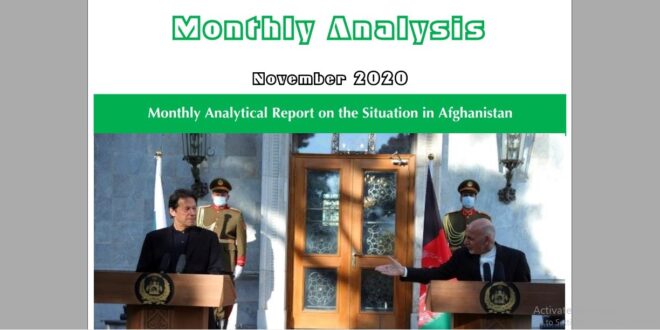
The history of Kabul-Islamabad relations is full of ups and downs and there has always been mistrust between the two countries. This mistrust stems from the Durand Line case, India’s role in Afghanistan and allegations of Taliban’s support by Pakistan over the past two decades. The two countries have always tried to end the mistrust. Now that the Afghan peace process is at a critical juncture, the international community and Afghanistan are calling on Pakistan to cooperate sincerely in the peace process. With this in mind, Pakistan’s Prime Minister Imran Khan arrived in Kabul on his first official visit on November 19 and met with senior Afghan officials, including President Ashraf Ghani.
During his one-day visit to Afghanistan at the invitation of President Ghani, Imran Khan pledged bilateral cooperation in the Afghan peace process. Mr. Kahn said at a joint press conference with President Ghani: “The objective of my visit is building trust and strengthening business relationships.” Imran Khan added: “The people and government of Pakistan have the same concerns as the Afghans. We want peace for Afghans, because Afghans need peace more than anyone else.” He said both Afghanistan and Pakistan should encourage the Taliban to be ready for peace talks. Addressing the gathering, President Ghani said that Afghanistan and Pakistan must respect each other and reach a common understanding and intensify joint efforts in the peace process.
Concurrently with the visit of the Prime Minister of Pakistan to Kabul, President Ashraf Ghani also ordered the release of a number of Pakistanis in order to build trust in the bilateral relations. Although some Afghan politicians reacted negatively to the order to release the prisoners, Pakistan welcomed it as a friendly move. Over the past two decades, Afghanistan has given privileges to Pakistan seeking its constructive cooperation with the Afghan government in the peace process. But the Afghan government’s hopes have not been fulfilled and relations with Pakistan have always been strained. Even after the formation of the National Unity Government, President Ashraf Ghani tried to improve relations with Pakistan and therefore gave the country many privileges, but when Pakistan failed to push starting face-to-face talks between the Afghan government and Taliban, relations between the two countries deteriorated more than ever and even armed clashes took place in the border areas.
Meanwhile, during Imran Khan’s visit to Kabul, a new document was signed between the two countries, in which the governments of Afghanistan and Pakistan pledged to work for peace and security, economic development, repatriation of Afghan refugees and people-to-people contacts. The document also sets out the mechanisms and timelines for implementing the decisions. The document recommends alternate visits by the two leaders to each other’s countries to keep the process of bilateral cooperation alive, and therefore, it is said that President Ghani will also visit Islamabad in the coming months.
However, it seems that Pakistan, under the pressure from the United States and the international community, has sought to cooperate in the Afghan peace process, but the overall analysis is that the Pakistani civilian government does not have a profound role in their policies toward Afghanistan, and therefore, Imran Khan’s visit may not have the outcomes that the Afghan government expects.
Tensions between the Government and Parliament
After months of delay, the ministerial nominees were introduced by the president to the House of Representatives (Wolisi Jirga) to receive the vote of confidence last month (October 21). The Wolesi Jirga also gave the herehereherevote of confidence to 10 nominees on November 21, but the process was postponed until the end of November due to tensions between the government and the Wolisi Jirga.
Speaking on the second day of the Geneva conference, First Vice President Amrullah Saleh accused the parliament of widespread corruption, saying that the corruption of some members of parliament is extensive and Afghanistan, unfortunately, had not been able to bring members of parliament to justice. According to him, in order to ensure justice, the immunity of MPs must be ended. He added that MPs were threatening the ministers of withdrawing the vote of confidence for accepting their demands. He also accused some members of the parliament of supporting criminals.
The remarks by the first vice-president provoked a backlash from the House of Representatives and postponed the process of giving the vote of confidence in the nominees. The MPs called Mr. Saleh’s remarks irresponsible and decided in a public meeting to file a complaint against him in the judiciary. According to them, the first vice president must provide documents for his allegations. The speaker of Wolisi Jirga said in that session that they would postpone the process of the vote of confidence in the nominees until the first vice-president presents evidence to prove his allegations. In a statement, the MPs called on President Ashraf Ghani to force Saleh to resign.
Despite these controversies, the Wolesi Jirga resumed the process of the vote of confidence in the nominees in late November, with the second group of ministers, including the Ministers of Information and Culture and Women’s Affairs, did not receive the vote of confidence, and some other ministers may also fail to get the vote of confidence. What will happen to these ministries, due to differences between President Ghani and Dr. Abdullah, makes it difficult to agree on new nominees in the short term. However, President Ghani has promised that no ministry would be governed by acting ministers, unlike the national unity government period in which some ministries have been governing by acting ministers for years.
Controversy over the Formation of High Council for National Reconciliation
The political turmoil and controversy over the results of the 2019 presidential election ended months later with the signing of a political agreement between the two leading electoral teams. The agreement was signed on May 17, 2020, in the presence of a number of political leaders and officials at the Presidential Palace. However, the official composition and members of the council have not been announced yet.
In August, President Ghani issued a decree announcing about 50 members to the council, but Dr. Abdullah opposed the president’s decree, insisting that it is his authority to appoint the members based on the political agreement. The majority of prominent politicians names were mentioned in the decree as member of the council, some of whom withdrew their membership of the council after the decree was issued.
Demands for the formation of the HCNR have risen again in late November after the Presidential Palace opposed the agreement of the negotiating teams on the procedure for the intra-Afghan negotiations. The European Union (EU) has called on the Afghan government to immediately establish the HCNR.
These demands are due to the fact that the political agreement has given Dr. Abdullah the authority to make all decisions in the peace process, but over the past few months, it has become clear that Dr. Abdullah still does not play a significant role in the peace process, and the important decisions are still being made by President Ashraf Ghani.
Therefore, on November 29, former President Hamid Karzai, Dr. Abdullah Abdullah, Chairman of the HCNR, and the Jihadi leader Abdul Rab Rasul Sayyaf, met with President Ashraf Ghani at the Presidential Palace and discussed the peace talks. There are also analyses that persuading Mr. Karzai and Sayyaf to accept the membership of the council was also an objective of the meeting.
Peace Process
Continuation of the Deadlock in the Intra-Afghan Talks
The Intra-Afghan talks between the Afghan government’s negotiating team and Taliban representatives began in Doha on September 12, but two-and-a-half months later (by the end of November) the two sides could not agree on a procedure for the negotiations. In late November, there were reports that the two teams had agreed on a procedure for negotiations, but opposition from President Ashraf Ghani has delayed the process. [Since the agreement on the procedure was reached in early December, the agreement’s details and analysis would come in the report of December].
Hafiz Mansoor, a member of the Afghan government’s negotiating team, told the local media for the first time that the two sides had agreed on the procedure for the intra-Afghan talks, but the Presidential Palace opposed them. He said that the president’s opposition to the agreement cannot stop this process from progressing. A day earlier, the president’s office had said that no progress had been made in the talks and that the Taliban are making demands that confronting the national interests. The reports came after Mohammad Masoom Stanekzai, head of the Afghan government’s negotiating team, and Abdul Salam Rahimi, a member of the team, travelled from Doha to Kabul to seek the president’s consent, but they have not succeeded to persuade the president.
Following these reports, the spokesman for the Taliban’s Qatar office said in a tweet on November 28: “The Intra-Afghan negotiation procedure was finalized by the negotiating teams in 21 articles on November 15, and was read out in the presence of the representative of the host country on November 17, as one of its copy was also given to the host country after the confirmation of both teams.”
After the Taliban issued the statement, the Afghan government’s negotiating team also issued a statement rejecting full agreement on the procedure. The statement said: “The two negotiating delegations have agreed in principles on the 21 articles, except the preamble of the procedure. Since the text of the preamble needs further clarification and discussion by the delegations, it was decided in the joint meeting on November 17, which was also attended by the representative of the host country, that the procedure would be presented to a general meeting and It will be finalized only after approval by both teams.” However, the spokesman for the Taliban’s Qatar office said in response to the statement of the Afghan government’s negotiating team: “The procedure for intra-Afghan negotiations, including its preamble was finalized by the two negotiating teams on the dates we mentioned in the previous tweet.”
It is said that the negotiating teams have agreed to resolve potential differences over the interpretation of sharia issues by scholars on both sides, but in relation to the inter-Afghan dialogue basis, in addition to the US-Taliban agreement, three other points are mentioned: the demands of the Afghan people, the commitment of both sides, and the repeated demands of the United Nations.
On the one hand, this shows that there are disagreements in the negotiating team of the Afghan government. On the other hand, there is the issue of the authority of the government’s negotiating team, which was a concern before the start of the intra-Afghan talks. The fact that the government’s negotiating team agreed with the Taliban on the procedure on November 15 and could not be announced due to opposition from the Presidential Palace indicates that the team does not have the authority to make decisions even at the grassroots level. It is necessary to obtain the consent of the Presidential Palace before making any decision. This is because the issue of negotiation procedure is not a fundamental issue in the intra-Afghan negotiations and cannot have any significant impact on future arrangements. The issue of the authority of the negotiating team will prolong the intra-Afghan negotiation process, and may also provoke a backlash from other political parties. The remarks of Hafiz Mansoor, a member of the government’s negotiating team on the finalization of the procedure, reflect a similar scenario.
The US Presidential Elections and Its Impact on the Peace Process
The US presidential election could have a direct impact on the situation in Afghanistan, and in particular on the peace process and the ongoing intra-Afghan talks in Doha. Basically, the Doha talks began as a result of US pressure to implement the US-Taliban agreement and the steps agreed upon in that agreement. There were even analyses that one of the reasons for the delay in the Doha talks was the US presidential election.
Although Joe Biden has won the US presidential election, and if the election results are not disputed because of Donald Trump’s allegations of electoral fraud and his self-proclaimed victory, Biden will officially take the office on January 20 as the US president. On the other hand, Donald Trump has said during the electoral campaign that he will withdraw all US troops from Afghanistan by the end of this year, so they may reduce the number of US troops in Afghanistan before January. Biden may also act on the basis of the peace agreement with the Taliban, as he is also in favor of ending the US war in Afghanistan.
Meanwhile, Biden has not yet made clear his position on Afghan peace and the ongoing US war in Afghanistan, all sides are concerned about the new US president’s policy towards Afghanistan. The Taliban in their first reaction to the US elections results, that they have signed the Doha agreement with the US government, not with a person, and they hope the new US president will remain committed to it. They called the US presidential election an internal issue of the US and said that change of persons should not affect the agreement.
Following the US presidential election, the US Secretary of State Mike Pompeo traveled to Doha on November 21 to meet with Mullah Abdul Ghani Baradar, the Taliban’s political deputy and head of the Qatar office. The meeting focused on removing Taliban officials from the blacklist, releasing the remaining prisoners and discussing the way forward for the deadlock in the intra-Afghan talks. Mike Pompeo’s visit shows that the current US administration is serious about the Afghan peace process, and the withdrawal of its troops from Afghanistan.
Security Situation
During the month of November, war was raging all over the country, but some new concerns have been raised about the security situation compared to the past few months. The deadly attack on Kabul University earlier the month of November and the mysterious nature of the attack has raised widespread concerns. Following the attack on Kabul University, the National Directorate of Security (NDS) warned almost all public and private universities in the country that similar attacks could be carried out by the insurgents. Therefore, alongside with the second wave of COVID-19, this was the reason for which all the educational institutions were announced closed until March 2021. Similar to the Kabul University attack, there was a bloody attack in Bamyan in late November, in which the Taliban denied any involvement. Also on the day of the vote of confidence in the security ministers from the Wolesi Jirga, there were dozens of rocket attacks on Kabul, but the Taliban issued a statement denying any involvement. The attacks highlighted the complexity of the security situation on a large scale and raised widespread concerns. In October, a private education center called Kausar Danish in the Dasht-e-Barchi area of Kabul city was also attacked. That bloody incident killed at least 25 students and injured more than 50 others. The ISIL claimed responsibility for the attack in a statement, however, the veracity of that statement has not been confirmed.
Despite this, given the widespread reactions from Afghans and the international community to the recent spate of violence in the past month, the Taliban did not carry out any mass attacks on provincial capitals during the month of November. Widespread Taliban attacks in Helmand over the month of October have provoked national and international reactions. However, Taliban attacks in some provinces have resulted in heavy casualties for Afghan forces, most notably in Ghazni and Badakhshan. Also on November 13, the Dehrawood district of Uruzgan province fell to the Taliban, and it was the second district to fall in November after the Maimi district of Badakhshan.
Major Security Incidents
In November, Kabul, Kandahar, Ghazni, Badakhshan and Bamyan provinces witnessed more bloodshed compared to other provinces. In early November, the Taliban carried out large-scale coordinated attacks in Kandahar’s Arghandab, Zherai and Panjwaiee districts, killing dozens of civilians, Taliban fighters and Afghan soldiers and wounding hundreds of others.
On November 2, ISIS fighters attacked Kabul University, killing 32 students and a policeman and wounding 47 other civilians, according to credible sources. However, the Afghan Interior Ministry said 22 people were killed and 27 others were wounded in the attack. The Taliban issued a statement condemning the attack, blaming the government of being behind the attack. Following the attack, a fake video released by ISIS revealed the mystery of the attack. The video was prepared with the same style of previous ISIS videos, in which three people were denying any involvement in the attack, calling it the work of the Taliban. But international researchers have called the video ridiculous and fake.
The fall of a district in Badakhshan, rocket attacks on Kabul city and bombings in Bamyan were other bloody incidents in this month. At least 28 Afghan soldiers, including the district’s police chief and NDS chief of the district, were killed in a Taliban attack on the Maimi district of Badakhshan on November 19. The district fell as a result of the attack. On November 21, 23 rockets were fired at Kabul city, killing 10 civilians and injuring more than 50 others. A bomb blast in the provincial capital of Bamyan on November 24 killed 17 civilians and a traffic policeman and injured about 60 others. Bamyan is one of the most secure provinces in the country and usually has low Taliban activity.
A deadly Taliban attack in Ghazni in late November also killed dozens of Afghan soldiers and wounded dozens more. The car bomb attack on an ANA battalion in Ghazni city on November 29 killed 30 people and wounded 28 others.
In addition, there have been deadly airstrikes by Afghan forces, killing and injuring civilians as well as the Taliban fighters. For example, a bombing in Kandahar’s Zherai district killed 10 civilians.
Casualties
In November, widespread violence on the battlefield killed hundreds of civilians, Afghan soldiers and Taliban fighters. In addition to both sides of the conflict, civilians, especially women and children, are the main victims. In the last 14 years, an average of five children have been killed or injured every day in Afghanistan, according to a recent report by Save the Children. According to the report, a total of 26025 children were killed or maimed in Afghanistan between 2005 and 2019. The United Nations’ political mission in Afghanistan also said in its latest report on civilian casualties last month that 2117 civilians had been killed and 3822 others wounded in the first three quarters of this year.
According to casualty figures compiled by QASED Strategic Research Center, 1614 civilians were killed or injured during the month of November, in which 745 were killed and 869 were injured. According to the figures of the report, the Taliban, government forces and civilians, were witnessed more casualties respectively. (Table 1).
Reviewing the figures of the monthly war casualties reports by QASED, shows that the number of casualties has dropped compared to the previous month (October). In October, 1954 civilians were killed or injured in which 1143 were killed and 811 others were injured. One of the main reasons for the drop in casualties was the national and international reactions to the escalation of violence in the past month, which has led to a sharp decline in Taliban attacks.
Nonetheless, civilians were still the main victims of the ongoing war in November, with most being killed or injured by ISIS and other mysterious attacks. QASED Strategic Research Center, as a war casualties’ monitoring organization in the country emphasizes that the ongoing bloody situation in the country could be ended through the success of the intra-Afghan negotiations and until a comprehensive ceasefire is not agreed between the two sides, armed groups will be allowed to carry out bloody attacks and activities in the country.
Table–1: Total Casualties of War and Security Incidents
| Name | Killed | Name | Wounded |
| Afghan Forces | 259 | Afghan Forces | 194 |
| Anti-government Militants | 288 | Anti-government Militants | 123 |
| Civilians | 198 | Civilians | 542 |
| Foreign Forces | – | Foreign Forces | – |
| Total | 745 | Total | 869 |
| Total Casualties 1614 | |||
The end