QASED Non-government Research Organization
Note: You can download the PDF format of the report from here.
Preface
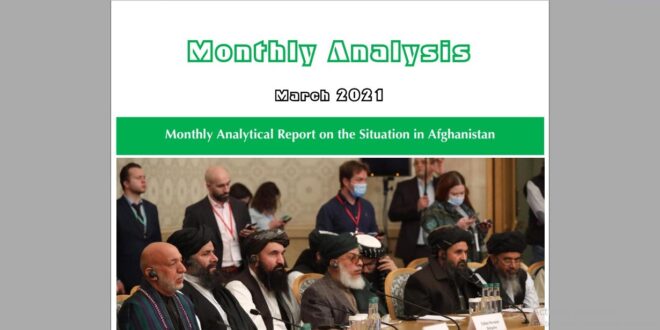
This report looks at the situation in Afghanistan in March 2021. The country’s political climate this month was largely dominated by peace-related developments. The new U.S. administration’s plan for accelerating the Afghan peace process, the U.S. Secretary of State’s letter to Afghan leaders, preparations for the Istanbul Conference and the intra-Afghan meeting in Russia were the most important topics this month. These peace efforts are being stepped up at a time when the security situation in the country has deteriorated, and particularly the battle-related death toll has risen again this month. Civilian casualties, in particular, were higher in March than in previous months, in addition to the persistence of targeted killings. Besides reviewing the country’s political situation and peace efforts, this report presents casualty figures of the warring parties and civilians in March, mainly relying on government, Taliban, national and international organizations and media sources. The details and analysis of these and other important issues are discussed in the report.
Political Situation
During March, the country’s politicians were mostly engaged in consultations on the new U.S. plan for peace in Afghanistan and a Conference on Afghanistan in Istanbul. Earlier, Afghan officials believed that the new U.S. administration, under President Biden, might rescind its agreement with the Taliban or at least not remain committed to it. But the developments in March show that the United States is seriously trying to settle the Afghan issue before the deadline set in the agreement with the Taliban.
U.S. Secretary of State’s Letter to Afghan Leaders
In the first week of March, Zalmai Khalilzad, the U.S. Special Representative for Afghanistan Reconciliation (SRAR), travelled to Kabul and Doha to share the new U.S. plan for peace in Afghanistan with the Taliban, the Afghan government and Afghan politicians. Then the U.S. Secretary of State Antony Blinken sent a letter to President Ghani and Dr. Abdullah endorsing the new peace plan presented by Khalilzad and emphasized the need of accelerating the peace process.
In his letter, Antony Blinken said that the main goal of Khalilzad’s proposal for the future state structure, Constitution, a new inclusive government and a permanent ceasefire is to accelerate the peace process between the Afghan government and the Taliban. He added that the proposal is not an “order” from the United States.
In the letter, the U.S. Secretary of State said that the foreign ministers and representatives of the United States, Russia, China, Pakistan, India and Iran would soon meet under the auspices of the United Nations to discuss peace in Afghanistan.
The letter’s main point was that a meeting between the Afghan government and the Taliban would be convened in Turkey in the next few weeks, where the peace agreement between the two sides would be finalized. Mr. Blinken had called on President Ghani to either attend the meeting or send his authoritative designees to this conference.
He also said in the letter that the United States had prepared a “revised proposal for a 90-day Reduction-in-Violence”, which is intended to prevent a Spring Offensive by the Taliban.
He also called on President Ghani to expand the scope of consultations on peace and reconciliation in the country and to include other Afghan leaders in addition to former President Hamid Karzai and jihadi leader Abdul Rab Rasul Sayyaf. He further said in the letter: “As you and your countrymen know all too well, disunity on the part of Afghan leaders proved disastrous in the early 1990s and must not be allowed to sabotage the opportunity before us.”
At the end of the letter, the U.S. Secretary of State warned President Ghani that the U.S. government had not yet ruled out any option, including the complete withdrawal of forces by May 1st. He expressed concern that besides the continuation of financial assistance from the United States to the Afghan forces after foreign troops withdrawal, the situation will worsen, and the Taliban could make rapid territorial gains.
The Afghan government has reacted somehow negatively to the letter. The First Vice President Amrullah Saleh said in his response that the letter from the U.S. Secretary of State did not cause any concern, nor did it change their position on peace. Mr. Saleh told a rally in Kabul on March 8 that the West had the right to write about the fate of its forces, hold conferences and negotiate with the Taliban, but it is up to the Afghan government to decide and deal with the fate of its 30 million nation. He reiterated President Ghani’s position that elections are the only way to transfer power and that he could talk to the Taliban about elections, but he would never violate the Constitution or never accept dictatorial peace.
The New U.S. Plan for Peace in Afghanistan
As the withdrawal date of all foreign troops under the Doha Agreement between the United States and the Taliban draws near, the United States has put forward a blueprint for peace in Afghanistan, which calls for the peace process to be accelerated and for the parties to reach an agreement as soon as possible. The main reason for the U.S. proposal was that the intra-Afghan talks in Doha did not yield any tangible results.
The Draft Peace Plan is prepared in three parts and provides a framework and means for political reconciliation and power-sharing between the warring parties. The first part deals with the Constitution of the future Afghan state, the second with the formation of a transitional peace government, and the third with a comprehensive and permanent ceasefire.
The first part of this draft introduces some new concepts in addition to some concepts of the current Constitution of Afghanistan. The first paragraph, for example, states that the official religion of the future government of Afghanistan is Islam, which the current Constitution also emphasizes. The plan also proposes a new structure called the High Council of Islamic Jurisprudence, which will provide Islamic advice to all local and national government bodies. There are various criticisms of this part of the Draft Peace Plan. On the one hand, the nature of this council is unclear, as giving advice does not make sense. But at the same time, there are concerns about religious tyranny by the rulers through such a structure. Afghan scholars and analysts, therefore, believe that the council should be replaced by a structure for the Islamization of the law, whether under the name of a court or a commission or committee or another name, but such an ambiguous structure may cause problems in the future. This section of the draft also deals with freedom of expression, human rights, the official policy of the future government and many other issues that are often covered in the current Constitution.
The second part of the Draft Peace Plan is about the transitional peace government and the political roadmap. The plan states that with the signing of this agreement, a transitional peace government will be formed immediately and will run the country until a new and elected government is in place. The draft does not specify the duration of the transition period, but describes the form of the transition period as having three equal branches (the executive branch, the National Assembly, the judiciary) and the Commission for the Drafting of the Constitution and the High Council of Islamic Jurisprudence. Besides, this section still has some dumb and controversial concepts. For example, the meaningful presence of women in government, with the word “meaningful” having ambiguity to a large extent. Or it suggests two options for the future government, one being a centralized state system and the other being a federal system, something that cannot be decided at such a conference. Instead, it can lead to controversy and failure of the conference’s discussions.
The third part is about a permanent and comprehensive ceasefire, which must be announced by the parties immediately after the agreement is signed. However, no specific mechanism has been proposed for implementing the ceasefire, and only a commission has been mentioned, which will be notified in case of violation of the ceasefire.
Overall, this is an appropriate plan for the Afghan issue, given its complexity and the need for external intervention to reach a settlement, because if the intra-Afghan talks continue without external pressure, it does not seem to have notable results in the near future. However, if the plan moves closer to a consensus, then there are some major shortcomings that need to be addressed. The plan, for instance, is designed for reconciliation between two sides, the government and the Taliban. While this is a similar mistake of the Bonn Conference almost two decades ago, when some groups were left out of power. Therefore, it must be ensured that no Afghan party is outside the realm of power and decision-making. Now, if all sides except the Taliban are considered as the government side, it may not be realistic. As we know, many politicians are opposed to the government’s policies, and the government’s future decisions will not be acceptable to them.
Moscow Conference
In the midst of the recent developments in the Afghan peace process, Russia announced a meeting on Afghan peace shortly after the U.S. Secretary of State’s letter to Afghan leaders and the sharing of the Draft Peace Plan with them by Khalilzad. The meeting was held in Moscow on March 18, and four government officials and at least six Afghan political leaders and five Taliban representatives were invited to the meeting.
However, the declared purpose of the meeting was to support Afghan peace and accelerate the peace process, especially negotiation about a ceasefire, but the main purpose of the meeting was to keep Russia involved in the process and an attempt to maintain international consensus on the Afghan peace, as the conference was organized by the United States, Russia, China and Pakistan as part of a tripartite mechanism called the Troika.
Russia, the United States, China and Pakistan said in a statement on the first day of the Moscow conference that they do not support the restoration of the “Islamic Emirate” in Afghanistan, and peace would be achieved through a negotiated settlement in the country. The announcement by the four countries also drew a backlash from the Taliban. Taliban representatives told a news conference that opposition to the Islamic Emirate is unacceptable. According to them, Afghanistan should be an independent country and Afghans themselves should choose the type of system for their country.
Although senior Afghan politicians attended the meeting, the discussions did not yield any meaningful results. The Afghan delegation was led by Dr. Abdullah, chairman of the High Council for National Reconciliation (HCNR). The Taliban delegation was led by Mullah Baradar, the group’s political deputy leader and head of the Qatar office. However, the Taliban delegation was not satisfied with the composition of the Afghan delegation and, in particular, did not agree with the arrival of General Abdul Rashid Dostum, so it is said that there was a verbal dispute between General Dostum and Taliban representatives. Another criticism was about the unequal number of male and female members of the Afghan delegation, as there was only one female member of the delegation invited to the conference, which women activists widely criticized.
Explaining the positions, Dr. Abdullah, head of the Afghan delegation, told the meeting that war is not the solution and neither side should impose its willingness on others. The head of the Taliban delegation also told the meeting that the Taliban want an “inclusive Islamic state” and that Afghans should be allowed to “decide their own destiny”. He said a ceasefire would be possible once the new Islamic government is established.
Heart-of-Asia Conference on Afghanistan
In late March, President Ashraf Ghani travelled to Dushanbe, the capital of Tajikistan, to attend the 9th Heart of Asia-Istanbul Process Ministerial Conference. The conference was held on March 30 under the theme “Strengthening Consensus for Peace and Development”. President Ghani told the meeting that according to the Constitution of Afghanistan, the transfer of power should take place through elections. He accused the Taliban of disrupting the peace process.
Istanbul Conference
For the first time, the U.S. Secretary of State wrote in his letter to Afghan leaders that a conference on Afghan peace would be held in Istanbul in the next few weeks, and the United States would formally ask Turkey to convene the conference. Turkey was the best choice for the conference, as Turkey has good relations with both the Afghan government and the Taliban. At the same time, Qatar-Turkey relations are friendly and will be a supportive and complementary step in the Doha peace negotiations process. The conference has been considered as a conference like the 2001 Bonn Conference on Afghanistan, in which the fate of the future Afghan government will be decided. However, it still has apparent differences with the Bonn Conference of 2001.
The announcement of convening this conference sparked widespread discussions among Afghans. The draft peace plan proposed by the United States is expected to be presented at the conference to the parties involved for discussions so that the process could be accelerated and the parties could reach a political settlement. The conference is scheduled to be held in April in order to reach a clear conclusion on the intra-Afghan talks before the withdrawal date of foreign troops (May) under the agreement between the United States and the Taliban.
This conference is considered a good opportunity to reach an agreement under international supervision and pressure because without international pressure, intra-Afghan negotiations may not have a significant result, at least in the near future. In this regard, the perception is that the Afghan government is not ready to relinquish power and is therefore proposing early elections, while the Taliban, on the other hand, are not ready to agree to the continuation of the current system. Therefore, the only solution is to form an interim government.
With the proposal of the Istanbul Conference, the second round of intra-Afghan talks in Qatar came to a halt, and discussions began at the national and international levels on accelerating the peace process. The Taliban did not formally comment on the new U.S. plan for Afghan peace and the Istanbul Conference until the end of March, and it is believed that the Taliban will not agree to participate in the conference until the withdrawal of all foreign troops in May because it will challenge the Taliban internally. The reason is that the U.S. government did not announce a clear position on the withdrawal of its forces before this conference and proposing the new peace plan.
Security Situation
Efforts for intra-Afghan understanding and reconciliation have intensified at the regional and international levels in March, while this month was bloodier than previous months. In particular, the number of civilian casualties this month has risen sharply.
In this month, some changes in the security apparatus were also seen. Particularly, the interior minister was fired and replaced by a new caretaker minister. President Ghani’s this decision also provoked a backlash from his government’s political partner, Dr. Abdullah, who called it a step against the political agreement on which the government was formed.
On the other hand, for the first time in this month, there were bloody clashes between local militia forces and Afghan forces. In Maidan Wardak province, a local illegal militia commander Alipur militias shot down an Afghan Army helicopter, killing nine Afghan soldiers, including four pilots. The incident has also sparked controversy among the country’s politicians, as the militant commander has the backing of senior Afghan government officials and has previously been released on bail by Second Vice President Sarwar Danish.
Targeted Killings
The number of civilian casualties this month was significantly higher than in previous months, and there were also targeted killings of civilians, especially civil activists, journalists and other civilian figures. Besides, the number of targeted killings of military and government officials was also high.
The first week of March saw a spate of targeted killings in Jalalabad. On March 2, three female employees of a private television were shot dead by unknown gunmen in Jalalabad. A day later, a female doctor was killed in a sticky mine blast in the same city. On March 6, a tribal elder was also killed in a sticky mine blast in Jalalabad. Also, on March 30, three female vaccinators were shot dead by gunmen in Jalalabad. Besides that, there were similar incidents in other provinces. For instance, on March 1, a bomb blast killed a tribal elder in Sheberghan, Jawzjan province, and wounded three civilians.
There were also targeted killings in Kabul. For instance, on March 3, a religious scholar was shot dead by unknown gunmen in Kabul. A few days later, on March 8, a prosecutor was shot dead by unknown gunmen in Kabul’s 5th District.
Civilian Casualties
There have been several deadly civilian casualties’ incidents this month, which has led to a marked increase in the civilian death toll compared to previous months. On March 3, seven Hazara workers were shot dead in a mysterious attack in the Surkhrod district of Nangarhar, for which no group claimed responsibility. On March 15, two buses were hit by sticky mines in Kabul, killing five women and children. Three days later, a bus was hit in Kabul’s 17th District, killing four civilians and injuring nine others.
Civilians also suffered heavy casualties in several operations by Afghan forces in March. On 8 March, at least 15 civilians were killed during an operation by Afghan forces in the Spera district of Khost province. Afghan officials claimed that the Taliban were also killed and wounded in the operation. Nearly three weeks later, on March 28, at least 17 civilians were killed in an operation by Afghan Special Forces called Campaign Forces in Sabari district of Khost province, which provoked strong reactions on social media and pictures and videos of the victims were widely circulated.
Also, Taliban landmines and rocket attacks have killed and injured civilians in different parts of the country, one of the leading causes of civilian casualties in the past two decades.
Casualties
According to the casualty figures compiled by QASED Strategic Research Center, 1371 people were killed or wounded during March 2021, including 848 killed and 523 others wounded. According to the report figures, the Taliban fighters, government forces, and civilians have suffered more casualties, respectively. (Table 1).
The death toll from war in this month shows that the casualty rate was much higher than in the few previous months. In February, 1120 people were killed or injured (801 were killed, and 319 were wounded). But March figures show an increase in both warring parties and civilian casualties this month.
QASED Strategic Research Center, as a war casualties’ monitoring organization in the country, once again urges all parties to the conflict to end the ongoing violence and prioritize peace and reconciliation rather than focusing on the battlefield.
Table-1: Total Casualties of War and Security Incidents
| Name | Killed | Name | Wounded |
| Afghan Forces | 276 | Afghan Forces | 192 |
| Anti-government Militants | 433 | Anti-government Militants | 206 |
| Civilians | 139 | Civilians | 125 |
| Foreign Forces | – | Foreign Forces | – |
| Total | 848 | Total | 523 |
| Total Casualties 1371 | |||
The end