QASED Non-government Research Organization
Note: You can download the PDF format of the report from here.
Introduction
This report provides an overview of the political, economic and security situation in Afghanistan during December 2021. This year has seen big changes in Afghanistan, particularly the regime change, however, the last month of the year ended while the country was still facing many political, economic, social and security challenges. Politically, there is still ambiguity about the country’s future system and Constitution, and the caretaker government of the Islamic Emirate has not yet recognized by any country. Economically, December saw an unprecedented fall in the value of the Afghani currency against the dollar, which led to a sharp rise in commodity prices in the country’s markets. In terms of security, although no major and deadly ISIS attacks have been seen this month, the month has witnessed a variety of security incidents, including bombings. In this report, besides these topics, you would read details and analysis of the important events of this month.
Political Situation
However, some political developments have been seen during the last month of 2021, but overall, this month ended at a time when Afghanistan was facing many political challenges. The biggest issue that has been the subject of national and international debates about Afghanistan since the Taliban takeover is the recognition or non-recognition of the caretaker government of the Islamic Emirate by the international community. In December, although officials in some countries have made statements that raised hopes for the recognition of the caretaker government of Taliban, but no clear progress was made by the end of the month.
In early December, the UN General Assembly finally approved the decision of the Special Trust Committee on December 6, as a result of which the Afghan seat in the UN was not given to the Taliban, but to Ghulam Mohammad Ishaqzai, the former government’s representative in the UN. The Taliban called the UN move “irrational” and said the seat was given to someone who did not represent the people and government of Afghanistan. Due to the fact that Afghanistan’s representative to the United Nations does not have an official address from which to take instructions and to formally represent, Ghulam Mohammad Ishaqzai resigned from his position on December 17 and was replaced by former Minister Counsellor Naseer Ahmad Faiq who has taken over as acting head of Afghanistan’s Permanent Mission to the United Nations.
After the announcement of the caretaker government of the Taliban, it was believed that some countries, such as Russia, China, Pakistan and Uzbekistan, would recognize the Taliban government. But the positions of most countries including these countries are still ambiguous. Russian President Vladimir Putin expressed optimistic statements about the Taliban’s government recognition in late December as called for the release of Afghanistan’s frozen assets, which were welcomed by the Taliban and some Taliban officials have also said they are considering appointing an ambassador to Russia, but later on December 31, Russian Foreign Minister Sergey Lavrov said it is too early to recognize the Taliban government. On the other hand, Russia’s special envoy to Afghanistan, Zamir Kabulov, said in an interview that the recognition process is continuing step by step and that Taliban representatives are attending international events.
A special meeting of the Organization of Islamic Cooperation (OIC) on Afghanistan was also held in Islamabad on December 19, which was proposed and initiated by Saudi Arabia, but the meeting did not achieve much for Afghanistan, particularly, for the Islamic Emirate. Even the representative of the Islamic Emirate was not treated very well in the meeting. The OIC member states have not announced any aid to Afghanistan, rather they called on the international community to provide assistance to Afghanistan. The meeting also called for the establishment of an inclusive government in Afghanistan. Besides this, Prime Minister Imran Khan’s remarks on women’s education, Pashtun culture, and the corruption of previous governments at the meeting provoked strong reactions in Afghanistan, particularly, former President Hamid Karzai called Imran Khan’s remarks an insult to Afghans and said that Imran Khan should not speak on behalf of Afghanistan. At the same time, India hosted a joint meeting with Central Asian countries, which was attended by the foreign ministers of five Central Asian countries. Addressing the gathering, Indian Foreign Minister Subrahmanyam Jaishankar said that the concerns of Delhi and Central Asia regarding Afghanistan are similar.
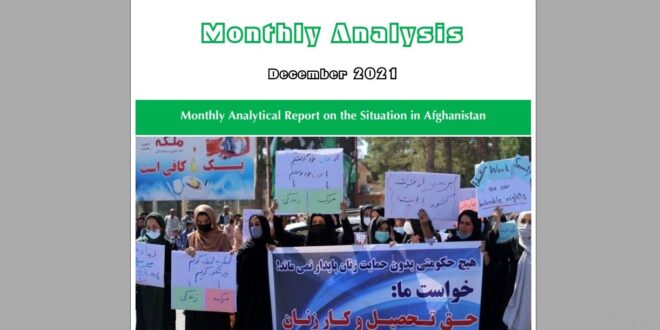
The reasons for not recognizing the caretaker government of the Islamic Emirate so far are apparently the lack of inclusive government and the human rights issue, especially the issue of women’s rights. It is the fourth month since the Taliban imposed a ban on girls’ secondary education, and officials in the Islamic Emirate say girls’ secondary education could not begin until a new policy is in place. That is why this month also some women have been protesting for the freedom and rights of women, which, as in the past, met with a repressive response from Taliban forces.
On the other hand, demands from the Taliban government regarding initiating intra-Afghan negotiations and the rule of law were also seen during the month. Former President Hamid Karzai has said that recognizing the Taliban government requires “legitimacy” at home and a Loya Jirga. Former Foreign Minister Haneef Atmar has called for the resumption of intra-Afghan talks to form a broad-based government. Despite these demands, the Islamic Emirate still does not seem to have a clear plan for national reconciliation, as well as for drafting a constitution, which has raised concerns about the country’s future political situation.
Economic Situation
The most important economic issue in December was the sharp rise in the value of the foreign currencies against the Afghani currency. On December 7, the dollar rose to 100 Afghanis for the first time in the past 20 years. In the following days, the dollar continued to rise and on December 12 it reached 115 Afghanis. Subsequently, the government stopped bidding for dollars in Sarai Shahzada, the country’s major currency exchange market, however, the market value of the dollar not only reached 130 Afghanis, but the dollar was hard to find in the market. The Taliban’s caretaker government cabinet convened on December 13. The meeting tasked an economic commission to take urgent action to keep the Afghani exchange rate stable. The head of the commission and second deputy prime minister, Abdul Salam Hanafi, told a news conference that the dollar smugglers would be treated as national traitors. One of the measures taken by the government to protect the value of the Afghani was to stop trading in foreign currencies. The government’s urgent measures, however, controlled the Afghani value against the dollar to some extent, but still, one dollar was exchanging for above 100 Afghanis in late December.
The rise in the value of the dollar reflects the deteriorating situation of the country’s economy as a whole. The widespread depreciation of the Afghani currency has had a profound effect on commodity prices in the country’s markets. A sack of flour, for instance, which used to sell for around 2100 Afghanis in previous months, has risen to 3000 Afghanis as the dollar has risen.
The value of the Afghani has been declining in recent years, and the former government had kept the Afghani’s value by supplying dollars to the market at a weekly basis. In 2003, when the new Afghani currency was printed and distributed, its value was 43 Afghanis per dollar, and before the Taliban came to power in August 2021, it was exchanged for 87 Afghanis per dollar.
The country’s deteriorating economic situation is at a time when there have been repeated warnings of a humanitarian catastrophe this winter since the Taliban came to power in Afghanistan. In December, there were widespread calls for aid to Afghanistan and the release of frozen Afghan assets. The International Crisis Group said in a statement that economic pressures do not appear to have changed the Taliban’s approach. The International Crisis Group suggests that Washington should “gradually” release Da Afghanistan Bank’s frozen assets and pay the first installment as a trial.
In this regard, international donors on December 11 approved the World Bank’s provision of 280 million dollars in frozen assistance to the United Nations’ humanitarian agencies. Meanwhile, the US Treasury Department has issued new licenses for humanitarian aid to Afghanistan. The new licenses allow the US government to conduct financial transactions involving the Taliban or the Haqqani network.
On the other hand, the issue of salaries of government employees remains unresolved and many government employees have not yet received their salaries, which has had a devastating effect on people’s daily lives. That is why some international organizations and countries have paid salaries to some civilian employees as part of their assistance to Afghanistan. The International Committee of the Red Cross (ICRC) announced on December 21 that it would pay the salaries of 10000 health workers in Afghanistan.
Security Situation
In December, although there was no mass and bloody attack by ISIS, like in previous months, there were still security problems and incidents across the country. There have also been a number of explosions, most of which have no clear-cut analysis of nature and are considered mysterious. The killing of Ulemas or religious scholars in these incidents is noteworthy, which were taking place even before the Taliban takeover and has left a number of prominent religious scholars dead.
Mawlawi Abdul Salam Abid, the Khatib of the Haji Abdul Rahman Grand Mosque in Kabul, was injured in an explosion on December 17. The incident took place after Friday prayers when a magnetic bomb attached to his car was exploded, injuring him and three others. Among the injured was Amanullah Safi, former head of Kabul Municipality’s garbage collection department, who died of his injuries three days later. Another blast took place in the Khair Khana area of Kabul in the evening of the same day, but no casualties were reported. A day later, Mawlawi Bismillah Shakir, another religious scholar and chief teacher of Kabul’s Arabic Darul Uloom, was killed in an attack by unknown gunmen in the Khair Khana area of Kabul.
On December 23, another explosion was reported near the entrance to the Kabul Passport Department. According to the interior ministry, the blast was caused by a suicide bomber being targeted before reaching his target which does not result in casualties. The incident took place on Thursday, the day on which passports were distributed to Taliban members. A few days after the incident, the work of the passport department was also suspended and then the department announced that the work of the department was suspended due to security problems. The ISIS claimed responsibility for the bombing of the Passport Department, as well as several other bombings, such as the blasts in Kabul’s Barchi area on December 10. With this in mind, concerns about the threat posed by ISIS were as serious as ever.
In addition, regional concerns about the threat posed by ISIS in Afghanistan continued. On December 28, Russian President Vladimir Putin met with his Tajik counterpart, Emomali Rahmon, and expressed concern about the security situation along the Afghan-Tajik border, and said he will be therefore in regular contact with Mr. Rahmon. Meanwhile, the UN Security Council’s sanctions committee announced on December 22 that it had added Sanaullah Ghafari, the leader of the ISIS-Khorasan group, to its list of those banned by the Security Council.
Another security issue is the killing and harassment of former government employees and staff, which has had a backlash this month. The United States and a number of other countries called on the Taliban on December 5 to implement the amnesty announced for former members of the Afghan security forces. In a joint statement issued by the US State Department, these countries expressed deep concern over the targeted killings and disappearing of former security personnel in Afghanistan.
On December 28, the Taliban’s interior ministry said it is investigating the torture of a former ANA officer whose videos had recently been leaked to the media. The video shows former Afghan army colonel Rahmatullah Qaderi apparently being brutally beaten. On December 26, in Panjshir province, a number of locals protested in front of the governor’s office against the killing of a young man, and chanted anti-Taliban and anti-Pakistan slogans.
With this, on December 30, the state news agency reported that Taliban leader Sheikh Hibatullah Akhundzada had reiterated in talks with local officials in Kandahar that the Taliban should respect the amnesty decree and not intimidate former government employees.
The end