QASED Non-government Research Organization
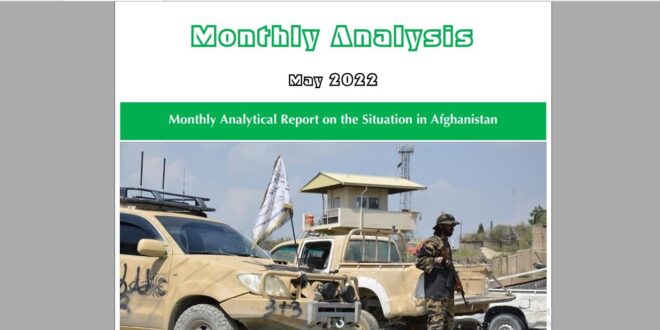
Note: You can download the PDF format of the report from here.
Introduction
This report provides a brief overview of the political, economic and security situation in Afghanistan in May 2022. In the political arena, the human rights situation in Afghanistan, particularly some of the Taliban’s orders and decrees about women, have provoked reactions and debates at the national and international levels, with concerns about the impact on global interaction with the Taliban. On the other hand, the Commission for “Return and Communications with Former Afghan Officials and Political Figures” has officially started its work, and some former politicians have already responded positively to their invitation. In the economic field, although there were concerns about the plight of Afghans and the humanitarian crisis in the country as in previous months, but there were also some economic developments at the national level. In terms of security, however this month saw fewer bloody explosions than last month, but various security incidents were recorded this month, and particularly there have been reports of armed conflicts and insecurity in the northern provinces. In this report, beside these topics, you would read brief details and analysis of the important events of this month.
Political Situation
The political developments of May were mostly focused on the human rights situation of Afghans, especially the issue of women’s and girls’ rights. The compulsory hijab for women, the right to work and education for women and girls, and other human rights issues became more and more noticeable to the international community this month.
On May 7, the Ministry for the Propagation of Virtue and the Prevention of Vice of the Islamic Emirate issued a decree urging all women in Afghanistan to observe the “sharia hijab” covering their whole body except the eyes when confronted by non-mahram men. The decree also urges women to stay inside unless necessary for important work, and outlines punishments for male relatives in cases where women fail to comply with the new dress code. It is worth mentioning that there are differences of opinion about the nature of the hijab, as it is claimed that the Taliban have a more radical interpretation of issues related to the hijab of women. Some Islamic scholars argue that the faces and hands of women, particularly in the Hanafi Jurisprudence, are not included in the hijab.
The Taliban’s decree provoked widespread reactions from countries and international institutions, calling it a violation of the commitments of Taliban leaders. The United Nations Assistance Mission in Afghanistan (UNAMA), UN Secretary-General António Guterres, Amnesty International, the European Union, and representatives of various countries and international organizations reacted to the Taliban’s order, calling it restricting the fundamental rights of Afghan women. For instance, the G7 foreign ministers –the United States, France, Canada, Germany, Italy, Japan and Britain– and the European Union’s foreign policy chief issued a statement on 12 May stating: “With these measures, the Taliban are further isolating themselves from the international community.” The UN Security Council also held a special meeting on the same day and expressed its deep concern over the recent restrictions on women in Afghanistan. In addition, a number of women demonstrated in Kabul.
The reactions intensified after the Ministry for the Propagation of Virtue and the Prevention of Vice ordered female presenters on Afghan TVs to cover their faces when presenting programs. The United Nations Security Council on May 23 issued a unanimous statement calling on the Taliban to “immediately reverse” policies restricting human rights and freedoms for Afghan women. The 15-member Security Council said in a statement that it is particularly concerned about “restrictions on education, employment, freedom of movement and travel, and the full, equal and meaningful participation of women in public life”. Of these, the restrictions on women’s travel is one of the issues that are much debated and it seems that the imposition of this restriction would lead to behaviors based on personal preferences and creates many problems for women, especially women heads of households will face serious problems under such circumstances.
At the international level, there is some consensus that the Taliban are taking a tougher line on women’s rights, although China and Russia are said to have objected to focus on human rights in Afghanistan in the May 23 declaration. On the other hand, the Taliban caretaker government’s foreign ministry said on May 27 in response to the UN Security Council statement on the imposition of restrictions on Afghan women that “they consider the concerns raised in the UNSC Declaration on the rights of Afghan women as unfounded”. In this statement, the Foreign Ministry of the Islamic Emirate called on the international community to respect the religious and cultural values of Afghans.
Overall, there are analyzes that the issue of hijab and women’s education have overshadowed the international community’s interactions with the Taliban, and diminished the optimism that has prevailed in recent months about expanding global engagement with the Taliban.
Besides that, Taliban leaders also seem to have differences and disagreements about most issues. Abbas Stanekzai, head of the Taliban’s negotiating team with the United States in Qatar and the Taliban’s deputy foreign minister, in a speech in Kabul criticized the Islamic Emirate government for its work, and besides referring to some other issues, said that the sharia and human rights of women in the country have not been guaranteed. He added, “[The Islamic Emirate] has not given women the right to education. There is no education at all in Afghanistan today. Give them their rights. Where can women learn Islam and Sharia?! It is clear that they should learn it in school”. According to him, it is the responsibility of the government to prevent deviance, not to ignore a fundamental right of a large segment of the nation for fear of its occurrence. Mr. Stanekzai’s remarks were widely welcomed on Afghan social media.
Another issue was the restrictions on media work in Afghanistan, which provoked reactions again this month. Amnesty International said in a statement on World Press Freedom Day on May 3 that journalists and their advocates in Afghanistan needed to continue working without fear of retaliation. According to the organization, at least 6400 journalists and media workers have lost their jobs in Afghanistan over the past eight months, and 231 media outlets have been shut down across the country. The Afghan Independent Journalists’ Association (AIJA) also issued a statement on May 10, expressing concern over the cessation of media outlets’ activities in Afghanistan, saying that 287 media outlets in the country had been shut down in the past eight months. Concerns over the sentencing of an Afghan journalist to one year in prison in Herat on May 12, concerns of the organization of Reporters Without Borders and other organizations that serve and support journalists about the disappearance of an Afghan journalist in Kabul on May 28, show the increasing restrictions on media work in Afghanistan.
In addition to the human rights issues that have attracted the most attention from Afghans and the international community this month, the Commission for “Return and Communications with Former Afghan Officials and Political Figures” announced the start of its work on May 21 in a press conference. The commission, led by Acting Minister of Mines and Petroleum Mawlawi Shahabuddin Delawar, issued a multi-article declaration saying that the lives and property of former politicians in Afghanistan would be safe and that those who wished to return would be given safety cards by the commission. Mr Delawar said there is no need to negotiations with the former politicians, but they could return to Afghanistan for a normal life. Some former politicians are said to have negotiated and agreed with members of the commission to return to Afghanistan, but at the same time some influential political figures have rejected the Taliban’s request. In addition, the Taliban have also promised to convene a Loya Jirga called the Afghan Assembly, a plan rejected by anti-Taliban politicians based in Turkey. Earlier, on May 18, about 40 Afghan political figures met at Abdul Rashid Dostum’s house in Ankara, the capital of Turkey, to discuss the formation of a “High Council of Resistance to Save Afghanistan”, which shows to some extent the gathering of the political opponents of the Islamic Emirate on a single axis.
If we take a general look at the developments of this month, it seems that some recent actions of the Taliban have led to the coldness of their relationship with the international community, and if this situation continues, especially the issue of girls’ education, dissatisfaction with them will increase nationally and internationally. However, it is said that the committee appointed by the Taliban to investigate the issue of girls’ education has sent its plan to the leadership of the Islamic Emirate and it is expected that in the near future an order on the girls’ education will be issued by the leadership of the Islamic Emirate.
Economic Situation
The economic impact of some international issues, especially the Russian war in Ukraine, was greater this month than in previous months in Afghanistan. Besides that, there have been concerns about the dire economic situation in Afghanistan, as well as the international community’s humanitarian assistance to Afghanistan.
At the governmental level, the Taliban for the first time approved the national budget for 1401 solar year on May 14, which totals 231 billion Afghanis. Of this budget, 203 billion is the regular budget and 28 billion is the development budget. The Taliban’s finance ministry said the budget would be funded “entirely from Afghanistan’s domestic revenues without foreign aid” and that there would be a budget deficit of 44 billion Afghanis this year, but with a financial plan they had drawn up it will achieve its “goals” by the end of this year. This budget is half the annual budget of the previous government because during the previous government, most of the national budget was spent on the battlefield. The total budget of the previous Afghan government in 1400 was more than 473 billion Afghanis, of which more than 311 billion Afghanis was the regular budget and more than 161 billion Afghanis was the development budget.
Over the past two decades, Afghanistan’s economy has relied heavily on foreign aid, with about 75 percent of the previous government’s budget being paid by the international community. It seems that despite international sanctions, the national income of the country has been increasing in recent months, and the main reason is seemed to be the elimination of corruption. The Ministry of Mines and Petroleum announced last month that it had collected about eight billion Afghanis in revenue in the past eight months, which is not at all comparable to the ministry’s revenues under the previous government.
On May 15, money exchangers across Afghanistan went on strike in protest of the Taliban government’s new conditions for issuing exchange and monetary services’ licenses. Under the new conditions of the Central Bank, money exchangers must submit a guarantee of five million Afghanis to the Central Bank of Afghanistan as a guarantee. Although the strike ended a day later, the value of the dollar rose slightly against the Afghan currency, and on May 16, one US dollar was exchanged for more than 90 Afghanis. Earlier, one dollar was exchanged for 88 Afghanis, and in the last two months, the value of the Afghani in the country’s markets has remained somewhat stable.
The devaluation of the Afghan currency against the dollar has a direct impact on the prices of food and other consumer goods, and this month, among other factors, this issue also caused the prices of commodity, especially flour and wheat, to rise in the markets and make the general public more troubled. Therefore, the Ministry of Finance of the Taliban government banned the export of Afghan wheat abroad. According to the Ministry of Agriculture, the country imports 1.5 to 3 million tons of wheat annually.
On the other hand, on May 17, the United Nations Children’s Fund (UNICEF) announced that the number of malnourished children in Afghanistan had doubled. UNICEF says 1.1 million children under the age of five in Afghanistan will face the most severe forms of malnutrition this year. According to UNICEF, this figure is almost double the number of malnourished children in 2018. Last year, the figure was just under one million. According to the UNICEF Representative in Afghanistan, the number of children under the age of five admitted to health centers with severe malnutrition has increased to 28000 in March 2022.
The United Nations World Food Program (WFP) also released a joint report on May 10 stating that some 20 million people, about half of Afghanistan’s population, are currently starving. The report says that although humanitarian aid prevented a humanitarian catastrophe last winter, there is still unprecedented hunger in the country. The World Food Program (WFP) has previously warned that Russia’s invasion of Ukraine could push up food and fuel prices in Afghanistan.
Security Situation
The security situation in the country was better this month than last month, and there have been fewer attacks and explosions in civilian places. Nevertheless, there were reports of unrest and war in the north of the country.
In the first week of May, the armed resistance of the Islamic Emirate called the Resistance Front claimed to have carried out attacks in Panjshir, Takhar, Kabul and Paktia provinces and also captured many areas in Panjshir province, but the Taliban denied this claim and said no security incidents have occurred in Panjshir, Takhar and other parts of the country.
Although the Taliban initially denied the allegations, in the following days some local Taliban officials confirmed the clashes and the loss of life of their fighters in Panjshir and Andarab valleys of Baghlan province. On May 13, Abdullah Abdullah, the former chairman of the High Council for National Reconciliation (HCNR), issued a statement saying that “the military in Panjshir, Takhar, Andaraba and Khost and Farang have launched field trials, killing and torturing oppressed civilians.” He added that most of the civilian killings had taken place in Panjshir province, Andrab, Khost and Farang districts and Takhar province, which he said causing “ethnic tensions” in the country. This is the first time that Abdullah has condemned civilian killings in Afghanistan since the Taliban took control of Afghanistan.
In addition, during May, some explosions and security incidents were recorded in different parts of the country. For instance, on May 13, an explosion at a mosque called Ayub Saber in the fifth police district of Kabul killed one person and injured several others. On May 19, a military vehicle belonging to the 209th Al-Fatah Corps was blown up by a landmine in Mazar-e-Sharif, leaving several dead and wounded, according to eyewitnesses. On May 25, several people were killed and wounded in a series of explosions in Kabul and Mazar-e-Sharif. According to Taliban officials in Balkh province, at least nine people were killed and 15 others were injured in three explosions in the fifth, tenth and thirteenth districts of Mazar-e-sharif city. However, eyewitnesses in Balkh province put the death toll in the blasts higher than figures given by Taliban officials. Another explosion took place in Kabul during the evening prayers inside the Hazrat Zakaria Mosque at the Chahar-Rahe Tarafic in Taimani area of Kabul city, wounding two people according to Kabul police spokesman. But the Emergency Hospital in Kabul tweeted that five people had been killed and 22 wounded in the blast at a mosque in the fourth police district. In recent months, there have been allegations that the Taliban, like former government officials, disseminate inaccurate information and statistics on sensitive events, especially security incidents, and even censor security incidents as much as possible. They try to make the situation look like there is no opposition to the current government. Of these explosions, the ISIS group claimed responsibility for the bloody explosions in Mazar-e-Sharif.
On the other hand, border tensions with Iran and Tajikistan intensified this month. Tajik officials said on September 9 that the Afghan border forces were on high alert after rocket attacks from Afghanistan. They said that as a result of clashes between the Taliban and ISIS fighters in the Khwaja Ghar district of Takhar province, several rockets hit the country “accidentally”. Three days later, ISIS released a video of its rocket attacks on Tajik territory, saying it had targeted Tajik military targets. The incident raises neighboring countries’ concerns about threats from Afghanistan. During a meeting with Tajik President Imam Ali Rahman in Tehran on May 30, the Iranian president said that both countries are seriously concerned about the presence of terrorists on Afghan soil.
On the other hand, tensions between Afghanistan and Iran have led to increasing pressure on Afghan refugees. Posting pictures of the mistreatment of Afghan immigrants on social media after the attack on two clerics in the courtyard of Imam Reza shrine caused widespread protests by Afghans, so much so that protesters in the city of Herat threw stones at the Iranian consulate and set fire to the entrance of the diplomatic mission. For this reason, on May 1, the Iranian Foreign Minister called Amir Khan Mottaki, Acting Foreign Minister of the Taliban, to provide security for the country’s diplomatic missions in Afghanistan. However, both Afghanistan and Iran strongly pursued diplomacy. Iranian Foreign Ministry spokesman Saeed Khatibzadah promised that Iran would give Taliban diplomats credentials for the first time to address the growing consular affairs.
Nevertheless, this situation has led to the widespread deportation of Afghan refugees living in Iran. The United Nations Office for the Coordination of Humanitarian Affairs (OCHA) said in a report on the second of the month that in the first four months of this year, about 251700 refugees had returned to Afghanistan from Iran. The Ministry of Refugees of the Islamic Emirate also said in a statement that a total of 82000 Afghans returned to Afghanistan from Iran last month, most of them deported.
The end