QASED Non-government Research Organization
Note: You can download the PDF format of the report from here.
Introduction
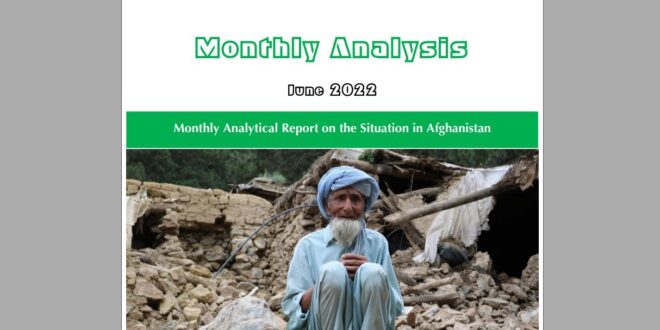
This report gives a quick overview of the political, economic and security situation in Afghanistan in June 2022. On the political side, this month, the meeting of religious scholars in Kabul by the Islamic Emirate drew attention at the national and international level, but the results of the meeting did not meet the existing expectations. Besides that, this month also saw some developments in the increasing international interaction with the Islamic Emirate, including the possibility of Russia recognizing the caretaker government of the Taliban and the reopening of the Indian embassy in Kabul. On the economic front, besides the previous factors, some new factors have increased concerns about the adverse economic situation of Afghans, as the prices of basic goods were increasing in the country’s markets. In terms of security, however, there was no any major and bloody security incident in June, but the Balkhab incident and the ISIS attack on a Hindu temple in Kabul raised concerns. In this report, beside these topics, you would read details and analysis of the important events of this month.
Political Situation
In June, the great gathering of religious scholars by the Islamic Emirate in Kabul, some developments related to international interaction with the Islamic Emirate, as well as human rights situation in Afghanistan particularly concerns about girls’ education were the important issues of this month, however, the biggest incident was the deadly earthquake in Paktika and Khost provinces, which attracted national and international attention.
Although the earthquake was a natural disaster, but it brought Afghanistan’s political affairs under the shadow at the national and international levels, and the officials of the Islamic Emirate were also busy traveling to the earthquake-affected region. On the night of June 22, a bloody earthquake caused widespread destruction in the southeastern provinces of Khost and Paktika. This incident made national and international news and according to the confirmed figures, at least 1150 people were killed, around 3000 others were injured, and thousands of houses were destroyed. After the incident, the process of providing aid inside and outside the country started. Different countries and international organizations shared their condolences and helped the earthquake victims. Along with government agencies and international donors, ordinary Afghans also participated in this process and presented a manifestation of national unity. Various officials of the Islamic Emirate also visited this area, and among them, Mullah Abdul Ghani Baradar, Deputy Prime Minister for Economic Affairs of the Islamic Emirate, promised to build at least 1000 houses for the earthquake victims.
On the 30th of this month, a large gathering of religious scholars similar to the Loya Jirga was held in Kabul, which lasted for three days. According to the organizers of the meeting, about 3500 religious scholars and tribal leaders participated in this meeting. Taliban leader Sheikh Hibatullah Akhundzada also addressed the meeting and issued a resolution at the end. The previous assumption about this meeting was that there might be discussions and decisions on some important national issues such as the type and fate of the future governmental system, the constitution, the case of girls’ schools and many other such issues, however, it was mostly against these expectations. The participants of the meeting renewed their allegiance to Sheikh Hibatullah Akhundzada as Amir al-Mu’minin and mostly condemned the opposition to the current caretaker government of the Islamic Emirate and called any kind of opposition as rebellion. Some of the participants said that the meeting should issue a fatwa to eliminate the opponents of the system in case of rebellion. Although this meeting is said to be an effort of the Taliban for its national legitimacy, but because all the participants were members or supporters of the Taliban and besides, there were no discussions about important national issues, therefore, its role in the case of the national and international legitimacy of the government seems to be limited.
Also, this month, the international community’s interaction with the Taliban was increasing as in the previous months. Even, Zamir Kabulov, Russia’s special representative for Afghanistan, said on June 15 that Russia may recognize the caretaker government of the Taliban. In another development, India reactivated its embassy in Kabul on June 23 for the first time after the formation of the caretaker government of the Taliban. At the beginning of this month, the Acting Minister of Defense of the Islamic Emirate said in an interview that they want defense relations with India, but diplomatic relations should be established first. The beginning of relations between the Islamic Emirate and India on the one hand has highlighted the issue of balance in the relations between Pakistan and India, and on the other hand, it shows the increasing interaction of the regional countries with the Islamic Emirate. Nevertheless, these analyzes are still outstanding that the countries of the region and the world may continue their relations with the Islamic Emirate in an informal manner according to their needs and may not easily recognize the Taliban government, as issues such as human rights and the issue of girls’ education are said to be an obstacle, because the belief is getting stronger day by day that some Taliban leaders are strongly opposed to girls’ education, and this issue may become more controversial. So far, it seems that the issue of girls’ education has caused the most dissatisfaction with the Taliban at the national and international level, and even many Taliban leaders are also angry with it.
Economic Situation
Afghanistan’s economic situation has faced many challenges in the last one year and has remained an axis of concern at the international level; but since last month, due to the war in Ukraine and some geopolitical changes, the economic situation of Afghanistan, like other countries, has deteriorated even more than before.
Although fortunately, in the past few months, the Afghani currency has maintained its value against the dollar, as during the month of June, one dollar was exchanged between 88 and 90 Afghani; but still the prices of basic goods in the markets were very high. In addition to the previous factors (particularly the sanctions on the Islamic Emirate), the increase in commodity prices had new and international factors. For instance, flour prices have increased by 47 percent compared to its prices of a few months ago, which is mostly due to the war in Ukraine. Besides this, oil prices were also increasing during this month. At the end of this month, one liter of petrol increased to around 90 Afghanis, while the price of one liter of petrol was 66 Afghanis almost two months ago.
With this, there are concerns about the further deterioration of Afghanistan’s economic situation in the coming months. The United Nations warned on June 7 that the economic situation of Afghans will worsen in the next three months. On June 3, UNICEF also expressed concern about the growing hunger and malnutrition of Afghan children. The Red Cross Committee (IRC) said in a report on June 16 that many people in Afghanistan are still selling their household appliances for food.
On the other hand, for the past few months, the Ministry of Mines and Petroleum of Afghanistan has been saying that the national income from mining has increased dramatically, and this has raised hopes along with some concerns. But this month, there was a wide debate about the export of coal to Pakistan. These discussions came out after Pakistan’s Prime Minister Shehbaz Sharif on June 28 directed the acceleration of coal imports from Afghanistan. The Prime Minister of Pakistan said that the country will save 2.2 billion dollars from the import cost every year by importing coal from Afghanistan. This case provoked widespread reactions of Afghans in the media and they also demanded to stop exporting coal in Pakistani currency to Pakistan. This was the reason why the Ministry of Finance of Afghanistan increased the tariff of coal exporting from Afghanistan from 90 dollars to 200 dollars per ton of coal.
Security Situation
The month of June was not too bloody in terms of security compared to the last month of May, but still some unrest and security incidents were recorded. This month, the Taliban’s internal disagreement with a local commander and armed clashes as well as some attacks by the ISIS group still attracted attention.
One of the most important security incidents of this month was the armed clashes with Hazara Talib commander Mawlawi Mehdi Mujahid in Balkhab district of Sarepul province. Mawlawi Mehdi Mujahid was the only Hazara ethnic commander in the ranks of the Taliban, who had parted ways with the Taliban since months ago. At first, the Taliban tried to persuade the commander through negotiations and bring him out of opposition, but they did not succeed. In the middle of June, there were reports of clashes between Mehdi Mujahid and the Taliban in Balkhab, but at that time the Taliban denied these reports. About 10 days later, on June 25th, for the first time, the Ministry of Defense officially issued a statement that the operation against the “insurgents” is underway in Balkhab. There were also reports of civilian casualties in these armed clashes, but they have not been officially confirmed. On June 29, UNAMA expressed concern over reports of human rights violations in Balkhab. Also, the United Nations Aid Coordinating Agency (OCHA) said in a statement that about 27000 people have been displaced in Balkhab and they are busy with providing aid to these displaced people.
In addition to this, another security incident that attracted widespread attention was the mass attack of the ISIS group on a Sikh temple in Kabul city on June 18. According to information from the security agencies, a security soldier and a Sikh citizen were killed and several others were injured in this incident; but the political and psychological effects of this attack were greater. A day after this attack, the Indian government agreed to issue online visas to Afghan Sikhs and Hindus to leave Afghanistan.
With this, it seems that the threat of ISIS group continues to exist in Afghanistan as the authorities of the Islamic Emirate are publishing reports of operations against ISIS militants from time to time. On June 11, Taliban spokesman Zabihullah Mujahid said that they targeted an ISIS fighters’ shelter in Takhar’s capital Taluqan city, as a result of which 7 ISIS militants were killed and 3 others were captured alive. The Taliban released this news at a time when, on May 9, last month, the Tajik authorities issued standby order to their border forces after missile attacks on the country’s territory from Takhar province of Afghanistan. The countries of Central Asia are constantly expressing concern about the activities of ISIS in Afghanistan.
A number of other security incidents have also been recorded. For instance, an explosion took place in a mosque in Imam Sahib district of Kunduz province on June 17. According to the preliminary statistics, at least one person was killed and many others were injured. On June 12th, an attack on the airport staff was reported in Balkh, as a result of which two people were killed. Also in the east of the country, at least two people were killed and more than 25 others injured due to an explosion in a market in Ghani Khel district of Nangarhar. There have been other such security incidents, but most of them are not confirmed by the security agencies.
On the other hand, in this month as in the previous months, news of some armed clashes and killings have been reported by the so called Resistance Front in Panjsher. However, this month, the incident of the downing of a Taliban helicopter in Panjsher province drew attention. The Resistance Front claimed on June 16 that it shot down a Taliban helicopter in Panjshir and captured four people alive, including the pilot, but the Taliban said that the helicopter made an emergency landing in Panjshir due to technical problems. However, after the release of a video of the helicopter being shot down by the Resistance Front, it became clear that the claim of the helicopter’s emergency landing due to technical problems is false.
The end