QASED Non-government Research Organization
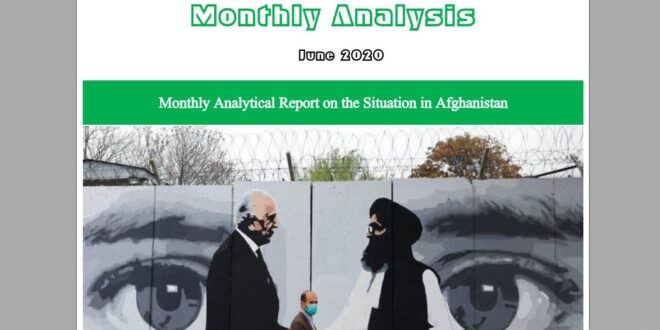
Note: You can download the PDF format of the report from here.
By: Hekmatullah Zaland
Preamble
In the month of June, the country’s political climate was largely dominated by peace-related efforts, developments and obstacles. In this regard, prisoner exchanges accelerated in early June, and the violence continued to decline after a three-day ceasefire in Eid days. This situation, however, raised hopes for a prompt commencement of inter-Afghan peace talks, but the process and prisoners’ exchange were slowed down again in late June. At the same time, efforts to accelerate the process resumed including a series of trips to countries in the region by Zalmai Khalilzad. This issue of analytical report tries to answer the following questions in addition to an analysis of the country’s security situation: What happened in the political arena this month? What were the key developments in the peace process? When will the inter-Afghan talks begin?
Political Situation
Political tensions have been reduced since the signing of the political agreement between President Ashraf Ghani and Dr. Abdullah Abdullah in May. But there are still signs that internal disagreement will slowly erupt due to power-sharing and other issues.
According to the agreement, Dr. Abdullah is the head of High Council for National Reconciliation, but the structure of the council and its official existence is yet to be declared due to the political disagreement on certain details relevant to the structure. This issue will have impact on the inter-Afghan negotiations, due to the fact that all aspects of peace process have to be led by the High Council for National Reconciliation presided by Dr. Abdullah.
On the other hand, after even one and half month of political settlement, still the members of the cabinet haven’t been completed and it has created a sense of distrust between the government and lower house of the parliament. It seems that it would be further delayed due to the 50-50 power sharing.
Beyond the formation of the government, there are other signs of differences between Dr. Abdullah and President Ghani. The issue of interim government is a case that President Ashraf Ghani has always reacted to and strongly rejected. But Dr. Abdullah told a US think tank on June 25th that the issue of forming an interim government could be discussed in inter-Afghan talks. Some days ago on June 10th, President Ghani told the Atlantic Council that it is too early to talk about interim government and that he would not repeat Dr. Najibullah’s mistake. Therefore, it seems that such issues will also lead to internal differences between Dr. Abdullah and President Ghani. According to the political agreement, Dr. Abdullah has the authority to make decisions on peace issues as the director of High Council for National Reconciliation.
In the month of June, incidents occurred regarding the Afghanistan-Iran relations due to the attack on Afghan refugees by Iranian forces. Protests against Iran took place in Afghanistan and it prompt tensions in the bilateral relations. This was the reason behind Afghan foreign minister Hanif Atmar’s trip to Iran. Beyond this, Afghan government and politicians were much involved in the peace related issues and there were certain developments and improvements which are discussed below.
Peace Process
The Implementation Process of the Doha Agreement
Although the agreement signed in Doha between the US and Taliban on February 29th 2020 was widely welcomed by Afghans and International Community as the first and most important step towards peace in the country, but at the same time various attempts have been made to challenge and question the agreement, and there have been various reports of Taliban violations of the agreement which were also published in the month of June.
In this series, the start of June witnessed reports by national and international media surrounding the report by UN on the links between Taliban and Al-Qaeda. The UN report claims that Taliban and Al-Qaeda haven’t been disconnected and Al-Qaeda is still operating in 12 provinces of Afghanistan. This report has estimated the number of Al-Qaeda fighters in Afghanistan between 400 to 600 fighters. This report has also mentioned that the Taliban has fought with Daesh group and that Daesh was responsible for the attack on a hospital in Kabul.
The report has not presented any evidence regarding the activity of Al-Qaeda in Afghanistan. Therefore, analysts believe that the report is an attempt to fail the signed agreement between US and Taliban, and the Taliban has also rejected the report calling it an attempt to fail the Doha agreement. They said in a statement that they are fully committed to the Doha agreement. The Taliban statement mentions: “According to the Doha agreement, the Islamic Emirate of Afghanistan permits no one to use the territory of Afghanistan against any one’s security, to establish training camps for harming someone, or to attract funds to use our territory against others.” Taliban has also asked UN’s Secretary General and Security Council member countries to not allow anyone to publish invalid information for their own interests.
Despite such reports which intend to debunk and question the agreement between the US and Taliban, it seems that so far US and Taliban are satisfied with the implementation process of the agreement between them. One of the most important aspect of the agreement is the withdrawal of US forces from Afghanistan. On June 19th, US media reported that in accordance to the agreement signed with the Taliban, so far 3400 forces have been withdrawn from Afghanistan. On May 27th, CNN reported that the plans to withdraw a further 4000 troops is final and due to start soon. After withdrawal of the mentioned forces, the number of troops in Afghanistan would reduce to 4500.
Criticizing the Violence
Another issue which is deemed as efforts to sabotage the agreement between the Taliban and the US, is the reports of increase in war related violence. According to the report by Afghanistan’s National Security Council, third week of June was the deadliest in the past two decades. According to the report, Taliban has killed and injured 841 Afghan forces which includes 291 dead and 550 Injured. According to the report, in that week, 42 civilians have also been killed and 105 others have been injured. But the Taliban has called these reports an attempt to intensify war and has mentioned that comparing with previous years, they have reduced the military operations by 40 percent. According to the Taliban spokesperson, after the signing of Doha agreement, they haven’t committed huge explosions in the major cities nor have they captured any districts, but are conducting defensive operations in areas attacked by Afghan forces or places where Afghan forces have tried to capture areas under their control.
On June 30th, US secretary of state Mike Pompeo in a video conference with Mullah Beradar, political deputy of Taliban and the head of Taliban’s Qatar office, accepted that the rate of war has reduced by the Taliban with no attacks in major cities and big military bases. Meanwhile he stressed on further reduction of violence.
Regional Consensus for Peace
On 7th June, US special representative for Afghan peace Mr. Zalmai Khalilzad had a trip to Pakistan and discussed with Pakistan’s military chief General Qamar Javid Bajwa the start of inter-Afghan dialogue. Mr. Khalilzad also visited Doha on June the 8th and discussed with political deputy of the Taliban and the head of Taliban’s Qatar office Mullah Beradar the prisoner’s exchange and the start of inter-Afghan dialogue. After three days, on 10th June, he met President Ghani and the head of High Council for National Reconciliation Dr. Abdullah and discussed the practical steps to commence the inter-Afghan talks and prisoners’ release.
Following the visit of Khalilzad to Pakistan, on June 9th, Pakistan’s chief of army General Qamar Javid Bajwa visited Kabul and in a meeting with President Ghani committed to support the ongoing peace process. On 20th June, Pakistan’s special envoy for Afghanistan Mohammad Saadiq also visited Qatar and met with the head of Taliban’s Qatar office to discuss the Afghan peace.
Zalmi Khalilzad again visited the countries in the region in the last days of June. On 28th June, US state department issued a press release and mentioned that the US special representative for Afghan peace has started visiting Uzbekistan, Pakistan and Qatar to gain support for the Afghan peace, and in those trips, he would discuss prisoners’ release, reducing violence and inter-Afghan dialogue. The statement mentions that in these trips, the head of US’s international development financial organization accompanies Khalilzad and economic development of Afghanistan and regional integration will also be discussed. According to the statement, Khalilzad would also have video conferences with Afghan authorities.
Prisoners’ Exchange
The exchange of 6000 Afghan government and Taliban prisoners is a prerequisite for inter-Afghan dialogue meant for trust-building and accepted by US in the Doha agreement. But although this process was accelerated in the ending days of May and start of June, and the number of prisoners released by Afghan government reached 3000, and more than 500 prisoners were released by Taliban, the process slowed down again in the second half of June.
Sohail Shaheen the Spokesperson for Taliban’s Qatar office tweeted on 11th June, stressing that Taliban is ready to enter into the inter-Afghan talks within one week after the 5000 prisoners get released. It seems that releasing the remaining prisoners is challenging for Afghan government. President Ghani told the Afghan national television in a recent interview that he has ordered the relevant authorities to clear according to the given list, which prisoners can be released and which prisoners can’t be released.
It seems that Afghan government would refrain from releasing those important prisoners whom it refrained from releasing at the start of releasing process and it caused delay in the process. Taliban would insist on releasing their 5000 prisoners which would seemingly further delay the process.
Inter-Afghan Talks
Qatar foreign ministry’s special representative Motlaq Al-Qahtani in his visit to Kabul met with Afghan officials and in the meetings, Afghan government agreed to hold the first round of inter-Afghan talks in Doha. President Ghani confirmed in the interview with the national television that the first round of inter-Afghan talks will be held in Doha, but other rounds of the dialogue would be held in different countries to include other countries in the process.
According to certain resources, it seems that the first round of the inter-Afghan talks would start on 11th July in Doha. But it seems that practically the talks would be further delayed. On one hand, the prisoners’ release process has delayed since some days which is deemed by Taliban the pre-condition for the inter-Afghan talks, on the other hand, there are differences on Afghan government side regarding the substance of the inter-Afghan talks. The members of the High Council for National Reconciliation presided by Dr. Abdullah Abdullah has yet to be selected, and mandate of the negotiating team is subject to disagreement. In this regard, it is worth mentioning that the head of Hizb – Islami party Gulbuddin Hikmatyar on 29th June told that the party would participate in the inter-Afghan talks and would cooperate with the government only if all the party’s prisoners are released and the party is recognized as the official opposition of the government.
Besides this, Afghan government is concerned over the position of Taliban in respect of inter-Afghan talks. Taliban is still not ready to enter in to talks with Afghan government as a government, and the government does not recognize the term “inter-Afghan” talks, and is insisting that the talks would be among the Islamic Republic of Afghanistan and the Taliban. Afghan government has long insisted that the peace negotiations shall be owned and led by Afghans. Taliban also uses the term “owned and led by Afghans” but intends different meaning. By the term “owned and led by Afghans”, Afghan government intends to mean the government, and Taliban intends to mean political parties.
Analysis of the Security Situation
However, in the last week of May, ceasefire was declared by the warring parties in respect of Eid event, and in the afterwards, violence remained low. But in the second half of June the level of violence rose again. On the other hand, although there were no major security incidents in major cities this month, but certain mysterious attacks occurred which sparked concerns of Afghan public in the current critical situation.
Mysterious Attacks
On 2nd June, in an attack on Wazir Mohammad Akbar Khan mosque, the mosque’s famous preacher and Imam was killed. At first, it was told that the attack was a suicide bomb attack but then it was revealed that it was due to explosives. This attack sparked country-wide reactions and anger of ordinary Afghans and the government was criticized for this. Some days after this attack, in another mysterious attack on 12th June, another famous preacher and Imam of a well-known mosque in Kabul Aziz Muflih was killed. Taliban strongly condemned both of the attacks and called it act of government. Afghan government also condemned the attacks. Although no one took responsibility of the attacks, but ordinary Afghans deem it an attempt by internal and foreign players to sabotage and fail the peace process.
On 22nd June, 5 officials of the office of Attorney General who played important role in releasing Taliban prisoners were killed in a mysterious attack. The special representative for Afghan peace condemned this attack and called it sabotage acts by internal and foreign players. Taliban also in a statement not only denied any involvement in the attack, but condemned it and called it peace sabotage act. On 28th June, two human rights activists were killed in an attack which was condemned by Taliban and they called it act of peace opposing players. Zalmai Khalilzad also reacted and condemned this attack.
Mysterious attacks on civilian targets and huge explosions which haven’t been claimed by any party, and airstrikes targeting civilians which usually claimed civilian lives have been widely witnessed in the past two decades. Public interpretation of these attacks is that they are carried out to realize political objectives at the back of the scene, put pressure and attain intelligence goals. Even currently at this very critical stage of the peace process, it is possible that the recent attacks are carried out by the parties which see their interests at risk in the peace process. It seems that the involved parties and Afghan public are aware of this situation and probably these kind of attacks would not be able to sabotage the process.
Casualties
In total, the month of June as the month of May, was a deadly month for warring parties and civilians. Still, the reports in June, indicates a decrease in war casualties compared to the month of May. According to the weekly report by Qased Strategic Research Center, the number of dead and injured in the month of May was 2184 which included 1203 dead and 945 injured. In the month of June. In four weeks of June, country wide casualties and injuries are reduced to 1540 which includes 973 dead and 567 injured. Looking in to the reports, majority of the casualties relate to Taliban, and then government forces and civilians respectively.
Although the total number of casualties in this month was lower than the previous month, still civilians have witnessed casualties. Majority of the civilian casualties are due to the road side bombs and rocket attacks by Afghan forces on civilian houses. UNAMA issued a statement in the first week of June and mentioned that in the first 48 hours of June, 10 civilians have been killed in Sarpul and Kunduz provinces due to road side bomb blasts and more than 10 were injured.
Civilians are the main victims of the ongoing war. According to a recently published report by (CIGAR), 35500 civilians have been killed from 2009 to 2019, and 2439 US soldiers have been killed and 20663 US soldiers have been injured in Afghanistan since 2001.
Table: Total Casualties of the Warring Parties and Civilians (June 2020)
| Wounded | Name | Killed | Name |
| 210 | Afghan Forces | 352 | Afghan Forces |
| 208 | Anti-government Militants | 469 | Anti-government Militants |
| 149 | Civilians | 152 | Civilians |
| – | Foreign Forces | – | Foreign Forces |
| 567 | Total | 973 | Total |
| Total Casualties 1540 | |||
The end