QASED Non-government Research Organization
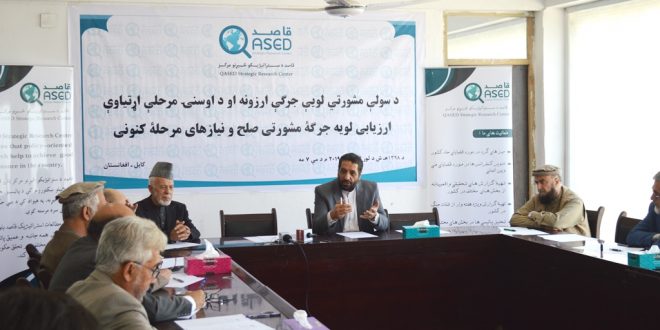
Activists of the peace process and observers evaluated the Consultative Loya Jirga and its results through an academic discussion in a technical debate environment. In addition, they discussed the initiatives and steps necessary at the present time to maintain peace in the country.
The discussion, which was organized by QASED Strategic Research Center in the shape of round-table, was held at the office of this center on (Tuesday, 7th of May 2019), a number of political activists, university professors, and scholars who are involved in peace efforts participated.
The Director-General of QASED Strategic Research Center, Dr. Abdul Baqi Amin, highlighted the objective of this discussion which was the positive and negative consequences of the Consultative Loya Jirga and the present barriers and solutions related to the peace process in the country. As he mentioned it this way to provide accurate advises to those involved in the current conflict in order to not lose the current facilitated opportunity for peace.
Participant of the discussion, author and analyst Waheed Muzhdah, mentioned the process of peace and especially the current talks between the US and Taliban. As per he said, not even a country in the region and the world is to accept the absolute governance of Taliban; therefore, these negotiations are forwarding in a complicated direction. He criticized the Article 3 of the released declaration by the Loya Jirga, in which it stated the factor of the ongoing war in the country has shown various readerships of religion, but he told that the call for a ceasefire was a good and necessary demand to stop the ongoing war.
Another participant of the discussion and the head of Afghan Research Center Ghulam Jailani Zwak stated that the peace talks are complicated and faced with the obstacles. He added that shouldn’t be silent against the obstacles facing the peace process. According to him, there is currently a need for negotiation between Taliban, Afghan politicians, and political parties, because if foreigners leave this equality, then the fear of war between such parties and powerful forces is seen, not between the public and the Taliban. As he said, unfortunately, the national unity government is now a major obstacle to such interconnected negotiations, and thus has challenged the peace in the country.
Professor Gul Rahman Qazi, the head of Peace and Salvation Council and participant of the Inter-Afghan talks’ meeting in Moscow, said that the case is not that much complicated, but there is a need for technical discussions and negotiations. He said that the Moscow’s meeting is a successful experience adding that it made it real that differences between Afghans can end considering that the difficulties from the external side have reduced hence internal issues can be solved. According to Mr. Qazi, the odds for peace are available this time, all parties and sides have to make sacrifices, especially those dedicates for peace, they should pay greater sacrifice and continue these efforts. He also rejected the various readerships of Islam and relation of Afghanistan’s war to Islam and Muslim-hood. He said: “It means that here gives Indulgence to all foreign interference and oppression, but in fact, this war was imposed on Afghans.”
Mr. Akbar Agha, the leader of Afghanistan Salvation Council, said the Consultative Loya Jirga is one-sided, however, the second article addressed only Taliban in terms of stopping the war. He said the Consultative Loya Jirga was conducted to Sabotage the efforts of Inter-Afghan talks, also added that this gathering was similar one to the meetings held in Indonesia and other places.
Shiite scholar and Chairman of the Islamic Movement of the Afghan People party, Shaikh Hadi, emphasized the need of formation a neutral group to succeed in talks in which it will shorten ideas and increase the trust between Taliban and the government. He stated that the election without peace is worthless and that such elections could not resolve Afghanistan’s problem.
Sayed Ishaq Gillani, leader of the National Solidarity Movement of Afghanistan, said in his speech that the irresponsible departure of foreigners could drag the country to so many problems. He added that there is no other way without an interim government so that the peace talks could succeed, and all should understand this fact.
Engineer Sayed Rahim Sattar, head of the Wardak National Council, said that in the present time neither the Taliban nor the government has a proper position. In such times, there is a need for understanding and compromise. He also disagreed with having the election before peace. He called upon an increase of peace-wanting movements, so that both sides of the conflict are driven to their responsibilities.
Member of the Peace and Savior Shura Muhammad Nazir Hemat, stated that the current opportunity for peace is a golden opportunity, since the foreign forces are the main factor of war in the country. As he said, this great and historic opportunity shouldn’t be lost due to the minor differences.
The activist of peace efforts and political analyst, Mr. Mohammad Hassan Haqyar, also expressed his views related to the Consultative Loya Jirga where he demanded continuity and promotion of such discussions for the breakthrough of peace negotiations.
Mr. Zubair Shafiqi, editor of the Weesa daily newspaper, said, “If Americans leave for good, it is very good, but if the exit is short-term and there is conspiracy behind, then it is a great opportunity to take our own advantage; therefore, most of the responsibilities rely on Taliban.
In conclusion of the discussion, Dr. Abdul Baqi Amin, head of the QASED Strategic Research Center said that the ceasefire call concluded from the Consultative Loya Jirga for peace is the voice of people and this is a serious requirement at the current stage for trust building and to stop Afghans’ bleeding.
The end