QASED Non-government Research Organization
QASED Strategic Research Center
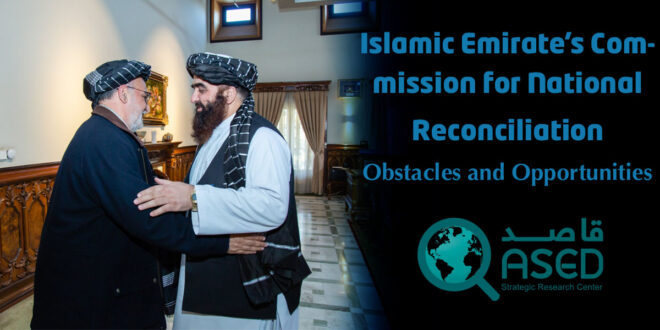
The caretaker government of the Islamic Emirate of Afghanistan in a recent decision established a commission for liaison with Afghans who have left the country so that they can return to their homeland. The commission is made up of senior Taliban officials led by Mawlawi Shahabuddin Delawar, Acting Minister of Mines and Petroleum. Also, Acting Minister of Foreign Affairs Mawlawi Amir Khan Muttaqi, Acting Minister of Information and Culture Mullah Khairullah Khairkhah, Acting Director General of Intelligence Mullah Abdul Haq Wasiq, Advisor to the Ministry of Interior Affairs Mr. Anas Haqqani are included as the members of this commission.
The commission was formed about seven months after the Taliban came to power. Over the past few months, there have been repeated calls for inclusive government at the national and international levels, as well as for the reconciliation of political opponents and disgruntled Afghan figures in order to ensure a long-term political and security stability of the country. Therefore, it was considered as a good step and was appreciated by various parties. However, with the formation of this commission, some important questions and ambiguities have arisen regarding the Islamic Emirate’s approach towards national reconciliation.
In this article, we briefly discuss the need and urgency of national reconciliation, the opportunities and obstacles facing the process as well as the necessary steps in this regard.
Taliban’s National Reconciliation Policy
Over the past seven months, the Taliban’s approach to national reconciliation has proved to be based solely on the issue of general amnesty, which on the one hand means that the Islamic Emirate only believes in the right to life for its political opponents and on the other hand there is no clear picture of the Islamic Emirate’s future treatment of former political actors.
One of the Taliban’s most significant steps towards national reconciliation so far has been a meeting with the Resistance Front in Iran, which did not lead to a positive result due to lack of a clear policy for national reconciliation. That is why Ahmad Massoud, leader of the Resistance Front, said in his New Year’s message that the Taliban’s demand from them was only to surrender and pledge allegiance to the Taliban and that is why negotiations with the Taliban have so far failed. The second important step is the formation of the new commission to liaise with Afghan figures and repatriate them to the country.
The formation of the commission was also largely overshadowed by the extension of the ban on girls’ education beyond the sixth grade, and the issue of girls’ education created widespread frustration and dissatisfaction, and therefore, this positive step of the Islamic Emirate was not given much attention. However, considering the composition of the commission, all members of the commission are senior Taliban officials, which shows that the Taliban attach great importance to this issue. But undoubtedly it would have been better if some more sincere Afghans had been included in the commission. Particularly those who have the ability to communicate with the political opponents of the Taliban outside the country and convince them to return to Afghanistan. Undeniably, it is very difficult for two hostile and conflicting parties to reach a conclusion. Otherwise, besides this commission, a council of Afghan figures should be set up to liaise with the other side and facilitate dialogue and confidence-building between them. Secondly, the Taliban have not provided any clarification for the commission’s objectives and responsibilities. It was necessary that this commission be established by a decree of the leadership of the Islamic Emirate and that the importance and urgency of this issue be taken into account. There was also a need for such a decree to clarify the Islamic Emirate’s policy on national reconciliation.
If the objective of the current national reconciliation efforts by the Taliban is that the political opponents should return to Afghanistan without addressing their demands and as soon as they are invited, it will be undoubtedly a failure, and it will be a similar process to the peace councils formed during President Karzai’s era which never led to peace in the country, as in those efforts there was no focus on fundamental issues, but were only failed efforts to get the opposition to join the system without addressing their basic demands.
The Need for National Reconciliation and the Opportunities Available
The announcement of the commission by the Taliban is undoubtedly a positive step towards the future security and political stability of the country, and considering the current situation, there is an urgent need for national reconciliation efforts, as without the success of national reconciliation efforts, even relative political and security stability will be difficult to achieve. Here are some of the opportunities and factors that make national reconciliation efforts a top priority in the current circumstances:
First: With the fall of the previous regime, the cessation of hostilities in the country is the first and foremost opportunity. With nearly four decades of bloody war ending and the Taliban taking control of all of Afghanistan, there is now an opportunity to eliminate all possible causes of future war, while at the same time most political opponents can easily give up their opposition.
Second: the announcement of a general amnesty by the Islamic Emirate after its ascension to power was a good start and paved the way for a broader inclusive reconciliation effort, but it also need a successful end as well, and giving political opponents the right to live in the country alone will not guarantee long-term stability.
Third: After the fall of the previous government, a number of senior politicians remained in the country and they in turn have their place in the national and international arena. Their presence is an opportunity and should not be overlooked.
Fourth: The current policy of many countries in the region and the world is not to support armed resistance against the Islamic Emirate and this is the greatest opportunity to ensure long-term stability, because Afghanistan has always been facing instability due to the interference of different countries in the region and the world.
Fifth: The political opponents of the Islamic Emirate are not yet united in a single front, but are desperately trying to form a single front. Before the opposition to the Islamic Emirate can be organized and strengthened, serious efforts must be made to negotiate with many of those politicians who have the potential to reconcile so that they renounce their opposition if they see their dignity and future secure in returning to Afghanistan.
Obstacles and Ambiguities
The most important obstacle to national reconciliation and the unification of all Afghans so far is that there is a perception among almost all the officials of the Islamic Emirate that they have defeated the United States and NATO and there will be no other force that can stand against them in the future. This thinking is fundamentally incorrect, because if the opponents of the Islamic Emirate cannot overthrow the government, it can at least create long-term instability. The issue of lack of inclusiveness of the government is also a major obstacle to national reconciliation. Prior to the fall of previous government, the Taliban had repeatedly stated that they would form an inclusive government, but now they distributed all government jobs and positions at the level of directorate and management to its own individuals, as their argument is disagreement on the definition of an inclusive government. They argue that there are people of all ethnicities and regions in the government. But basically the caretaker government currently lacks people other than members of the Taliban and thus it is considered a one-party government.
In addition to these obstacles, there are some ambiguities, most of which are considered in one way or another obstacles to political stability and national reconciliation. First and foremost, the ambiguity about the future of the system has led other parties to be skeptical of the Taliban’s national reconciliation efforts, as seven months on, there is still no clarification about the constitution, the nature of the future system and other fundamental issues. Now there are two scenarios, either all the people see themselves in the government or a partisan government will rule the country. Past experiences have shown that the one-party system cannot survive and other political parties must also see their future secure in the system, while even the Taliban sympathizers do not yet play a consultative role in the system.
What should be done?
There is no doubt that some Afghan politicians have proved to be so corrupt over the last 20 years that the Afghan nation does not want them to re-enter Afghan politics and on the other hand it seems that some of these politicians are not satisfied with anything other than the collapse of the current system, but there are also a large number of politicians who have fled the country due to the current critical situation. To reconcile them, a pragmatic approach must be taken to weaken the opposition rather than strengthening it, and to ensure future security and political stability.
On the one hand, it is not possible to remove all the political actors of the past few decades, nor is it in the interest of the future stability of the country. The Taliban now control Afghanistan, not as a party or a group, but as a responsible government, and must pursue a realistic approach to future political and security stability. The past decades have proved that whenever governments have abandoned realistic peace and reconciliation with their opponents, they have ultimately collapsed. Giving the political actors of the past decades only the right to life in the country and the lack of any clarity on the details of this policy is neither a realistic strategy nor a success.
If the Islamic Emirate really prioritizes national reconciliation, then these efforts and the reconciliation of the opposition and dissatisfied Afghans will undoubtedly prevent foreign interference, who are currently the only tool of the intelligence circles in the region and the world. On the other hand, it will guarantee the inclusiveness of the current system, as well as national and international legitimacy. But if the Taliban does not take a pragmatic approach and adopt a somewhat selfish approach, there is no doubt that the current relative peace will also be challenged and dissatisfaction will increase day by day inside and outside the country, with which the current government and the country as a whole could once again face sufferings. Therefore, there is an urgent need for the Islamic Emirate to give top priority to national reconciliation and to work for national reconciliation with its opponents through a clear and realistic policy, not just as a matter of distracting the public mind and making it a tool to prevent such efforts by other sides.
The end