QASED Non-government Research Organization
By: Abdulbari Kabiri (Translated from Pashto)
An in-depth look at the ongoing crisis in Afghanistan reveals that the war started for a variety of reasons as it continues for a variety of reasons, but overall the main issue at each stage was whether one party or a coalition parties has always tried to monopolize power and there has been no consensus among all the political factions in the country on a mechanism for how the government should gain power, under whose supervision and how the affairs of the country should be run; and finally how to transfer power back at the end of each term or how the government to be replaced in case of misuse of responsibilities in exceptional circumstances.
Background
More than 40 years ago, before the Soviet Union invaded Afghanistan, the civil war in Afghanistan began shortly after the 7th of Saur 1357 [solar year] – April 27, 1978. At that time, two parties, Khalq and Parcham, tried to monopolize power and removed other parties and political rivals from the political arena. The Soviet invasion, backed by coalition partners in the government, intensified the war, increasing the US, NATO and regional countries assistance to the anti-government armed forces aimed to prevent the infiltration of the Soviet Union in the region. After more than a decade of war, Soviet troops withdrew from the country, but the fighting continued among Afghans, leading to the overthrow of an Afghan government that had been imposed on the people by force for years.
Victory in the war did not bring joy to the jihadi parties, but rather they engaged in a civil war with each other to capture and retain the government until all other parties were finally forced by the Taliban Islamic Movement to leave the country. Although the mujahedin coalition government remained in exile, the Taliban in Afghanistan used force to complete their rule within a single party and a single ideological base. That is why, the internal militancy resistance against the Taliban government, as well as extensive efforts against them in the international arena, continued for several years. These and similar reasons led to the US-led International Coalition invading Afghanistan in the aftermath of the 9/11 attacks, along with the Taliban’s internal opponents, as a result of which the Taliban Islamic Emirate was collapsed.
After the formation of a new interim coalition government in 2001, when free elections were promised, there were hopes that henceforward all Afghans would have their role in the government in terms of government structure, duration and functioning, and will be practically implemented. But unfortunately, the fighting continued again until Afghan government officials fled the Afghan capital on August 14, 2021, the Afghan forces were disbanded, and the Taliban Islamic Movement took control over the vast majority of Afghanistan’s territory. Although the Taliban Islamic Movement is now the only dominant force controlling Afghanistan, the group has not yet formally announced a new government and is in talks with various parties over the next government, the outcome of which is still unclear.
Two Main Reasons for the Continuation of War
- Power Monopoly: Power monopoly is a major cause of Afghanistan’s crisis. Over the past 40 years, the monopoly power of one group has led to the interaction of other groups and the provision of war. The monopoly of power ideologically reinforces the ideology of the same group over all the people and prevents the participation of people of different ideologies. The coup of 27 April 1978 (7 Saur), for instance, isolated pro-Islamic and liberal parties and the people associated with them began to fight against the government.
- Misuse of Political Power: As a least-developed country, the people of Afghanistan generally suffer from poverty and economic hardship. The group or coalitions of groups that wield political power use the state resources more in comparison to the general public. The political elites in Afghanistan have always lived as a wealthy class, and the parties that have used their power by force have over-exploited state resources and their party, group, and members gained a lot of wealth while other people live a life of deprivation. That is why groups outside the government have fought against governments and called for social and political justice, which has always led to the fall of government and the resumption of crisis. In the 1990s, for instance, all government institutions were run by Jihadi parties under the Jihadi-led government.
Responsible Approach to the Future
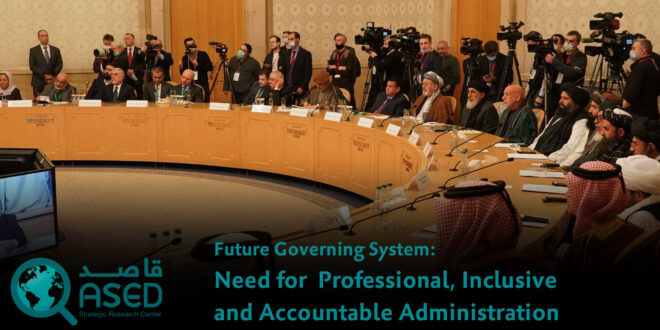
In order to eliminate the causes of war in the country for the future, Afghan politicians must create a professional, inclusive and accountable government. Professional government is one in which the most qualified people from different walks of life are hired on the basis of merit, and the political leadership only oversees and holds them accountable, and except for a limited number of political positions in the ministries, all government affairs should be handed over to professional staff. The ideological principle of professional government is a government based on human learning, and successful governments around the world rely on such government institutions. Professional administrations are made up of all races and men and women in terms of gender, and ultimately provide services to the people. Professional governments are generally made up of people who are highly qualified and have adequate work experience in accordance with the regulations and are evaluated based on the results of their actions and success in their duties. Professional administrations generally do not abuse power, as on the one hand the staff of professional administrations are recruited for specific tasks and overseen by the political leadership, and on the other hand, employees of a professional body can easily face legal action for abuse of power. Generally, professional governments guarantee the continuity of work, financial commitment and future security to their competent staff and officials depending on the economic and social situation of the country.
The formation of a professional governmental body should be based on contemporary administrative knowledge, the centralization of power, the division of responsibilities, and the rewards and punishments of which are important and fundamental features. The professional administration as a whole takes its orders from the political leadership and carries out the work for the management of affairs in the country by implementing modern working methods. Different countries of the world are governed by professional governments and work as impartial governments. This means treating all citizens equally in their day-to-day activities, providing services to all, appointing people from all walks of life and being impartial in their moral standing. Governments in Western countries have strict procedures for political neutrality for civil servants; civil servants are required to be impartial to the public they serve, just as they are required to be impartial to their superiors who have won elections. Professional government institutions handle the country’s general affairs in the Western world, China, Russia, Saudi Arabia, and most other Gulf States. In the history of Afghanistan, even during the period of constitutional monarchy, the affairs of the country were run by the prime ministry of the time in accordance with professional values.
In a professional administration, the executive (impartial) and the political (partial) institutions are separated. This means that political institutions take legislative and oversight responsibility in the country. But the executive branch makes regulations in accordance with the laws of the country and then acts accordingly. Even in the light of the sacred religion of Islam, the executive approach to guaranteeing justice is to treat people equally and impartially, and not on the basis of wealth or lineage, but on the basis of merit and piety.
In light of the above discussion, at this critical stage in Afghanistan, the need for such a professional, inclusive and accountable government is paramount.
The end