QASED Non-government Research Organization
Note: You can download the PDF format of the report from here.
Introduction
This report provides an overview of the country’s political, economic and security situation in March 2022. On the political front, this month has seen an increase in the international community’s growing engagement with the Islamic Emirate, most notably the acceptance of Taliban diplomats in several countries as well as their participation in some international events. However, the Taliban’s extension of the ban on girls’ education beyond the sixth grade has provoked national and international outrage and frustration, which is expected to have a significant impact on the political situation in the long run. On the economic front, this month was better than previous months. On the one hand, the value of the Afghani currency remained stable against the dollar, and on the other hand, the easing of economic sanctions since last month had an impact on the situation. On the security front, this month was relatively calm and no major security incidents have been reported, partly due to the Taliban’s search operation in Kabul and several other provinces last month. In this report, beside these topics, you would read details and analysis of the important events of this month.
Political Situation
The month of March saw several developments and events regarding the international community’s growing engagement with the Taliban, national reconciliation, human rights situation, and other fields. Despite some positive developments in the political arena, pessimism and ambiguity regarding the future political situation of the country was still prevalent, the most important factor of which was the extension of the ban on girls’ education, which led to an assumption that this would have a negative impact on the political situation in Afghanistan.
In terms of international engagement with the Islamic Emirate, the acceptance of Taliban diplomats in some countries, a visit to Turkey by a Taliban delegation led by Acting Foreign Minister Amir Khan Muttaqi, the meeting of the Organization of Islamic Cooperation (OIC) in Islamabad, and the meeting of Afghanistan’s neighbors in China were notable events of this month. There have also been improvements in the United Nations’ approach to dealing with the Taliban, particularly the extension of UNAMA’s mission in Afghanistan.
On March 17, Fazal Mohammad Sabir, a Taliban diplomat, was appointed acting head of the Afghan embassy in Turkmen capital Ashgabat, as the official diplomat of the Islamic Emirate in Turkmenistan. Turkmenistan’s Deputy Foreign Minister has also attended the ceremony. On the other hand, Afghan diplomats in Turkey told the media on March 15 that the Taliban had taken control of the Afghan embassy in Turkey. The news came as Taliban acting foreign minister Amir Khan Mottaqi was on an official visit to Turkey, where he also addressed diplomats at the Afghan embassy. Russia’s foreign ministry said on March 31 that it had given credentials to a Taliban-appointed diplomat. So, the Afghan embassy in Russia had been officially handed over to the Taliban.
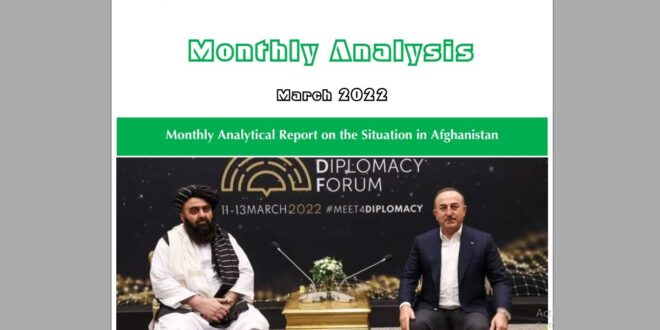
The acting Taliban foreign minister also met with Thomas West, U.S. Special Representative for Afghanistan in Turkey. Thomas West described the visit as useful and said he had talked with the Taliban delegation about Afghanistan’s economic growth and stability, education and air travel. During the visit, Amir Khan Mottaqi addressed a gathering in the Antalya Diplomacy Forum and stressed that the current Taliban government is inclusive and claimed that currently there are no political prisoners in the country. China also hosted a meeting of foreign ministers of Afghanistan’s neighbors on March 30, which was attended by the Taliban’s acting foreign minister. Mr Mottaqi also met with Iranian Foreign Minister Amir Abdollahian and Russian Foreign Minister Sergey Lavrov.
Meanwhile, Deborah Lyons, UN Secretary-General’s Special Representative for Afghanistan, said in a report to the UN Security Council on March 3 that it is impossible to assist Afghans without working with the authorities in Afghanistan. On March 18, the United Nations Assistance Mission in Afghanistan (UNAMA) was extended for another year. All of these developments reflect the growing international community’s engagement with the Taliban caretaker government.
Another issue that has been one of the most politically significant in recent months was the return of former politicians to Afghanistan. On March 16, the Taliban’s caretaker government said it had set up a commission to “liaise with Afghan figures and bring them back to the country.” The new commission is headed by Mawlawi Shahabuddin Delawar, Acting Minister of Mines and Petroleum, and Amir Khan Muttaqi, Acting Minister of Foreign Affairs, Khairullah Khairkhawa, Acting Minister of Information and Culture, Sheikh Mohammad Khalid Hanafi, Acting Minister of Vice and Virtue, Qari Fasihuddin Chief of Staff, Mullah Abdul Haq Wasiq, Director of Intelligence, and Anas Haqqani are members of the commission. However, the purpose and functions of the commission have not been clarified and no practical step has been taken since the announcement of its formation.
An important aspect of the national reconciliation effort is the resistance front led by Ahmad Massoud and some other former officials, which is currently virtually suppressed and has no visible activity. A meeting was also held between the delegates of Islamic Emirate and representatives of Ahmad Massoud. But this month, on March 25, Ahmad Massoud said in a New Year’s message that the Taliban had so far only demanded surrender and allegiance, and therefore, talks with the Taliban had so far failed.
On the other hand, the human rights situation in Afghanistan is one of the issues most closely linked to the recognition of the Taliban government. This month has seen a lot of negative developments in this regard. Pressure on the media and the arrest of some media journalists continued, for example, the arrest of three TOLOnews reporters on March 18 and the March 27 ban on BBC and Ashna TV. On the other hand, the dismissal of some government employees late this month due to lack of beards and hats was a case that provoked widespread reactions.
The most significant case regarding the human rights situation was the extension of the Taliban’s ban on girls’ education beyond the sixth grade, which provoked widespread national and international reactions. On March 23, the start of the new school year in Afghanistan, girls above the sixth grade were not allowed to go to school, despite previous commitments by the Taliban government. The Taliban called the extension of the ban a failure on their part to create a safe and conducive environment, but it later became clear that there was a difference of opinion among Taliban officials about girls’ education beyond the sixth grade and that there was no safe environment issue. At the national level, including various Afghan personalities and parties, and international organizations and countries, including the United Nations, reacted strongly to this decision, calling it a very disappointing decision. Some other countries, including the United States and Britain, have warned that the move would have a lasting effect on the Taliban’s efforts to gain political support and legitimacy at home and abroad. But these reactions did not affect the Taliban’s decision. There are speculations that extending the ban on girls’ education would have a profound effect on the legitimacy of the Taliban government and on the international community’s interaction with their government, as well as on the level of internal discontent.
Economic Situation
Since the Taliban military takeover led to extensive economic sanctions imposed on Afghanistan, the country has in the past few months witnessed a series of national and international concerns and debates over the country’s deteriorating economic situation. However, with the easing of sanctions last month, the economic situation has improved somewhat, as evidenced by the stabilization of the value of Afghani currency against the dollar over the past month. One dollar was exchanged for about 88 Afghanis during March. However, the current economic crisis has caused commodity prices to remain high. In the case of commodity prices, oil and gas prices have fallen sharply in Afghanistan due to the Ukraine crisis.
This month, unlike previous months, although political issues have heated up debates about Afghanistan compared to economic issues, there have been some notable developments in the economic arena as well. On March 2, the World Bank’s Executive Board formally approved nearly 1 billion in aid to Afghanistan. However, the extension of the ban on girls’ schools late this month caused the World Bank to suspend four of its 600 million projects in Afghanistan.
On the other hand, this month the Taliban caretaker government has also taken steps in some basic economic projects. In this regard, the construction of a large irrigation canal called Qosh Tepa in the north of Afghanistan has started. The canal starts from Kaldar district of Balkh province and reaches Andkhoy district of Faryab via Jawzjan province. The canal is estimated to be 285 km long and is said to irrigate tens of thousands of acres of land. The canal will cost about 60 billion Afghanis, which officials say will be paid from national revenue. Some steps have also been taken in the field of mining. On March 3, officials at the Ministry of Mines and Petroleum said that China was interested in investing in Afghanistan’s mines and that the demands of both sides were mutually acceptable.
Humanitarian assistance to Afghanistan continued as in previous months, with a series of distributions across the provinces continuing this month. On March 20, the nineteenth $32 million package of international humanitarian aid arrived in Kabul and was handed over to the International Bank of Afghanistan (AIB).
Despite all this, concerns remain about Afghanistan’s economic crisis. For example, on March 31, UN Secretary General António Guterres said that out of hunger, Afghans “sell their children and even sell their body parts.” Mr. Guterres made the remarks while addressing a conference on raising funds for Afghanistan in Geneva.
Security Situation
The month of March was relatively calm in terms of security and there were no major security incidents. There were assumptions that the launch of search and clearing operations by the Islamic Emirate in several provinces in February would have a positive impact on the security situation.
Meanwhile, there have been debates that security incidents occur in some parts of the country, but they are widely censored and unpublished. However, news of some security incidents also surfaced. For example, on March 4, a bomb exploded in front of a mosque in the Dand-e-Patan district of Paktia province, killing three people and injuring about 20 others.
The biggest concern about the security situation in Afghanistan since the Taliban’s return to power has been the activities and attacks by ISIS, which has carried out several deadly attacks in its first months, particularly on Shiites in some provinces. The bloody mass attacks on mosques have attracted national and international attention, and there was growing speculation that the Taliban will not be able to prevent ISIS from waging a guerrilla war. Nearly eight months later, the Taliban now appear to have succeeded in defeating ISIS. That is why on March 10, Abdul Rahim Muslim Dost, a former leader of ISIS’s Khurasan branch, who had recently joined the Taliban, claimed that the number of ISIS fighters in Afghanistan had dwindled and that the group had weakened. There has been virtually no ISIS attack since November.
On the other hand, SIGAR recently reported in its March 31 report that the opening of prisons with the advent of the Taliban has led to the release of hundreds of ISIS fighters and strengthened the group. The United Nations also said in a recent report on March 8 that 400 Afghan civilians had been killed and many more wounded since the advent of the Taliban. The UN report said that eighty percent of the nearly 400 civilian deaths were caused by Islamic State, or ISIS, a major challenge for Taliban. During the meeting of Afghanistan’s neighbors in China, the Iranian foreign minister also expressed concern over the threat posed by ISIS and called for establishment of a new mechanism to fight the group.
Another aspect of the security situation is the mysterious killings, which are believed to be carried out by the Taliban in retaliation. The number of such killings has risen sharply in recent months, mostly involving members of the former government, but Islamic Emirate officials have always denied retaliatory attacks, but at the same time recommended to their fighters that retaliatory attacks must be stopped.
Overall, there is speculation that if the Taliban continue to hold sway and do not succeed in overcoming political differences, armed movements may gradually increase in the near future, as they still do. Almost every month, one or more armed opposition fronts demonstrate their existence.
The end