QASED Non-government Research Organization
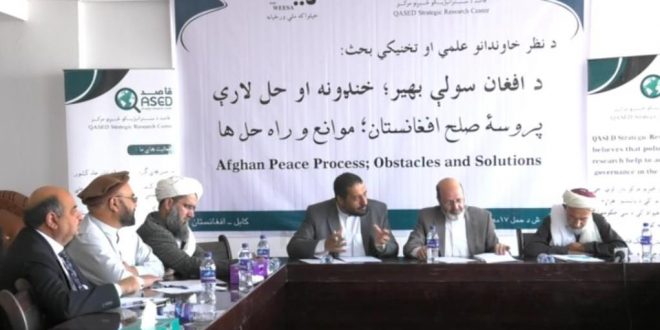
The Afghan Peace Process; Obstacles and Solutions
Many Afghan peace activists, political figures, university professors and scholars have discussed various aspects of the Afghan peace process in an academic and technical discussion.
The round-table discussion was jointly held by the Qased Strategic Research Center and Weesa Daily on 6th April 2019, in the meeting room of this center.
In this discussion, the continuation of the ongoing peace process was emphasized and the common standpoint of all participants was that peace is a national need and such created opportunity should be taken seriously by all.
The first speaker of the discussion was Mohammad Nateqi, who have attended the last Inter- Afghan conference in Moscow, he said that the peace process has two components; the key and important component is the US-Taliban talks and the second is Inter-Afghans dialog and negotiation. According to him, the talks between US and Taliban have already forwarded well; however, the second round of talks with Afghan people was left behind. According to Mr. Nateqi, the US position is clear and Mr. Khalilzad tolerantly said that the United States of America is tired of killing and Afghans are tired of being killed that’s why this process should end successfully. He added, “We have not been able to finalize a list of participants for the meeting and the list that was previously made are not accepted by sides”. According to him, peace case is a technical and specialized issue, two hundred participants are heading to this meeting where technical discussions cannot be conducted in such scenario. As per he says, the attraction of Taliban, the constitution, and the type of future governance system, Afghan military and other technical issues are there that can be discussed by a technical team. In addition, he criticized the government where they suspect all parties and wanting to do everything on their own. Mr. Nateqi added that the talks should be serious and by any possible attempt the armed combat should stop. He said, “Consequently, if agreed on a temporary government is good, but the ceasefire shall be enforced as soon as possible, which is the most urgent need of the Afghan nation.”
The second speaker of the discussion was the leader of the National Solidarity Movement of Afghanistan, Syed Ishaq Gailani, he emphasized the need for the ongoing peace process to succeed saying: The talks between the US and Taliban are good so far, however most of the other sides in the government especially the President, peace emerges as an instrument to their own benefits. According to him, unfortunately, since the past few years, peace has blown out, but the main place for peace remained missing. Everyone want the peace process to be under their own leadership and to have their current power remain safe. While peace seeks sacrifice, unfortunately, the government, jihadist leaders and others do not have a fair attitude in the peace issues. He said that the government’s consultative Loya Jirga was an effort to sabotage peace, but it was said that there is a possibility that the formation of Loya Jirga may serve as a platform for voices that opposite the government to rise and make a space. He also emphasized that, it is very important that we do not see the dictatorship again and his suggestion was that until a stable government is created, international forces should not leave.
Another speaker, writer and jihadist figure Mohammad Zaman Muzammel said: “It’s good if America is leaving Afghan land, but we Afghans must be together under one agreement”. According to him, India and Saudi are not satisfied with the peace process; therefore a general understanding is needed. It is clear at the present time that the main obstacle of the Inter-Afghans understanding is Mr. Ashraf Ghani; while the Moscow meeting brought the peace process a half-year closer and has changed the Taliban. He proposed an increase of independent and popular figures to be included among Inter-Afghans meeting participants. Furthermore, he said that if the national and independent figures part has not been strong enough in this combination, the government and Taliban will not reach peace.
Professor Gul Rehman Qazi, head of the Peace and Salvation Council, said: Everything is clear, peace is needed by the people, but peace requires courage and sacrifice. He said that both issues were mentioned in Moscow’s meeting and it was a successful meeting, however, alike meetings should continue in the future. According to him, it appears that Americans are leaving and it is very good hence the opportunity should be used and the efforts of Mr. Khalilzad should be supported. Professor Qazi said that inter-Afghan understanding is very important, a country-wide coalition group should be formed and follow the peace process. According to him, national agreements and regional agreements related to peace are very important.
Mr. Fazlulhadi Wazin, university professor and the first vice-president of Mr. Hekmatyar (who is a candidate for the presidential election), said that the presence of Khalilzad in the peace process is very important since he has made a very good and soft contact with Taliban. Therefore, an appropriate opportunity has been created that should not be lost, a timetable should be formed and work for inter-Afghans meetings should be framed. As per he said, the first step is the Americans withdrawal to make necessary arrangements, the second step is a temporary administration to be established and the third step is a permanent ceasefire which should be done however, everything should be done before the withdrawal of the Americans, moreover, the budget required to form a temporary government shall be given. According to him, the unacceptable and urgent withdrawal of American forces is dangerous. Concerning the inter-Afghan talks, Mr. Wazin said that the government is not honest in the peace case, power for the peace process should be gathered from the nation, stating clearly to the government and Taliban that the peace cannot be kept and the internal conflicts put to an end.
Mr. Nazar Mohammad Mutmaeen, a peace activist said: since the Americans are going to leave the country, in terms of withdrawal, one-year timeframe might be enough. The withdrawal of Americans is a part of the case; however, the Inter-Afghan understanding is another part of the case in which there are still many obstacles going on. He says that there are many figures and circles in the government that do not want peace and oppose it. According to him, the meetings in this regards should be Inter-Afghans and continues inside the country instead of other countries, the next governance and all concerned issues should be negotiated and agreed.
Mawlawi Abdul Salam Abid, another participant of the meeting, said that the withdrawal of Americans is a public demand for all Afghans; but if there is no general agreement, the withdrawal of American will repeat the past year’s problems. He insisted that the Taliban should agree on a government which includes all Afghans. He proposed a neutral government instead of a coalition government in addition to a public gathering of Religious Scholars to issue a joint fatigue to prevent the civil war as its seen necessary. He also thinks that, the negotiation group should be neither from Taliban neither the government sides, but indeed it should be a neutral and independent group.
Political analyst, Ghulam Jailani Zwak, said that the matter is still between the US and the Taliban, as it is not clear that the United States is leaving due to defeat or based on conspiracy. He expressed concerns over the fact that the matter will not be limited to Taliban only; but the name and flag of ISIS maybe used for the future warfare. He also expressed a concern that major obstacle related to the current ongoing peace process, especially the Inter-Afghans understanding, is the government; if peace comes, this government will not be in place since it opposes peace. Furthermore, according to Mr. Zwak, the goal of the government by forming the Loya Jirga was the eradication of peace; if the government does not cooperate, peace is difficult.
Another speaker of the round-table discussion and editor of the Weesa Daily, Mohammad Zubair Shafiqi, said: the withdrawal of Americans is not agreed yet; however, responsible withdrawal of these forces is crucial. According to him, the current created Inter-Afghan understanding should not be sabotaged, indeed Inter-Afghan meetings must continue until the Taliban and the government comes to common ground of an agreement.
All participants also called for a non-declared ceasefire to stop the greatest blooding of Afghans, to sense a change in Afghan people’s along the peace process.
The end