QASED Non-government Research Organization
By: Abdulbari Kabiri
Very recently, the Afghan peoples’ hopes for a brighter future were elevated. US-led foreign forces agreed to leave Afghanistan responsibly and promised to support the Islamic Republic of Afghanistan with the presence of the Taliban in the government, preserving the achievements of the past two decades. Afghanistan, as a country that has been at war for about four decades, needed such an internal and external consensus to be able to deal with the problems of the previous long decades of war and move towards peace and prosperity. But, unfortunately, the events of August 15, 2021, once again turned Afghanistan into a single-party, single-ideological system monopoly of political power, like the governance type of two decades previously, namely the Taliban’s Islamic Movement government accompanied by international sanctions and a deplorable economic situation. Although the Taliban leaders are currently calling for a change in governance, it remains to be seen to what extent the promised changes will be implemented and how effective these will be.
In this article, I would like to briefly discuss the three critical factors of the current stage of the country: monopoly of power, brain drain, and economic sanctions, and I aim to provide an analysis of the situation so that we can explain the urgent need to start intra-Afghan talks, which were halted with the escape of the previous government officials.
Monopoly of Power
By monopoly of power, we mean sole control of a single group or party over the government and decision-making institutions in a country. This is without limitations of time or on the roles that are granted to members of this group. This group may be a family, a political party, the military, or another distinct group of population. Monopoly of power is condemned in today’s human societies. Contemporary governance is people-centered, where the people are engaged in managing their affairs, so the continuity of such monopolizing powers is in question and cannot guarantee the wellbeing of the people. Most countries with authoritarian regimes have difficulty achieving the wellbeing of their people, also they are under constant pressure from the international community and face many restrictions in international relations.
Looking at history, about 43 years ago, the war in Afghanistan began due to the seizure of power by a certain group, and it happened when the People’s Democratic Party of Afghanistan took power and removed others from the political scene. In the later stages of the previous regime, the monopoly of power was one of the country’s main problems. After the victory of the Mujahedeen parties, the government was composed of a political mass that was mainly monopolized by the Jamiat-e-Islami and its affiliated parties. The Taliban Islamic Movement had also been a monopoly government in the 1990s, with most of the government positions held by members of the Movement. After 2001 and the establishment of the Islamic Republic of Afghanistan, the monopoly of power was tempered to some extent, but the absence of the Taliban and Hezb-e-Islami as two powerful factions in the country, prevented an inclusive government from forming. In the aftermath of the events of August 15, 2021, despite repeated claims by the Taliban that they did not want to seize power by force, the standing caretaker government was formed through a military defeat, and the government emerged as a monopoly government in which all significant government positions were dedicated to their members.
Political power is generally seen as a privilege in poor and developing countries, including Afghanistan, because there is widespread poverty and government duties offer a special opportunity to political elites to hold excessive powers and special financial privileges. In the contemporary history of the country, when the current crisis began, the People’s Democratic Party appointed inexperienced and incompetent people to government positions as privileges. Islamic parties went a step further, not only by not having any oversight process in the distribution of their group resources, but by maintaining a permanent leadership, giving public and state resources to members of their groups, and even to specific families, again, as privileges. The Islamic Emirate (1996-2001) followed the same trend during their rule, and while the people fled the country due to widespread poverty, the high- and mid-level members of the Taliban Movement had a relatively comfortable life. Unfortunately, this trend was repeated even more tragically during the Islamic Republic of Afghanistan’s rule. Those in power, using various strategies, appropriated the country’s national resources.
This strategy is now being repeated. After August 15, 2021, the monopoly of power by members of the Taliban Islamic Movement became apparent, particularly after the announcement of the Islamic Emirate caretaker government, since it is viewed that government duties are a privilege and should be proffered to those who have been deemed to have made sacrifices. In practice, this strategy not only deprives people of trust in the government but also widens the distance between people and the ruling classes. Additionally, it imposes restrictions on joint national efforts and harms the country’s economic, political, and social growth by preventing the public from being motivated by equal citizenship, feeling disconnected, or, in some cases, fearful. Thus, the growth of countries with one-party regimes seems slower than that of countries with political pluralism.
Therefore, there is an urgent need for Afghanistan to have an inclusive government in the true sense of the word, along with a governance mechanism to support all sections of the population to forever end the use of force to gain political power. For Afghanistan to stabilize, the recently established Islamic Emirate of Afghanistan needs to apply a mechanism that prevents the use of force to gain power. In one-party systems, not only do ordinary people perceive non-participation but also, in some cases, they see it as contrary to their interests and try to support regime change. In societies with political pluralism, those who want change can try to effect it through electoral support without disrupting the system, but when the struggle for change is blocked, disengaged members of society cooperate with anti-regime groups, and eventually the system stagnates and, in some cases, collapses. This was what most of the country’s elite community did for the Islamic Republic government. Some Afghans warned that they should strengthen the system by partnering with the armed opposition, but these efforts did not bear fruit, and we have all seen the results. It must now be understood that efforts against the Islamic Emirate of Afghanistan undoubtedly have negative implications and may be seen as a threat in the long run. It must be understood that there is a sufficient tendency in both the region and the world to support the internal resistance of countries and use it as instability for regional and trans-regional goals, at the very least.
Brain Drain
Over the past 40 years, Afghanistan has been continuously plagued by brain drain. For the first time since the coup of April 27, 1978 (7 Saur), the elite individuals who had led and managed the government for decades were forced to leave the country or revolt against the ruling party due to the hostile policies of the ruling People’s Democratic Party. In the ensuing decades, these people could not return to their country or their jobs. After May 28, 1992, when the ruling party lost the war and the government fell to the opposition military parties, the same thing happened again, and, despite the announcement of a general amnesty for the previous government’s officials and employees, experienced and managerial level people left the country or were isolated and the government once again fell into the hands of minimally educated and less experienced people.
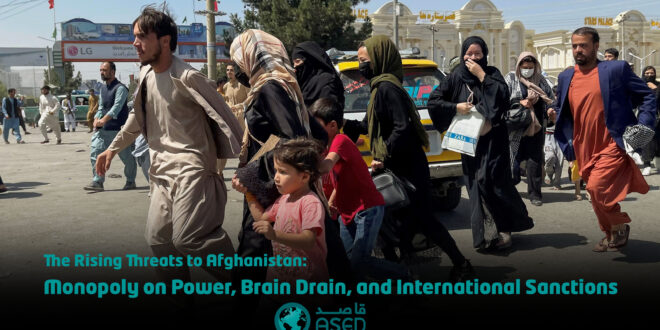
Since the early 2000s, after the occupation of Afghanistan by US and NATO forces and the establishment of the Islamic Republic of Afghanistan, efforts have been made to recruit cadres for the newly established administration. Numerous incentive programs have been used by the international community to bring competent people into Afghanistan, coinciding with the development of domestic education and a significant improvement in the community cadre. However, after the events of August 15, 2021, the brain drain crisis recurred. Government institutions disintegrated, and professional and elite individuals fled the country, despite a general amnesty announced by the Taliban Islamic Movement. As the Afghan people leave, capital flight also occurs because part of that capital belongs to those who have left or are about to leave the country.
Afghanistan’s current government is expected to prevent people from fleeing and try to eliminate the reasons they are leaving. Government officials need to understand that, for more than 25 years, the Taliban’s relationship with a large section of people has been antagonistic and that most of the country’s paramilitary parties, that also have the support of many Afghan people, have waged long wars against Taliban. However, the Taliban’s public amnesty and non-revenge approach played a key role in reducing this hostility, but the Islamic Emirate, as the government in charge, has a responsibility to create a friendly atmosphere to prevent more people who feel threatened from fleeing. Qualified and experienced people leaving the country is detrimental because it creates a vacuum and, conversely, creates problems for the countries to which these people head; countries such as Pakistan and Iran, which already host a large mass of longtime Afghan refugees who have been unable to return to their country, have repeatedly barred most Afghans from being accepted into their territory. Other countries that have had recent good relations with Afghanistan are also complaining about the increase in Afghan refugee numbers, like Turkey and Tajikistan. In addition, governments have a responsibility to curate their citizens’ wellbeing, and Afghanistan is no exception.
International Community Sanctions
Economic and political sanctions against the Islamic Emirate, which recently came to power, have a negative impact on daily life, which, if not managed properly, will cause a humanitarian catastrophe. On the one hand, Afghanistan is not self-sufficient in terms of basic goods and services, and on the other, this landlocked country needs to use the territory of neighboring and regional countries to connect with other nations. They go together with other economic and social factors to create decadence in the country. Afghanistan, like other countries in the world, is in dire need of friendly and cordial relations with countries in both its region and the world. Trade relations, whether in the form of export and import growth or foreign direct investment, are one of the major factors in economic growth. Afghanistan has not yet made good use of its natural resources since water, arable land, and mining need direct investment from international entities.
Thus, today’s international community, given its extensive economic and trade relations, can be successful in enforcing sanctions and can act as a means of pressure to do so effectively. Even countries with great influence in world trade are afraid of economic sanctions. For countries with small, fragmented economies, sanctions lead to bankruptcy and, in most cases, can cause humanitarian catastrophes.
Although the international community has a moral responsibility not to link humanitarian aid to political issues, it does not diminish the responsibility of the Islamic Emirate, which must take appropriate steps to remove the internal factors of international community sanctions.
The Way Forward
Although the disintegration of the Islamic Republic of Afghanistan and the complete domination of Afghanistan by the Taliban ended the peace talks between the Taliban and the previous government, the current situation of the country urgently needs the resumption of intra-Afghan talks to address the three issues mentioned above. The Islamic Emirate of Afghanistan now has a responsibility as a functioning government to provide a logical way out of the current crisis. Today, fortunately, the war in Afghanistan has stopped, but Afghans must reach a full internal consensus to prevent both the economy from collapsing and the reliance on global assistance so that Afghanistan, along with other countries in the region and the world, is a pioneer in the growth and wellbeing of its citizens.
The Taliban Islamic Movement should not attribute the ownership of Afghanistan to its group because Afghanistan is the common home of all Afghans, and all citizens of this land should share in determining the future of their country. Although the fall of the previous government gave the Taliban a chance to dominate the entire country’s territory, it now has the responsibility to resume incomplete talks with the country’s political masses to find a successful solution to the future of the government, governance, and current crisis.
Intra-Afghan talks on including the political system and resolving the tensions that Afghanistan is currently facing may also help lift the economic sanctions since the international community considers economic sanctions to be dependent on the Taliban government’s performance, and, when other political groups work together with the current system through dialogue and friendly relations, it will pave the way for stability in the country.
The end