QASED Non-government Research Organization
Note: You can download the PDF format of the report from here.
Introduction
This report provides an overview of the political, economic and security situation in Afghanistan in February 2022. On the political front, February has seen some developments compared to previous months, and there has been growing assumption that international community interaction with the caretaker government of the Islamic Emirate is on the rise. Likewise, some former officials returned to Kabul for the first time this month. On the economic front, there was a progress in easing economic sanctions on Afghanistan, and the value of the Afghani currency has improved and stabilized compared to the past few months. At the international level, however, there were concerns about Afghanistan’s deteriorating economic situation. On the security front, this month saw slightly higher security incidents than the previous month, with civilians in particular being targeted in a number of incidents, but the launch of a huge security sweep of several provinces and house-to-house searches in these provinces also drew attention on the national and international levels. In this report, beside these topics, you would read details and analysis of the important events of this month.
Political Situation
February marked the end of six months of Taliban rule, but this month saw some political developments compared to the past few months. However, the political situation in the country was still full of ambiguities and mistrusts, but the increasing interaction of the international community with the Islamic Emirate, the return of some former government officials to the country and so on were some of the issues that raised hopes this month of improving the country’s political situation.
In February, some statements and actions were taken by the international community regarding the recognition of the Islamic Emirate, indicating that the international community would gradually recognize the Taliban as a de facto government of Afghanistan, and would begin interacting with the new government. That is why, Anas Haqqani, a senior official in the Islamic Emirate, said on February 22 that the recognition of the Islamic Emirate continues silently and practically.
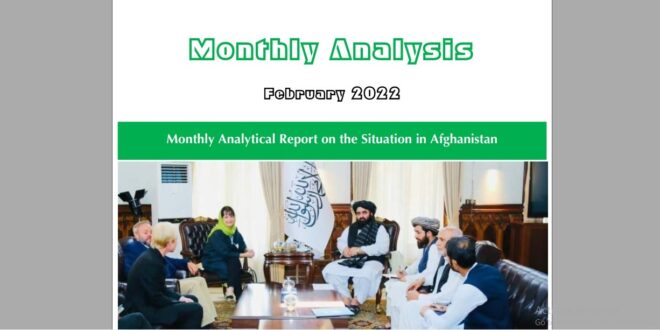
Following the growing international engagement with the Taliban, on February 10, the United Kingdom sent a delegation to Afghanistan, including the Charge d’Affaires of the Embassy. A statement issued by the British Embassy in Kabul said that the British delegation had returned to Afghanistan to assist in the ongoing efforts to avert a growing humanitarian crisis in the country.
On February 14, a Taliban delegation led by Acting Foreign Minister Amir Khan Muttaqi traveled to Qatar, where they met with representatives of the Gulf and European countries. The talks focused on the ongoing humanitarian crisis in Afghanistan, humanitarian assistance, women’s and minority rights, girls’ education, and job opportunities for women, as well as the participation of all ethnic groups in the Taliban government.
A high-level Uzbek government delegation also visited Kabul on February 22. The delegation, led by Deputy Prime Minister of Uzbekistan Sardar Omar Zakov, met in Kabul with some Taliban officials, including the Prime Minister of the Islamic Emirate, and discussed the expansion of cooperation and the implementation of important regional economic projects.
Thomas West, U.S. Special Representative for Afghanistan, also said on February 21 that it is in everyone’s interest to maintain diplomatic relations with the Taliban. However, he had previously emphasized in a lengthy speech on February 16, the end of sixth month of the Taliban’s rule in Afghanistan, that the United States will not recognize the Taliban unless it changes its attitude and behaviors. But he also said that the United States does not support any resistance group against the Taliban and called on other countries in the region to take a similar stance. According to him, cautious optimism has been raised about the provision of education for all in Afghanistan, but efforts to form an inclusive government have not yet yielded results. The EU and Central Asian special envoys to Afghanistan also reiterated their call for an inclusive government in Afghanistan at a joint meeting on February 23.
Recognition of the Taliban government has been linked partly to the protection of human rights at all levels, including the provision of educational opportunities for women and the release of some female activists. This month has also seen some progress in this regard. On February 2, public universities reopened in some provinces for the first time since the Taliban took power, and girls have also been allowed to return to their classes. Many parties, including the United Nations, welcomed the opening of university doors for girls. On February 26, public universities in colder regions, including Kabul, also reopened after a long hiatus. Officials at the Ministry of Higher Education said that state universities are open to both boys and girls, but girls would go to classes in the morning and boys in the afternoon.
International pressure on Taliban to release the detained women activists also continued this month. Deborah Lyons, the UN Secretary-General’s Special Representative for Afghanistan and Head of UNAMA, said on February 10 that in her meeting with Foreign Minister Amir Khan Mottaqi, international concerns and angers over the unknown fate of missing Afghan women activists has been expressed to the Taliban and they have assured a solution to the issue. Two days later, on February 12, news broke of the release of Parwana Ibrahim Khil and three other female activists. The United Nations Assistance Mission in Afghanistan (UNAMA) confirmed and welcomed their release in a tweet.
Moreover, on February 9, Abdul Salam Rahimi, the former State Minister for Peace, returned to Kabul and was warmly welcomed by the officials of the Islamic Emirate, especially the Ministers of Foreign Affairs and Interior Affairs. He became the first senior former official to return to Kabul since the fall of the previous government. Following his return, rumors have been circulating that he has come to Afghanistan to negotiate the return of former President Ashraf Ghani, and that President Ghani may return to Afghanistan in the near future. But a few days later, on February 20, Hamdullah Mohib, the former government’s national security adviser, released a joint photo with President Ghani, saying that rumors of Mr. Ghani’s return to Kabul were baseless. Mr. Mohib added: “President Ghani still supports a fundamental debate for the good of the nation that involves representation of all the people of the country.” On February 27, Zarifa Ghafari, the former mayor of Maidan Wardak province, returned to Afghanistan after six months in exile.
All of this was to some extent indicative of an increase in interaction between the Taliban and the international community, as well as mutual flexibility. Therefore, there are hopes that the political situation in the country is slowly improving, but overall, there is still ambiguity about the future system and the type of governance, which is why Afghans are concerned about the country’s future situation and the issue of government inclusiveness.
Economic Situation
In the economic field, some developments during February raised hopes that the country’s economic situation would improve gradually. Although the US presidential decree on Afghanistan’s frozen assets this month drew strong national and international backlash, as it was partly due to the same backlash that the United States has taken steps to reduce the existing sanctions on Afghanistan and as a result, the value of the Afghani against the dollar has risen compared to the recent months.
After months of international demands and pressure on the United States to unfreeze Afghanistan’s assets, US President Joe Biden finally issued an executive order on February 12 to conditionally distribute 7 billion in frozen assets. According to the executive order, the 7 billion frozen assets of the Central Bank of Afghanistan kept in the United States will be divided into two equal parts, half of which (3.5 billion) will be given to Afghanistan for humanitarian aid, while the other half will be kept in the United States for compensation to the families of some of the victims of the September 11, 2001 attacks.
Biden’s decree on Afghanistan’s frozen assets provoked widespread national and international reactions. In a statement, Da Afghanistan Bank called US President Joe Biden’s decree unfair and said it is unacceptable to them. Hundreds of people protested in several provinces, including in Kabul, against the US decision. Amnesty International on February 22 condemned the decision to allocate 3.5 billion to the victims of 9/11 and said that the money belongs to the people of Afghanistan and should not be paid as compensation to the families of the victims. Chinese Foreign Ministry spokeswoman Hua Chunying said in response to Biden’s decision on Afghan assets that the world’s richest country is stealing from the world’s poorest country. She added, “Afghans’ asset is Afghans’ property and should be managed by them”.
The US Treasury Department issued a license on February 26 to facilitate financial transactions with Afghanistan, due to growing international pressure on the United States regarding Afghanistan’s assets and repeated demands for recovering Afghanistan’s economy. Under the license, financial institutions and private companies can participate in business transactions and activities in Afghanistan, despite US sanctions. Earlier, on February 3, the US Treasury Department said that from now on, international aid agencies would be able to send money to Afghanistan through banks for humanitarian aid without fear of sanctions. The Central Bank of Afghanistan on February 27 commended the US Treasury Department for its decision and called on the United States to reconsider its decision regarding the frozen Afghan assets as well. In the wake of the pressure, US officials have said they are trying to ensure that economic sanctions do not lead to a worse economic situation for Afghans. The White House has reportedly decided that economic activity in Afghanistan will be protected from any restrictions.
These developments have also had a significant impact on the value of the Afghani currency, and for the first time in the past six months, the value of the Afghani became relatively stable. With the announcement of the US Treasury Department on February 3, the value of the dollar fell below 100 Afghanis. Three days after the US Treasury Department authorized the transfer of cash to Afghan public and private banks, the exchange rate of one dollar in Afghanistan’s largest exchange market (Sarai-e-Shahzada) was about 88 Afghanis. However, the rise in the value of the Afghani currency did not affect the prices of basic commodities in the markets and the rise in commodity prices in the past few months has remained high. That is why the general public has called on the government to control commodity prices as the Afghani appreciates.
Moreover, as part of the Taliban’s international efforts to improve the country’s economic situation, a Taliban delegation arrived in Switzerland on February 9 and met with representatives of international aid agencies and Swiss officials in Geneva and discussed the humanitarian situation in Afghanistan. The Taliban delegation’s visit to Geneva was organized by Geneva Call, a non-governmental organization, with the aim of discussing humanitarian aid and human rights in Afghanistan. The organization said on February 11 that Taliban representatives had accepted a “humanitarian agreement”. The agreement recognizes the right to health and education for all Afghans, the organization said in a Twitter message.
In spite of all this, the demands for the recovery of Afghanistan’s ailing economy continued at the international level. The International Committee of the Red Cross (ICRC) said on February 22 that 24.4 million Afghans still needed humanitarian assistance. Five days later, on 27 February, the committee’s chairman, Robert Mardini, called on donor countries to take steps to strengthen Afghanistan’s economic situation and prevent further disruptions to the delivery of public services in the country. The International Rescue Committee (IRC) also called on the United States and the European Union to find immediate solutions to the Afghan people’s economic woes so that Afghans can access their basic needs. The committee has warned that the current famine could kill as many Afghans as it has in the last 20 years of war.
Security Situation
In the security front, on the one hand, several bloody incidents have been reported this month, and on the other hand the government launched a house-to-house search operation in Kabul and several other provinces which also drew national and international attention.
Civilians have been targeted in a number of security incidents this month, some by Taliban forces and others by unknown gunmen, but most of these incidents have been political in nature. On February 12, an armed attack on the house of Engineer Mohammad Khan, former government deputy chief executive, in the Kart-e-Parwan area of Kabul city, killed one of his sons and a bodyguard, and wounded his wife, who died a day later of her injuries. Khalid Zadran, spokesman of Kabul Police Headquarters, said in a Twitter message that the incident is the result of a family dispute. However, Dr. Abdullah Abdullah, the former chairman of High Council for National Reconciliation (HCNR), said in a statement that Mr. Mohammad Khan’s house was attacked and in a way denied the claim of family dispute.
On February 14, Habib Afghan, a former member of the Wolesi Jirga, accused the Taliban of killing six members of his family and injuring another during a local militant attack in Kapisa province. A spokesman for the Islamic Emirate, Zabihullah Mujahid, also confirmed that some members of Habib Afghan’s family had been killed in Kapisa province, but said the attack was carried out by unknown gunmen and two Taliban soldiers were also in the targeted vehicle and both of them were killed in the incident. According to him, “Three relatives of the former commander (Habib Afghan) and two Mujahideen were martyred in the attack, and two men were arrested in connection with the incident.”
In a number of other incidents, some civilians were targeted by Taliban forces at checkpoints, prompting widespread reactions on social media. In one incident on February 20, security forces of the Kandahar Local Government opened fire on a rickshaw at a checkpoint in Kandahar City, killing one woman and injuring two others. In response to the incident, some residents of Kandahar City protested and brought the body of the woman to the governor’s office to demand justice for the perpetrators. A day before, a Taliban police officer opened fire on a car at a checkpoint in Kabul, killing a young doctor. These incidents are not the first of their kind, but have occurred in Kabul, Herat and some other areas before. A woman named Zainab was killed in a similar incident in Kabul some time ago. The incident provoked widespread reactions, and eventually a Taliban delegation visited the woman’s family, paying them 600000 Afghanis and assuring them of justice.
Moreover, in a bloody incident on February 24 in Kunduz and Takhar, eight polio vaccinators, including four women, were killed by unknown gunmen, as a result of which the polio vaccination campaign in these two provinces was suspended after the incident. A number of other civilians were also targeted by unknown gunmen. For example, a doctor in Baghlan province on February 17, a former police officer in Spin Boldak district of Kandahar on February 21, two civilians in Helmand province, a prosecutor in Gardez city, and two other civilians in Kabul and Takhar provinces were killed in similar incidents. Thus the incidence of targeted killings was high in February.
In addition to these security incidents, another notable case this month was the start of house-to-house search by the Taliban government in several provinces. The Taliban announced on February 25 that they had launched a clearance operation in the capital Kabul and some surrounding provinces. A spokesman for the Islamic Emirate, Zabihullah Mujahid, said in a statement that the operation involved the Ministries of Defense and Interior, as well as intelligence, led by Deputy Defense Minister Mullah Fazel Mazloom. The Taliban spokesman later shared the results of the operation with the media. A statement said that in the first days, they had captured nine kidnappers, 53 robbers, six ISIS members and hundreds of miles of light and heavy weapons. But on the other hand, besides welcoming the operation by some Afghans, there were some objections as well. The EU ambassador, for example, called for an end to the sweep operation, saying it had spread fear among Afghans.
The end